ES
ES  EN
EN 
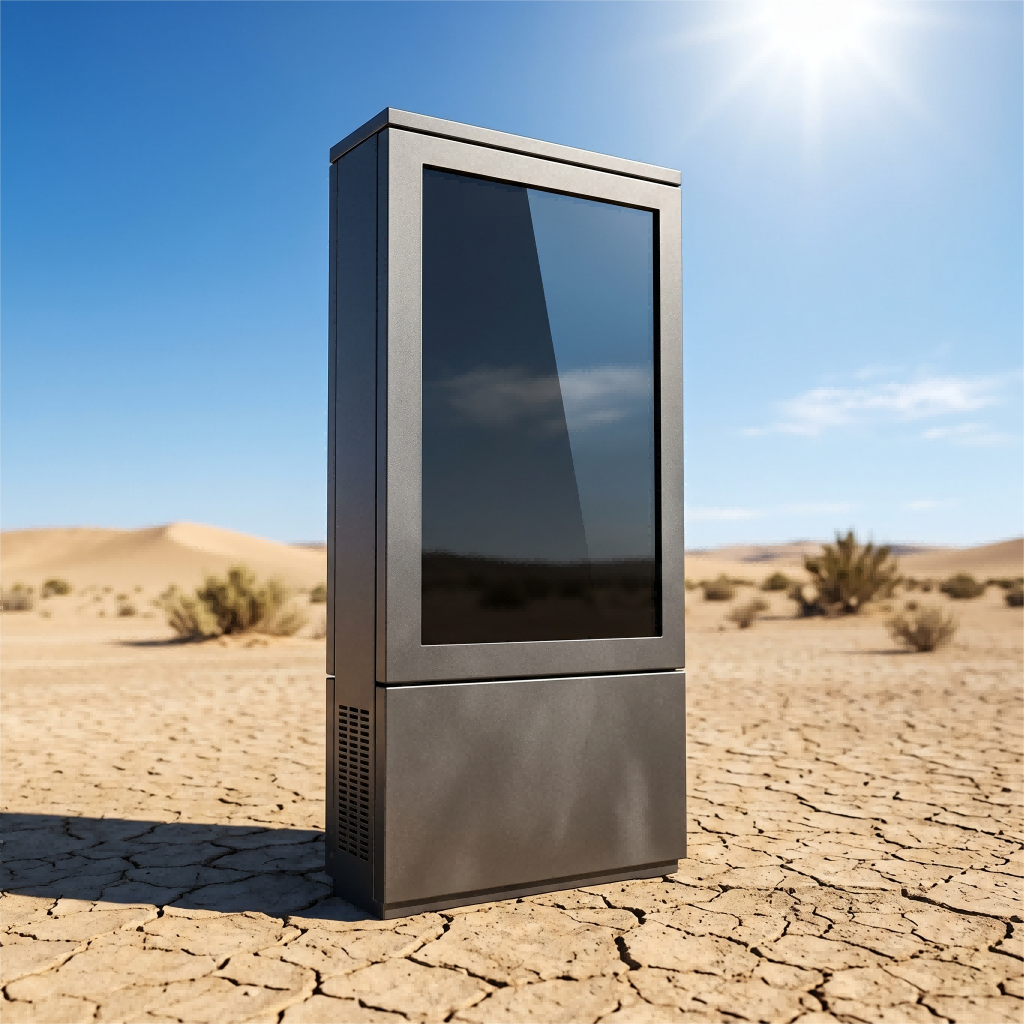
Tabla de contenido
Deploying a digital display indoors is straightforward. Moving that same display outdoors, however, introduces a hostile environment where ambient temperatures swing drastically, solar radiation threatens to destroy the liquid crystal layer, and airborne contaminants risk shorting out internal electronics.
To build commercial-grade outdoor digital signage or kiosk systems that last for years without catastrophic failure, structural and thermal engineers must treat the enclosure not just as a metal box, but as a dynamic environmental control unit.
Here is the authoritative technical breakdown of modern outdoor LCD thermal design and environmental ingress protection.
1. Thermal Management Systems: Air Cooling vs. Air Conditioning vs. Natural Convection
The core engineering challenge of an outdoor LCD system is managing internal heat. An outdoor kiosk must dissipate both the heat generated by its internal electronics (specifically the high-brightness backlight) and the external heat absorbed from direct sunlight.
There are three primary methodologies utilized in outdoor LCD thermal management:
[System Classification]
 ├── Forced Air-Cooling (Open-Loop vs. Closed-Loop Heat Exchanger)
 ├── Active Air Conditioning (Compressor-Based HVAC)
 └── Natural Convection (Passive Dissipation)
Forced Air-Cooling Systems
Forced air cooling is the most common and cost-effective approach for temperate environments. It is split into two distinct mechanical architectures:
- Open-Loop Direct Air-Cooling: Ambient air is drawn directly into the enclosure via intake fans, passed over the front and back of the LCD panel, and exhausted. While highly efficient at removing heat, it introduces a major risk: it drags outdoor moisture, dust, and pollutants directly inside, placing a heavy reliance on high-efficiency particulate filtration systems that require frequent maintenance.
- Closed-Loop Heat Exchangers: The internal air loop is entirely sealed from the outside environment. An internal fan circulates air within the sealed chassis, driving heat toward an internal heat exchanger plate. External fans then blow ambient air across the opposite side of the exchanger to dissipate the heat. This completely eliminates the threat of internal contamination but suffers from a lower thermal efficiency compared to open-loop designs.
Active Air Conditioning (HVAC)
When operating environments regularly exceed 40°C (104°F), passive or forced-air systems lose their required thermal gradient (the difference between the internal target temperature and external ambient temperature).
Active air conditioning uses a closed-loop compressor and refrigerant cycle. This allows the internal enclosure temperature to drop below the outside ambient temperature.
Engineering Trade-off: While active HVAC systems guarantee a stable internal environment regardless of external heat waves, they significantly increase the total power budget of the kiosk, introduce mechanical vibration points, and add substantial weight and structural volume to the enclosure.
Natural Convection (Passive Cooling)
Passive systems rely strictly on thermal conduction through the enclosure walls and natural buoyancy-driven airflow (warm air rising). This method is reserved almost exclusively for low-wattage, small-format displays or specialized ink-based technologies. For high-brightness commercial LCDs, passive dissipation is mathematically incapable of shedding the thermal load generated by thousands of nits of backlighting.
2. Ingress Protection (IP) Ratings Demystified
When specifying an IP65 digital signage enclosure, engineers often misinterpret what these standardized numbers actually mean for real-world reliability. Ingress Protection ratings are defined by IEC standard 60529 and consist of two digits: the first measures protection against solid objects, and the second measures protection against liquids.
| Clasificación IP | First Digit (Solids Protection) | Second Digit (Liquids Protection) | Ideal Outdoor Application |
| IP55 | 5: Dust-protected. Ingress of dust is not entirely prevented, but it must not enter in sufficient quantity to interfere with safe operation. | 5: Protected against water jets projected by a nozzle (6.3 mm) against the enclosure from any direction. | Semi-outdoor environments, transport hubs with overhead canopies, or regions with minimal driving rain. |
| IP65 | 6: Dust-tight. No ingress of dust permitted; complete protection against solid contact. | 5: Protected against water jets projected by a nozzle (6.3 mm) against the enclosure from any direction. | The standard industry baseline. True outdoor environments exposed to severe rainstorms, windblown dust, and street-level washing. |
| IP68 | 6: Dust-tight. No ingress of dust permitted; complete protection against solid contact. | 8: Protected against continuous immersion in water under conditions specified by the manufacturer (typically up to 3 meters). | Extreme environments prone to flash flooding, marine docks, or heavy sub-surface condensation conditions. |
The “Over-Specification” Trap
Specifying IP68 for a standard sidewalk kiosk is generally an expensive engineering mistake. Achieving true IP68 requires hermetic sealing and pressure-compensation bladders to handle atmospheric expansion and contraction. For the vast majority of outdoor deployments, a precision-welded IP65 enclosure combined with properly designed drip-loops and hydrophobic ventilation vents provides maximum defense against nature without unnecessarily driving up fabrication costs.
3. Combating Direct Sunlight: Isotropic Failure and Visibility
When resolving the outdoor display direct sunlight solution, engineers face a double-edged sword: they must provide enough display brightness to overpower the sun, while simultaneously preventing the sun from destroying the display’s liquid crystals.
Solar Radiation and Isotropic Transition
Standard liquid crystals change state and lose their alignment properties when they get too hot. This threshold is known as the isotropic clearing point.
When direct sunlight hits a standard LCD panel, the black matrix layer acts as a highly efficient heat absorber. If the internal temperature of the liquid crystal layer crosses its clearing point (typically between 70°C to 80°C in consumer panels), the screen develops permanent or temporary black blotches—a phenomenon known as isotropic failure.
To build a ruggedized system, engineers must deploy specialized industrial panels utilizing High-Tni liquid crystals, which push the clearing point threshold up to 105°C or higher, allowing the display to absorb direct solar radiation without losing structural image integrity.
Sunlight Absorption -> Localized Heating -> Exceeds Tni Threshold -> Isotropic Failure (Black Blotches)
*Solution: Deploy High-Tni (~105°C) Industrial Liquid Crystals + IR-Cut Glass Barriers*
High-Brightness and Contrast Enhancement
To remain readable under 10,000 foot-candles of direct ambient daylight, an outdoor display must output a minimum brightness of 2,000 to 3,000 nits (candela per square meter), compared to a standard indoor TV which outputs roughly 350 nits.
However, raw brightness alone cannot solve visibility; you must also manage reflection.
       [Ambient Sunlight]
               │
               ▼
   ┌───────────────────────┐  ◄── Anti-Reflective (AR) Glass Coating
   │    Protective Glass   │
   ├───────────────────────┤  ◄── Optical Bonding Layer (Eliminates Air Gap Refraction)
   │     LCD Polarizer     │
   └───────────────────────┘
By applying an Anti-Reflective (AR) coating to the protective glass cover and utilizing optical bonding (filling the structural air gap between the protective cover glass and the LCD polarizer with an index-matched optical adhesive), internal reflections are reduced from roughly 8% down to less than 0.5%. This drastically improves the perceived contrast ratio without requiring the backlight to run at power-intensive, heat-generating limits.
4. Surviving Extreme Environments (-20°C to 50°C)
True industrial reliability requires the internal components to operate within their optimal performance curve, even when the external environment experiences massive temperature shifts.
The Low-Temperature Challenge (-20°C)
At sub-zero temperatures, liquid crystals become sluggish, causing severe motion blur, color shifting, and slower response times. Furthermore, the power supplies and control boards can struggle to initialize due to changes in component capacitance.
To prevent cold-start failures, outdoor kiosks must integrate internal thermostatically controlled pulse-heaters. Before the main display panel receives power during a sub-zero boot sequence, internal heating elements warm the enclosure’s inner air volume to at least 0°C, ensuring the electronics stabilize safely.
The High-Temperature Challenge (50°C)
At the upper end of the operational envelope, the internal system components must be actively protected from thermal runaway. Industrial kiosks leverage a network of internal digital temperature sensors connected to an autonomous microcontroller.
If the internal ambient air approaches critical thresholds, the system executes an intelligent thermal throttling protocol: it increases internal fan RPMs to max capacity, and if necessary, dynamically scales back the backlight brightness from 100% down to 50% to reduce internal thermal load until environmental equilibrium is restored.
Conclusión
Engineering high-performance outdoor LCD systems requires balancing thermal dissipation, environmental isolation, and optical performance. Moving away from consumer-grade compromises and embracing industrial LCD screen cooling system kiosks featuring closed-loop configurations, high-Tni liquid crystals, and IP65-certified sealing guarantees your deployment will deliver consistent performance, maximum uptime, and a low total cost of ownership across its lifecycle.
- Refrigeración de Precisión: Cómo MWE Redefine la Fiabilidad en la Señalización Digital Exterior
- Protección contra la intemperie para señalización digital en exteriores: Garantizar la durabilidad en todas las condiciones
- Kiosco de pie vs. Cartelería digital de montaje en pared: ¿Cuál es mejor para tu tienda minorista?
- Por qué la unión óptica es el estándar de oro para señalización digital en exteriores: la ventaja de MWE
- ¿Qué es la clasificación IP? Guía sencilla para señalización digital resistente a la intemperie