DE
DE  EN
EN  ES
ES 

Table of contents
- Introduction: The EV Charging Experience Gap
- Why EV Charging Stations Need Dedicated Outdoor Displays
- Three Revenue Models for EV Charging Station Screens
- Technical Requirements for EV Charging Displays
- Real-World Use Cases
- Designing for the EV Driver Experience
- Why MWE Display Is the Right Partner for EV Charging Networks
- Frequently Asked Questions
Introduction: The EV Charging Experience Gap
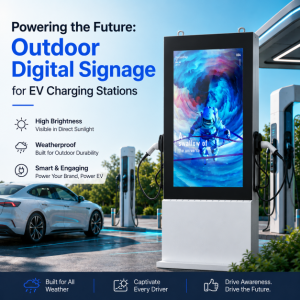
The global electric vehicle (EV) fleet surpassed 40 million units in early 2026, and with that comes an explosion of charging infrastructure. Yet most EV charging stations share a common complaint from drivers: the experience is boring, uninformative, and misses a massive monetization opportunity. While the charger handles the electricity, the real estate around it sits idle. This is where outdoor digital signage enters the equation — turning a utilitarian charging stop into a connected, revenue-generating touchpoint.
Industry analysts project the global EV charging infrastructure market will exceed $185 billion by 2030, with digital signage integration becoming a standard feature in premium charging networks. For operators, the question is no longer if to add screens to charging stations, but which specifications can survive the harsh outdoor environment while delivering reliable, high-impact content.
Why EV Charging Stations Need Dedicated Outdoor Displays
Unlike indoor retail screens, EV charging stations present a unique set of environmental and operational challenges:
- Direct sunlight exposure: Most chargers are in open parking lots or curbside locations with no shade. A standard TV blacks out above 500 nits. EV displays need 2500–5000 nits for true sunlight readability.
- Temperature extremes: Charging stations generate heat from the power electronics, combined with solar gain on the display surface. Active thermal management — not just passive ventilation — is essential for 24/7 reliability.
- Weather and vandalism protection: IP65-rated enclosures protect against rain, dust, and jet sprays. IK10-rated glass resists impact. Anti-theft locking mechanisms prevent tampering in unattended locations.
- Dwell time opportunity: The average EV charging session lasts 20–45 minutes (Level 2) or 15–30 minutes (DC fast charging). That is prime captive audience time for advertising and information delivery.
Three Revenue Models for EV Charging Station Screens
1. DOOH Advertising & Brand Partnerships
Digital Out-of-Home (DOOH) advertising at EV charging stations is the fastest-growing segment in the signage industry. The captive, high-disposable-income audience (EV owners statistically skew toward higher income brackets) makes charging station displays prime real estate for premium brands. Operators can sell ad slots programmatically or through direct partnerships, with CPM rates 2-3x higher than traditional outdoor advertising.
2. Local Business & Wayfinding Promotions
An EV driver waiting 25 minutes for a charge wants to know what is nearby. Integrating local business promotions — a coffee shop two blocks away, a grocery store with EV parking, a restaurant running a lunch special — turns the screen into a community discovery tool. Split-screen layouts can display charging status alongside hyperlocal ads, creating utility-driven engagement.
3. Charger Network Branding & Information Delivery
For charge point operators (CPOs), the screen is a brand-defining asset: real-time charging status, pricing updates, availability of adjacent stalls, maintenance alerts, and emergency contact information. A well-designed screen reduces call center volume by preemptively answering the top 10 driver questions.
Technical Requirements for EV Charging Displays
Not all outdoor digital signage is built for the charging station environment. Here are the specifications that matter most:
Sunlight Readability: 2500 Nits Minimum
Standard indoor displays become unreadable in direct sunlight. EV charging stations in uncovered parking lots require high-brightness displays with 2500 nits or more. At 2500 nits, content remains vibrant even under midday sun — essential for ad revenue and driver information. MWE Display’s outdoor signage line delivers 2500–5000 nits across 32″ to 86″ sizes, ensuring readability from any angle.
Weatherproof Rating: IP65/IP66
Charging stations face rain, dust, snow, and high-pressure cleaning. An IP65-rated enclosure protects against water jets and dust ingress, while IP66 offers even higher water protection for areas prone to flooding or high-pressure washdown. Combined with IK10 impact resistance, the display survives in parking lots, highway rest stops, and curbside locations.
Active Thermal Management
Heat is the #1 cause of LCD failure in outdoor environments. An EV charging station compounds this problem with nearby power electronics generating additional heat. Active thermal management systems — combining airflow design, heat sinks, and temperature-controlled fans — maintain optimal operating conditions even in 50°C (122°F) ambient temperatures. MWE’s engineering ensures 99.99% uptime through precision cooling design.
Remote Monitoring & Content Management
EV charging networks span hundreds or thousands of locations. Manually updating content or troubleshooting issues at each site is impractical. An OMC (Operations & Management Center) remote monitoring system gives operators real-time visibility into every display’s temperature, brightness, power status, and content playback health — exactly the same infrastructure reliability required for charging network uptime SLAs.
Real-World Use Cases
Highway Rest Stop Charging Hub
A major European highway service area deployed 65″ outdoor digital kiosks at eight DC fast-charging bays. Each display shows real-time charging progress, nearby restaurant promotions, and local tourism information. The result: a 12% increase in on-site restaurant revenue and a new advertising revenue stream covering 40% of the display hardware cost within the first year.
Urban Curbside Charging with Retail Integration
In a pilot project in Singapore, semi-outdoor window-facing displays were installed alongside curbside EV chargers. The semi-outdoor display shows real-time charging availability while promoting products from the adjacent store. Drivers can scan a QR code to pre-order and pick up items before their charging session ends — merging the digital and physical shopping experience.
Fleet Depot Operator Dashboards
Commercial EV fleet depots use large-format outdoor displays (75″-86″) as central command dashboards, showing real-time charging status across dozens of vehicles, shift schedules, and energy consumption analytics. The high-brightness screen is readable from across the depot yard, and the rugged IP65 enclosure withstands the daily wash-down environment typical of fleet operations.
Designing for the EV Driver Experience
Best practices for EV charging station digital signage content:
- Above the fold: Charging status (time remaining, kW rate) must be visible from 10+ feet away. Use large sans-serif fonts with high contrast.
- Secondary zone: Advertising or promotional content occupies the remaining screen area. Rotate 3-4 ads per charging session to maximize impressions.
- Call to action: QR codes linking to nearby offers, loyalty programs, or payment — trackable and measurable.
- Night mode: Automatic brightness reduction (2500 nits during day, 300-500 nits at night) prevents light pollution and saves power. Many municipalities now require this for outdoor displays near residential areas.
Why MWE Display Is the Right Partner for EV Charging Networks
With over a decade of outdoor LCD engineering experience, MWE Display (Marvel Technology) brings proven reliability to the EV charging infrastructure ecosystem. Every outdoor digital signage product is built with:
- 2500-5000 nit high-brightness panels with optical bonding for zero glare
- IP65/IP66 weatherproof enclosures tested for continuous outdoor operation
- OMC remote monitoring system with 12+ onboard sensors (temperature, humidity, brightness, power)
- Sizes from 32″ to 86″ in freestanding, wall-mounted, and integrated form factors
- Custom OEM/ODM support for charging network branding and integration
Explore the full range of outdoor digital signage solutions designed for the next generation of EV charging infrastructure.
Frequently Asked Questions
Can a standard TV be used at an EV charging station?
No. Standard consumer TVs lack the brightness (typically 300-500 nits vs. 2500+ needed), weather sealing (no IP rating), and thermal management required for outdoor EV charging environments. They typically fail within weeks due to heat, moisture, or sunlight damage.
What size display works best for EV charging stations?
For single charging bays, 43″ to 55″ displays provide optimal viewing distance (5-15 feet). For fleet depots or central hub installations, 65″ to 86″ screens serve as effective command dashboards readable from across the parking area.
How can EV charging station operators monetize their displays?
Three primary models: (1) DOOH advertising sold programmatically or through local brand partnerships, (2) sponsored content from nearby businesses targeting waiting drivers, and (3) premium ad placements on the charging network’s own brand screen.
What is the typical ROI timeline for EV charging station digital signage?
Operators typically recover 30-50% of hardware costs through advertising revenue within the first year. Combined with reduced support calls (via on-screen information delivery) and increased on-site retail revenue, the total ROI period ranges from 12 to 24 months depending on location traffic.
- MWE986 Outdoor DC EV Charging Station with 55″ advertising screen
- Transportation
- Boosting Revenue with 55-Inch LCD outdoor screen digital signage in a German Park
- The Profit Potential of Outdoor Digital Signage Business Models
- Choosing MWE (Marvel Technology): The High-Brightness Specialist for Window Displays