EN
EN  IT
IT  ES
ES  FR
FR  DE
DE 
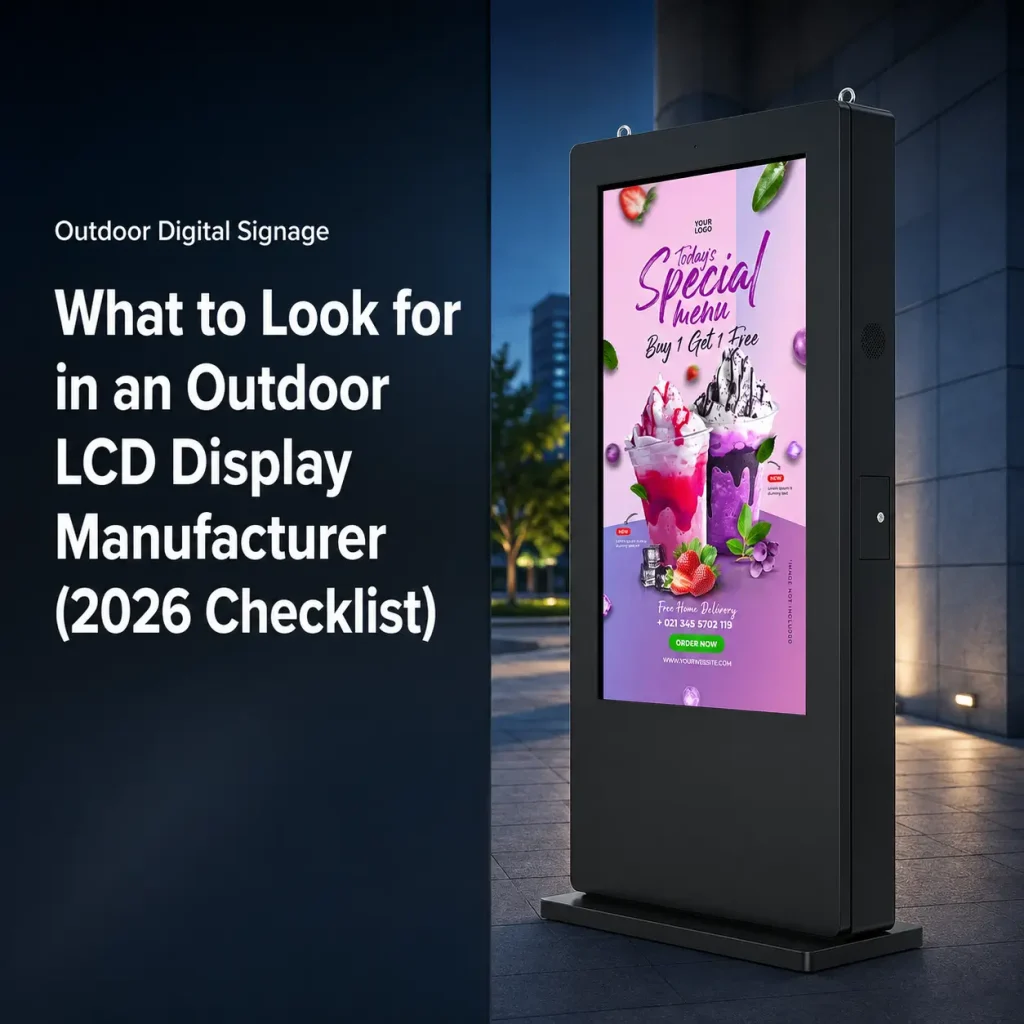
Quick answer: When evaluating an outdoor LCD display manufacturer, look for verified high brightness (2,500 nits or higher for direct sunlight), IP65 or better weatherproofing, proven thermal management, meaningful certifications (ISO 9001, CE, FCC, UL), remote monitoring capability, and a warranty with real after-sales support. Everything else — MOQ, lead time, price — is negotiable; these seven points decide whether your screens survive year one outdoors.
Outdoor LCD displays are not commodity hardware. They run 24/7 in rain, direct sun, dust and temperature swings across the -30°C to 55°C operating range. The manufacturer you pick determines whether your network runs for years or becomes a maintenance sink. This guide walks through the seven things that actually separate capable outdoor LCD manufacturers from general display assemblers. For the full selection process, start with our Outdoor LCD Display Buying Guide 2026.
1. Verified Brightness, Not Spec-Sheet Brightness
Outdoor displays need high brightness to stay readable in direct sunlight — 2,500 nits is the practical minimum, and 3,000–4,000 nits is common for sun-exposed locations. The problem: quoted nits are often lab numbers, not real-world numbers. Some suppliers quote peak brightness measured in ideal conditions, while actual sustained brightness is far lower.
Ask how brightness is measured and whether the display sustains it in operation (thermal throttling can cut brightness after 30 minutes in the sun). We published a field method for measuring real brightness — How to Measure Real Brightness of an Outdoor LCD — and you can apply the same test to any supplier’s sample.
2. IP Rating That Matches Your Environment
IP65 (dust-tight, protected against water jets) is the baseline for outdoor use. IP66 adds stronger water protection; IP55 is only suitable for sheltered semi-outdoor spots. For vandal-prone locations, look for IK10-rated glass or enclosures as well.
Check that the rating is tested, not assumed. A manufacturer should show you the test standard and, ideally, field deployments in climates like yours. See our breakdown of IP65 vs IP66 vs IK10 for what each rating actually means.
3. Thermal Management Design
Heat is the #1 killer of outdoor LCDs. A 2,500-nit panel in a sealed cabinet in 40°C ambient can push internal temperatures past the LCD’s safe range, causing image degradation, backlight failure, and reduced lifespan. Good thermal design is engineered, not accidental: airflow paths, heatsinks, fan or heat-exchanger systems, and high-temperature shutdown logic.
Ask what the operating temperature range is and how cooling works. Ask for thermal test data — a responsible manufacturer has it. We documented our own field methodology in How to Test Outdoor Kiosk Heat Management; the same approach works when auditing any supplier.
4. Real Certifications
Certifications are the minimum bar, not a differentiator. For exporting to North America and Europe, look for ISO 9001 (quality management), CE, FCC, RoHS, and for certain markets UL/ETL or UKCA. Verify certificates are current and issued for the actual product family — some suppliers list certificates for one product while selling another.
You can usually check certification validity with the issuing body. If a manufacturer hesitates to share certificate numbers or test reports, treat it as a red flag.
5. Remote Monitoring and Management
When you have 10, 100, or 1,000 screens deployed, you cannot check them by hand. Look for a manufacturer that offers or supports remote monitoring: temperature, humidity, brightness, power, door status, and fault alerts. This turns maintenance from reactive to proactive.
MWE Display supports OMC remote monitoring for outdoor LCD networks — see how it works. When comparing suppliers, ask whether remote monitoring is included, what parameters it tracks, and whether it works with your CMS.
6. Warranty and After-Sales Support
A 1-year warranty is common; 2–3 years is what serious outdoor display manufacturers offer. Read the terms: what is covered (panel? enclosure? labor?), where the repair happens (local depot vs. return to China), and typical response times. Also ask about spare parts availability — outdoor displays fail eventually, and a spare-parts pipeline is worth more than a glossy brochure.
7. OEM/ODM Capability
Most outdoor display projects need some customization: enclosure color and branding, touch options, mounting, software integration, local certifications. A manufacturer with in-house engineering can adapt; a pure assembler cannot.
Our guide to OEM vs White Label vs Brand explains the difference and how to choose the right engagement model.
2026 Supplier Checklist
| Checklist item | What to verify |
|---|---|
| Brightness | 2,500+ nits, sustained (not peak), measured method disclosed |
| IP rating | IP65 minimum; IP66 for harsher exposure; IK10 if vandal risk |
| Thermal | Operating temp range, cooling method, thermal test data |
| Certifications | ISO 9001, CE, FCC, RoHS; UL/ETL/UKCA per target market |
| Remote monitoring | Supported, what parameters, CMS compatibility |
| Warranty | 2–3 years, clear terms, local repair option |
| OEM/ODM | In-house engineering, customization track record |
| References | Deployments in similar climates/industries, contactable |
Frequently Asked Questions
What is the minimum brightness for an outdoor LCD display?
For direct sunlight, at least 2,500 nits is recommended. Locations with full sun exposure typically use 3,000–4,000 nits. Verify the brightness is sustained during operation, not just a peak spec.
What IP rating do outdoor displays need?
IP65 is the baseline (dust-tight, water-jet protected). Choose IP66 for harsher weather, and add IK10-rated glass for vandal-prone areas.
How long do outdoor LCD displays last?
Commercial outdoor LCD panels are typically rated for 50,000+ hours of backlight life. Real-world lifespan depends on thermal management, operating environment, and maintenance.
Are cheap outdoor LCD displays worth it?
Usually not. Low prices often mean lower-grade panels, weaker thermal design, and thinner after-sales support — which shows up as downtime and repair cost within the first year outdoors.
What certifications should an outdoor LCD manufacturer have?
ISO 9001, CE, FCC, and RoHS as a baseline; UL/ETL for North America and UKCA for the UK depending on your target market.
Choosing the right partner is a process, not a guess. Work through the checklist above, compare shortlisted suppliers against the same criteria, and validate with samples and references. If you want to see how MWE Display approaches outdoor LCD manufacturing — thermal testing, brightness verification, certification and after-sales support — talk to our team and we will walk you through it.