EN
EN  IT
IT  ES
ES  FR
FR  DE
DE 

Table of contents
The transition from traditional printed billboards to dynamic outdoor digital signage represents a massive leap forward for the advertising, retail, and transportation industries. However, moving delicate electronic components from a climate-controlled indoor environment into the unpredictable and often harsh outdoors introduces a critical point of failure: the weather.
For B2B buyers, system integrators, and advertising network operators, hardware failure is not just an inconvenience—it is a catastrophic disruption that results in lost advertising revenue, breached Service Level Agreements (SLAs), and exorbitant field maintenance costs. To mitigate these risks, industry professionals rely on standard certifications to gauge hardware durability. Among these, the IP65 rating stands out as the fundamental baseline for any serious outdoor commercial display. But what exactly does this rating mean, and why is it non-negotiable for your deployment strategy?
IP65 Rating Explained
IP65 is an Ingress Protection standard defined by IEC 60529. The first digit “6” means complete dust-tight protection (highest level) — zero dust ingress. The second digit “5” means protection against low-pressure water jets from any angle — sufficient for rain, snow, and hose-down cleaning. For outdoor digital signage, IP65 is the minimum recommended rating to prevent weather-related hardware failure.
Understanding the Ingress Protection (IP) System
IP stands for Ingress Protection, a globally recognized engineering standard defined by the International Electrotechnical Commission (IEC) under standard 60529. This classification system grades the degree of protection a mechanical casing or electrical enclosure provides against the intrusion of solid foreign objects (like dust and dirt) and moisture (like rain and humidity).
An IP rating is always followed by two digits, and each digit signifies a specific type of defensive capability. Let us break down what an IP65 rating guarantees for your digital signage:
- The First Digit (6) – Solid Particle Protection: The first number ranges from 0 to 6. A “6” represents the highest possible level of protection in this category. It means the display enclosure is completely dust-tight. No microscopic dirt, pollen, urban smog, or fine particulate matter can penetrate the internal chassis.
- The Second Digit (5) – Liquid Ingress Protection: The second number ranges from 0 to 9. A “5” certifies that the enclosure is protected against low-pressure water jets directed from any angle. It can withstand torrential downpours, blowing snow, and even the direct spray of a hose used by municipal workers cleaning the streets.
Why standardizing on IP65 is Crucial for Outdoor Deployments
Placing a standard commercial monitor inside a generic, loosely sealed weatherproof box is a recipe for rapid hardware degradation. Purpose-built IP65 outdoor digital signage offers distinct, measurable advantages that directly impact your operational efficiency and bottom line.
1. Total Immunity to Urban Debris and Particulate Matter
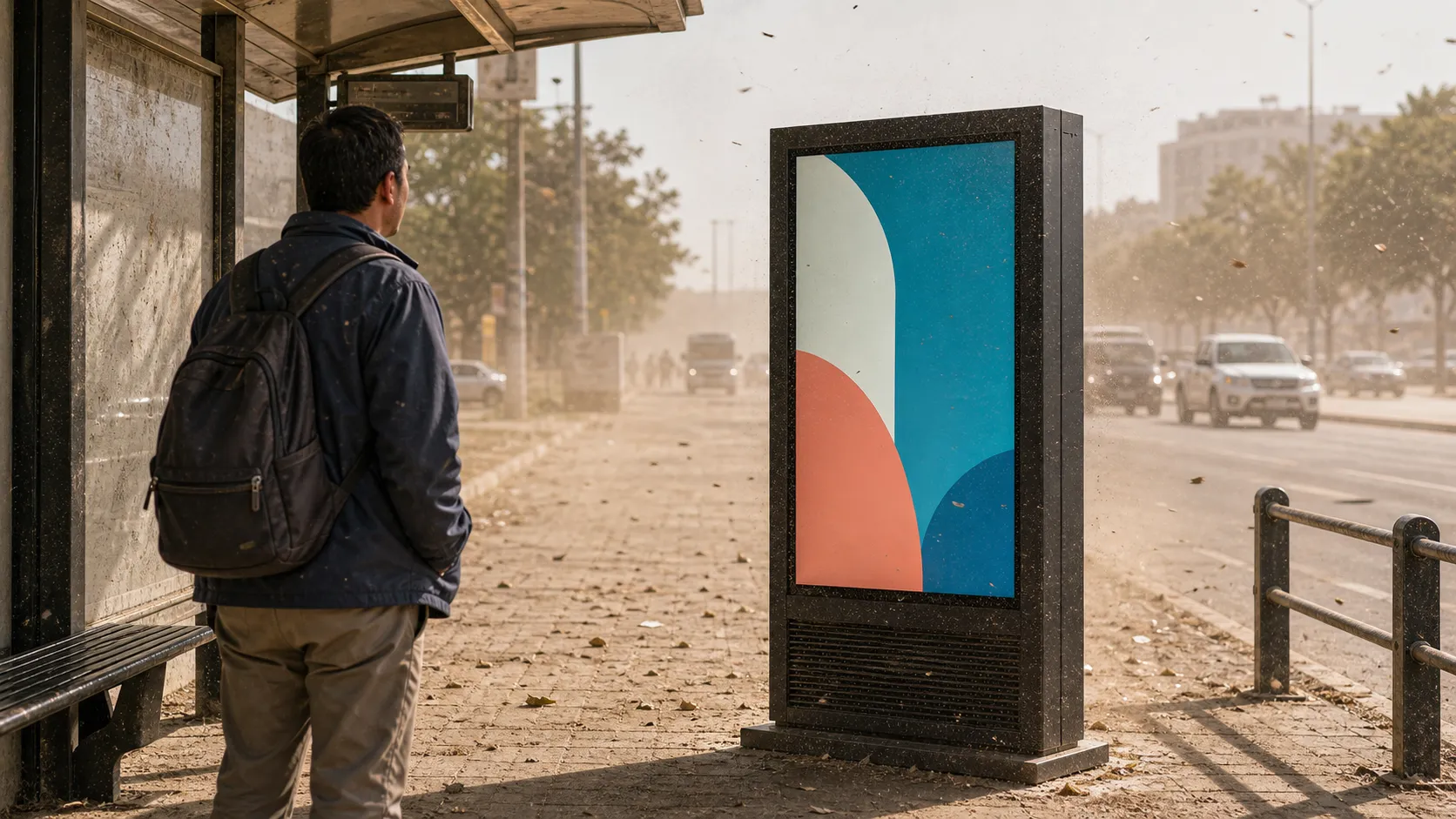
Displays deployed in busy transit environments—such as bus shelters in London, high-traffic retail parks in Hemel Hempstead, or railway stations—are constantly bombarded by vehicle exhaust fumes, brake dust, and industrial dirt.
If an enclosure is only rated IP54 (dust protected, but not completely dust-tight), fine particles will eventually bypass the seals. Once inside, this dust coats the motherboard and clogs internal cooling fans. This acts as a thermal blanket, trapping heat and causing the Central Processing Unit (CPU) and LCD panel to overheat and fail. An IP65 rating ensures that the internal ecosystem remains pristine, allowing internal cooling mechanisms to operate at peak efficiency for years.
2. Uninterrupted Uptime in Severe Weather Conditions
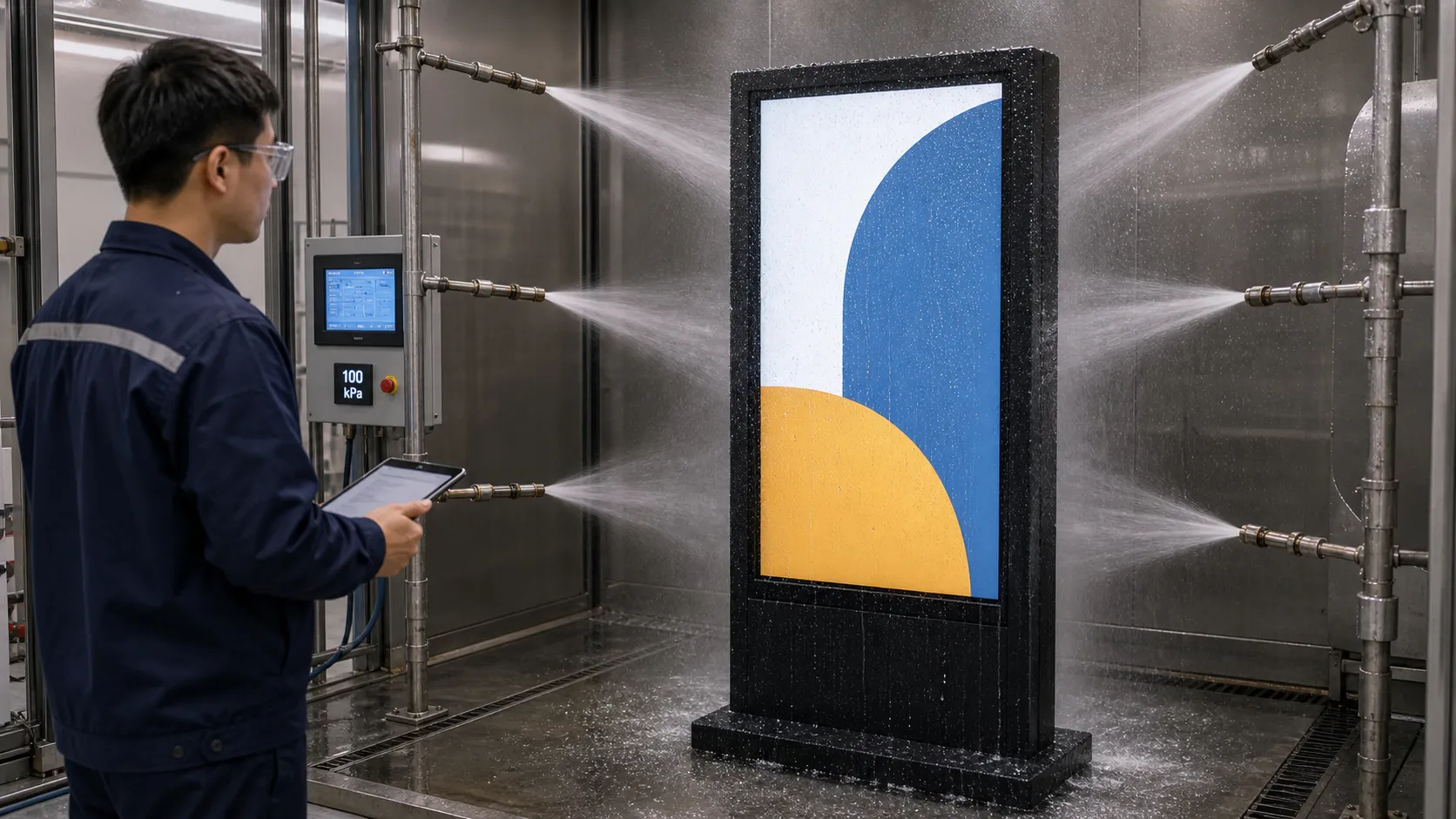
Water and electricity are a fundamentally destructive combination. In tropical climates like Singapore, displays face sudden, torrential monsoons and relentless ambient humidity. In northern climates, displays must survive freezing rain and thawing ice.
An IP65 rating guarantees that moisture cannot short-circuit the power supply, media player, or the delicate driver boards attached to the LCD panel. Furthermore, premium IP65 enclosures incorporate specialized Gore-Tex breathers or intelligent thermal loops that allow internal heat to escape while preventing external humidity from entering, effectively eliminating internal screen condensation (fogging) behind the protective glass.
The Diagnostic Approach: Lowering TCO and Maintenance Costs
Modern digital signage procurement requires a diagnostic marketing mindset. Buyers are no longer simply purchasing hardware; they are investing in long-term solution ecosystems. A critical metric in this ecosystem is the Total Cost of Ownership (TCO).
The most expensive component of operating a digital signage network is the “truck roll”—the cost of dispatching a specialized technician to physically travel to a site, open a kiosk, diagnose a hardware fault, and replace weather-damaged parts. Frequent truck rolls will rapidly consume your projected ROI.
By deploying strictly IP65-rated hardware, you virtually eliminate environmental damage as a variable. Your field-service costs plummet because the displays are mechanically isolated from the elements.
Seamless Integration with Remote Device Management (RDM)
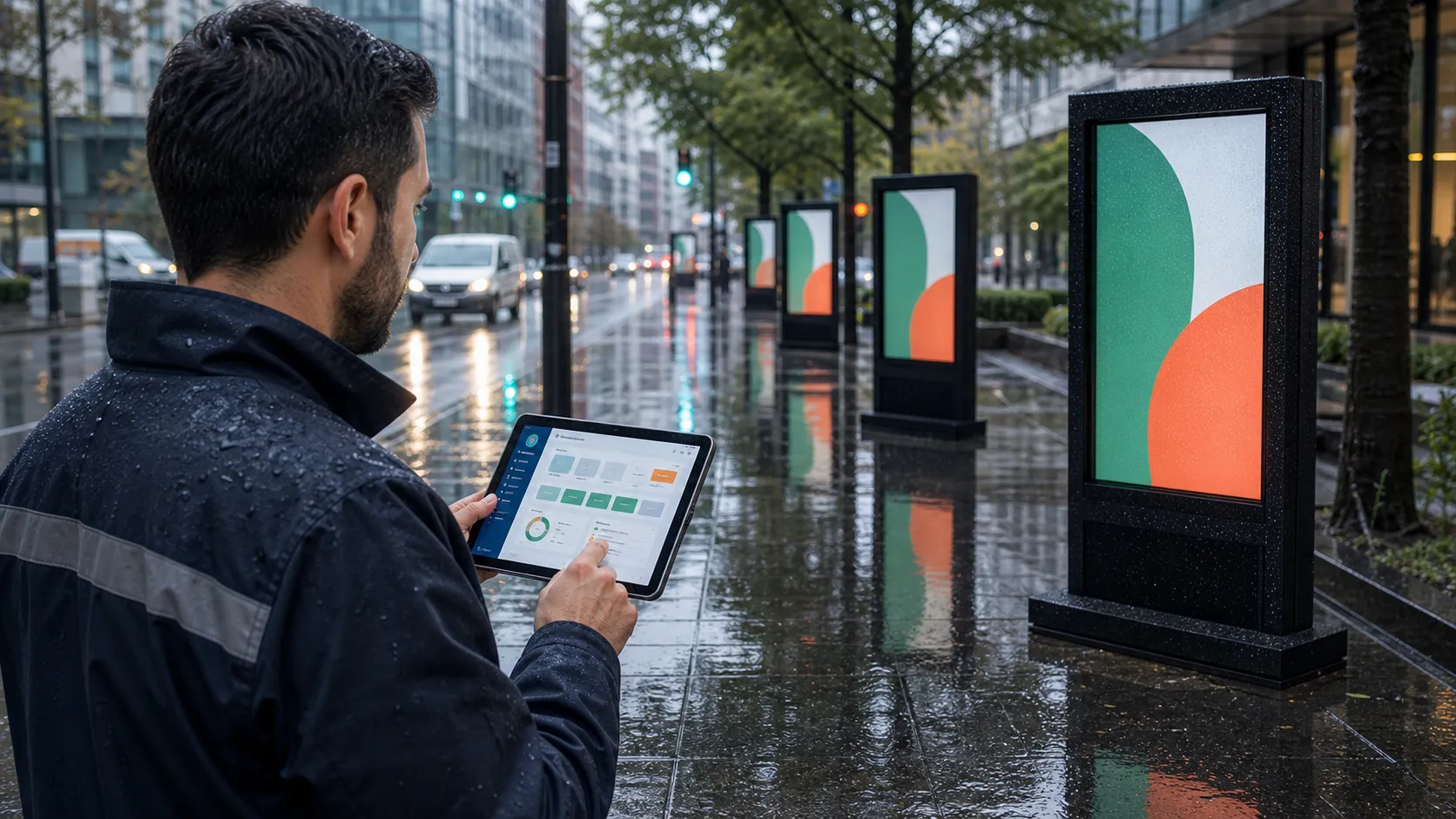
Physical protection is only half the battle; the other half is digital oversight. True operational efficiency is achieved when IP65 hardware is paired with a robust Remote Device Management (RDM) platform operated from a central Operations Management Center (OMC).
Because an IP65 enclosure protects the hardware from random environmental shorts and dust-induced overheating, your RDM data becomes highly accurate. When an RDM dashboard flags a temperature warning or a power fluctuation, you can trust that it is a genuine system metric rather than a false alarm caused by a leaking seal. This synergy between ruggedized physical hardware and intelligent remote monitoring allows network operators to transition from reactive troubleshooting to proactive, predictive maintenance.
Secure Your Outdoor Network with Marvel Technology
When sourcing commercial displays, settling for inadequate ingress protection will lead to catastrophic hardware failures and damaged brand reputation.
At Marvel Technology, we specialize in engineering solutions, not just screens. Our outdoor digital signage and interactive kiosks are built from the ground up with strict, factory-tested IP65-rated enclosures, ruggedized vandal-proof glass, and intelligent temperature control systems. We empower our clients with hardware that guarantees 24/7 uptime, reducing maintenance overhead and maximizing campaign visibility regardless of the forecast.
Frequently Asked Questions
What does IP65 rating mean for outdoor displays?
IP65 is an Ingress Protection rating: ‘6’ signifies complete dust-tight protection (highest level), meaning no dust or dirt enters the enclosure. ‘5’ signifies protection against low-pressure water jets from any direction — sufficient for rain and hose-down cleaning. For outdoor signage, IP65 is the minimum recommended rating, and many premium displays combine IP65 front with IP54 rear for ventilation.
Why is IP65 crucial for outdoor digital signage deployments?
IP65 protects against four primary outdoor threats: rain and humidity (water causes short circuits and corrosion), dust and particulates (accumulation creates thermal insulation and overheating), condensation (temperature cycling creates internal moisture), and insects or debris (nesting blocks vents and causes failures). Proper IP65-rated seals eliminate all four failure vectors.
How does IP65 rating affect total cost of ownership?
IP65 directly reduces TCO: unprotected displays require 2-4 annual service calls ($200-800 each), while IP65-rated units average 0-1. Unprotected displays last 2-4 years versus 5-8 years for IP65-rated. For mission-critical deployments, IP65 compliance eliminates a common liability gap. Over 5 years, IP65-rated displays have 30-50% lower TCO than unrated alternatives.
What is the difference between IP65, IP66, and IP67?
IP65 protects against low-pressure water jets (standard rain and cleaning). IP66 protects against high-pressure jets (suitable for pressure washers but tighter seals reduce ventilation). IP67 protects against temporary immersion (1m for 30 minutes, generally unnecessary). Important: higher IP ratings can reduce ventilation and raise internal temperatures, potentially lowering reliability — match the rating to actual exposure risk.
How does RDM integrate with IP65-rated outdoor displays?
RDM extends IP65 protection with active monitoring: internal humidity sensors detect seal breaches before failure occurs, pressure equilibrium monitors track vent function, temperature delta tracking compares internal vs. external temps to detect cooling degradation, and seal lifecycle records predict gasket replacement intervals. This proactive monitoring reduces unplanned downtime by up to 60% in large outdoor networks.