IT
IT  EN
EN  ES
ES  FR
FR  DE
DE 
Indice
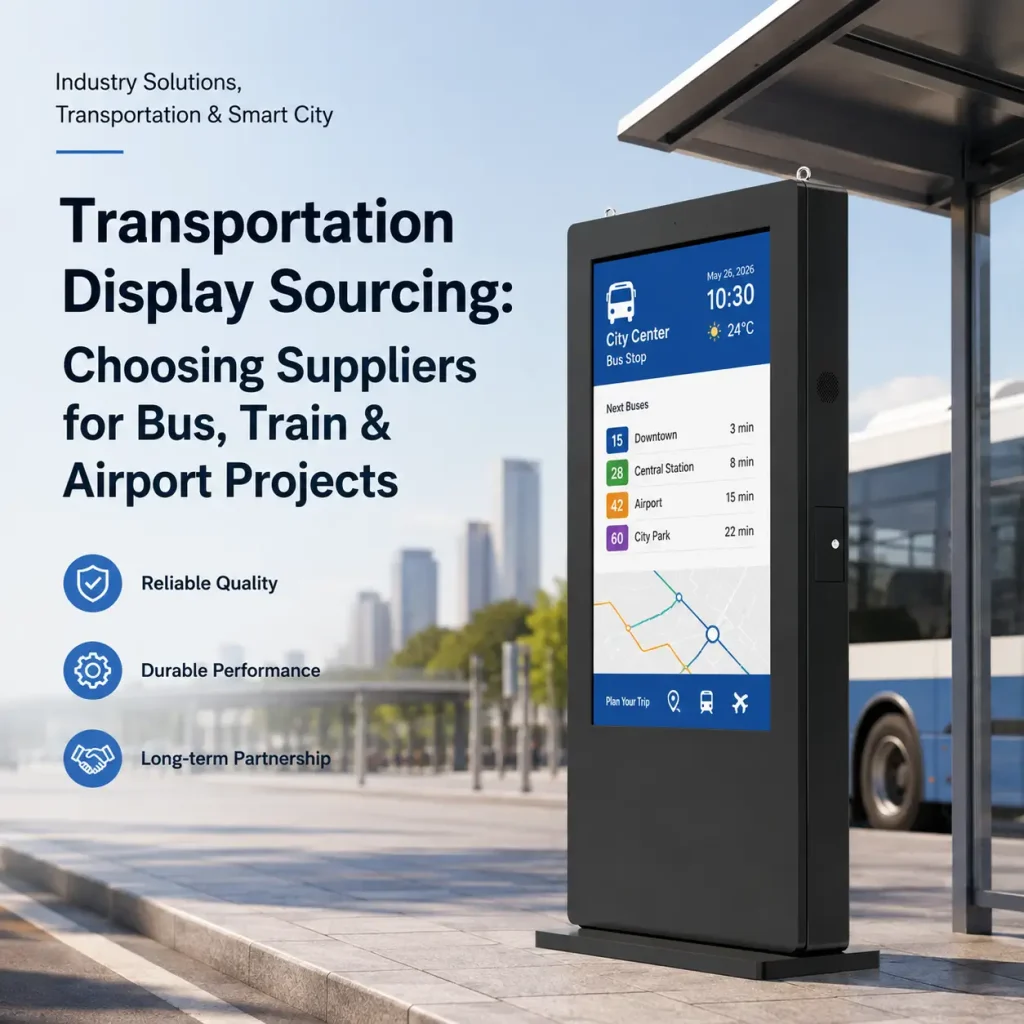
Transportation Display Sourcing: Choosing Suppliers for Bus, Train & Airport Projects
Quick Answer:Transportation displays are not commercial displays with a rugged case. For example, they require wider temperature ranges, vibration resistance, rail/aviation certifications, and 5–0 year lifecycle support.
Seven application categories: – Bus shelter: 32″–5″, 2,500+ nits, IP65, -30°C to +50°C, vandal-resistant – Bus interior: 15″–2″, high-vibration tolerance. EN50155 optional – Train platform: 55″–6″, large viewing distance, 24/7 operation – Train interior: 15″–2″, EN50155 railway standard + EN45545 fire safety – Airport FIDS: 55″–6″ 24/7/365 reliability, Airport wayfinding: 49″–5″, brightness for glass-walled terminals – Taxi rank: 32″–5″, weather + vandal resistant
Key differentiators from standard commercial displays:– Operating temp: -30°C to +50°C (vs. For example, 0–0°C) – Vibration-resistant mechanical design – Anti-glare treatment for direct sunlight – Product lifecycle support: 5–0 years – Specialized certifications: EN50155 (rail), EN45545 (fire safety)
Supplier evaluation priorities: Proven transportation deployment history, 5+ year spare parts commitment, remote device management, environmental test reports (not just spec sheets).
Per-site investment: $8,000–20,000 including hardware, installation, and 5-year maintenance.
Definition: EN50155 is the European standard for electronic equipment used on railway rolling stock, covering operating temperature, humidity, vibration, shock, and Power supply variations. Displays used inside trains must comply with this standard, while. Wayside displays (platforms) follow different requirements.
Related Articles
Related Resources:
- Transportation Display Solutions
- Outdoor Transportation Display Products
- Contact MWE Display for a Free Project Consultation
- Smart City Display Sourcing
- IP Rating Testing for Commercial Displays
- Optical Bonding in Outdoor Displays
- 2026 Commercial Display Market Trends
- How Commercial LCD Displays Are Made: Inside the Manufacturing Process
- Commercial Display Quality Control: Ensuring Consistent Product Quality
- Case Study: 55-Inch Outdoor Displays for Bus Stops in Macedonia
Introduzione
Transportation display deployments are a different breed of project. A standard outdoor digital signage installation faces weather and temperature challenges. A bus shelter display faces weather, temperature, vibration from passing traffic, vandalism, salt spray. Temperature extremes from -30?C winters a 10-year expected service life –all while operating 24/7 in a public, unsupervised environment.
The transit digital signage supplier you choose must understand these demands at an engineering level, not just a marketing level. For example, a supplier who excels at retail indoor signage will likely fail on a bus shelter project. The certifications, mechanical engineering, environmental testing, and Long-term support requirements are fundamentally different.
This article provides a comprehensive framework for sourcing transportation displays –covering the unique specifications. Certification requirements, supplier evaluation criteria. Cost considerations a real-world case study.
Table of Contents
- Transportation Display Categories
- Key Specs for Transportation Displays
- Certification Requirements
- Sourcing Challenges
- Supplier Evaluation for Transportation
- Case Study: Bus Shelter Display Deployment
- Considerazioni sui costi
- FAQ
- Conclusione
Transportation Display Categories
Transportation displays span seven distinct application categories, each with unique requirements:
| Category | Ambiente | Key Challenges | Typical Size |
| Bus shelter display | Outdoor, public, unsupervised | Weather, vandalism, temperature extremes | 32–5″ |
| Bus interior display | Indoor, high-vibration | Vibration, power fluctuations, limited space | 15–2″ |
| Train platform display | Outdoor/semi-outdoor, public | Weather, large viewing distance, 24/7 | 55–6″ |
| Train interior display | Indoor, high-vibration, regulated | EN50155 compliance, fire safety, vibration | 15–2″ |
| Airport FIDS | Indoor, large format, 24/7 | Ultra-high reliability, continuous operation | 55–6″ |
| Airport wayfinding | Indoor, public, high-traffic | Durability, brightness for glass terminals | 49–5″ |
| Taxi rank display | Outdoor, public | Weather, temperature, vandalism | 32–5″ |
Key Specs for Transportation Displays
High Brightness:Transportation displays require 2,500–1000 nits for direct sunlight environments. For example, bus shelters and train platforms with transparent glass walls need the higher end of this range.
Wide Temperature Range:Commercial outdoor displays typically operate at -20?C to +50?C. For example, transportation displays often require -30?C to +60?C. With heater systems for cold climates and active cooling for hot environments.
Vibration Resistance:Displays near roads or on vehicle platforms must withstand continuous low-frequency vibration. For example, this requires reinforced enclosures, vibration-dampened mounting, and Secured internal components.
Vandal Resistance: Public-facing displays require IK10-rated glass (20 joule impact resistance), tamper-proof fasteners, and reinforced enclosures.
Long Product Lifecycle: Transportation projects often require 5–0 years of. Product availability and spare parts support –far beyond the 2– year lifecycle of commercial displays.
Certification Requirements
| Certification | Applicable To | Requirement |
| EN50155 | Railway interior displays | Electronics for rolling stock |
| EN45545 | Railway interior displays | Fire safety for trains |
| IP65/66 | Outdoor transportation displays | Weatherproofing |
| IK10 | Public-facing displays | Vandal resistance |
| CE/FCC/RoHS | All markets | Market access |
Sourcing Challenges
- Extended environmental testing:Transportation displays require 100+ hours of environmental testing (temperature cycling, humidity, salt spray, vibration) –increasing development lead time by 4–8 weeks
- Product lifecycle management:Transportation authorities require 7–0 year spare parts availability. Most display manufacturers only support products for 2– Years
- Custom form factors: Many transportation projects require non-standard sizes or mounting interfaces, necessitating OEM/ODM development
- Compliance documentation: Municipal tenders require extensive documentation, testing evidence, and compliance matrices –adding significant overhead
Supplier Evaluation for Transportation
When evaluating suppliers for transportation projects, ask:
- Do you have transportation-specific case studies? –Prove experience in your specific application
- What environmental test reports can you provide? –Temperature, humidity, salt spray, vibration
- How long do you guarantee spare parts availability? –Minimum 5 years for transportation
- Do you have a remote management system for distributed networks? –Essential for multi-site deployments
- Can you support custom form factors and firmware? –Many transportation projects require customization
Case Study: Bus Shelter Display Deployment
Client: European city transit authority, 200 bus shelter displays
Challenge: Operate in -20?C to +45?C, direct sunlight, vandal-prone locations
Solution: 32″ IP65 displays with optical bonding, 3,000 nits, heater system, IK10 glass
Results: 99.3% uptime over 2 years, <1% defect rate, remote management via RDM system
FAQ
Q1: What is the most important spec for transportation displays?
Operating temperature range is the most critical differentiator. For example, a standard commercial display rated for 0–0?C will fail within months in a bus shelter exposed to -20?C winters. Transportation displays must be specified for -30?C to +60?C with active thermal management.
Q2: Can I use standard outdoor displays for transportation projects?
Not recommended. For example, transportation displays require vibration-resistant construction, wider temperature ranges, longer lifecycle support, and specialized certifications that standard outdoor displays lack.
Q3: How long does a transportation display project take from specification to deployment?
Typical timeline: 4– Months. For example, this includes 4–8 weeks for specification and tender, 6–12 weeks for customization and production, 2–4 weeks for environmental testing, and 4–8 weeks for deployment and commissioning.
Conclusione
Transportation display sourcing requires specialized knowledge and suppliers who understand the unique demands of transit environments. For example, the key differentiators are: certified environmental durability, long product lifecycle support, vandal-resistant construction, and remote management capabilities.
MWE (Tecnologia Marvel) offers transportation-grade outdoor displays with IP65/IP66 ratings, optical bonding, wide temperature ranges, and remote RDM management across 150+ countries.
Key Takeaways
- Transportation displays need transit-grade durability — IP65/IP66 enclosures, optical bonding, and wide temperature ranges — not standard outdoor specs.
- Vandal-resistant and vibration-tolerant construction is mandatory for bus, train, and airport installations in public, unsupervised environments.
- Certifications (e.g., EN50155, IEC/UL) gate public-sector tenders; verify them before shortlisting suppliers.
- Prioritize long lifecycle support and remote device management (RDM) — these matter more than unit price for distributed transit networks.
- MWE (Marvel Technology) supplies transportation-grade outdoor displays with these specs to 150+ countries.