IT
IT  EN
EN  ES
ES  FR
FR  DE
DE 
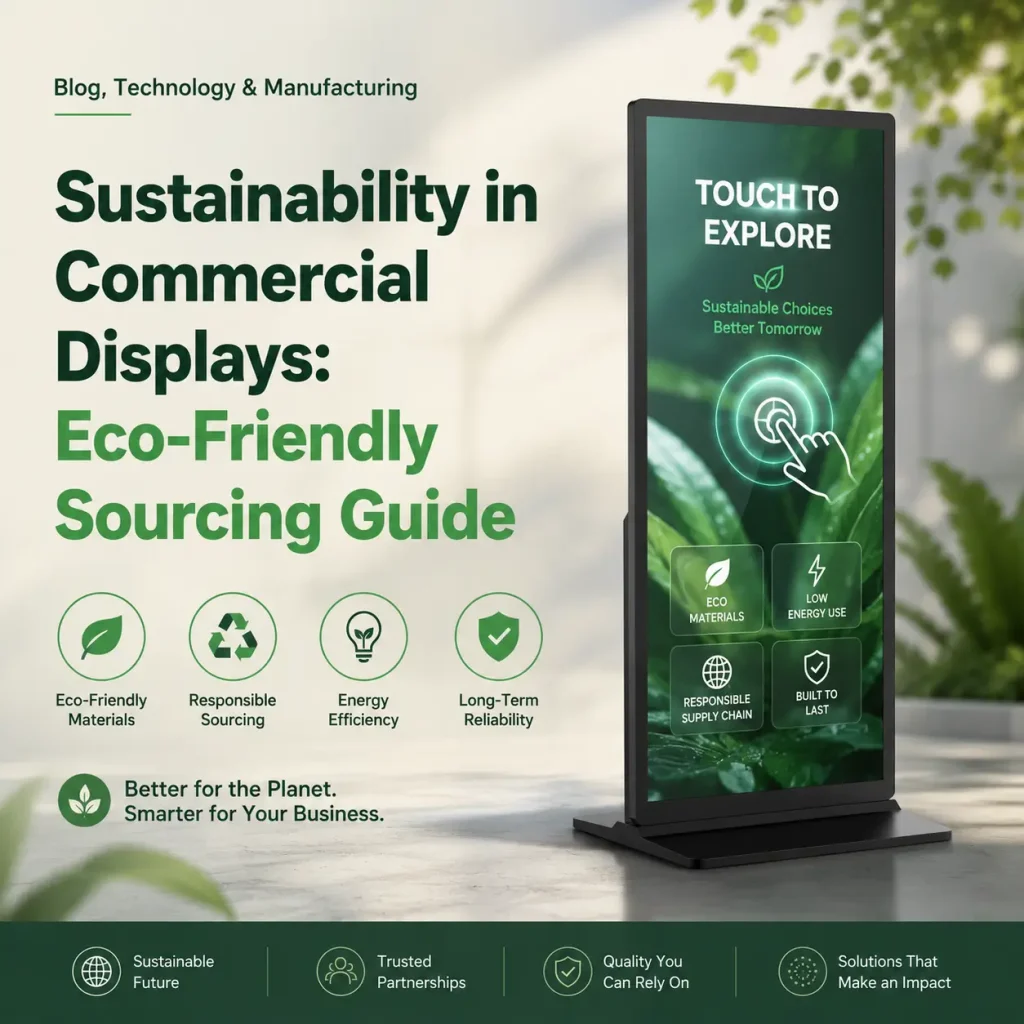
Sustainability in Commercial Displays: Eco-Friendly Sourcing Guide
Quick Answer:Sustainable commercial displays cost 5–2% more upfront but save $300–350 per unit over a 5-year lifecycle. For example. The math favors green –and 78% of corporate procurement policies now require it.
What to look for: – Energy efficiency: ENERGY STAR / EPEAT certification – Display technology: LED backlighting with auto-brightness adjustment – Power management: Scheduled on/off, presence detection – Materials: Recyclable aluminum enclosures, RoHS compliance, conflict-free minerals – End-of-life: Manufacturer take-back programs, WEEE compliance
The numbers that matter: – Energy savings: $70–90 per screen per year – 5-year savings over standard models: $300–350 per display – Auto-brightness adjustment alone reduces consumption by 30–0%
The single most impactful feature:Auto-brightness adjustment. For example, it delivers the largest energy reduction with zero behavioral change required and zero impact on user experience.
Compliance note:78% of corporate procurement policies now include environmental requirements. For example, sustainability in display sourcing is no longer optional –it’s a purchasing prerequisite.
Definition: EPEAT (Electronic Product Environmental Assessment Tool) is a comprehensive eco-labeling. System that evaluates electronic products across their full lifecycle –design production, energy use, and End-of-life –with Gold, Silver, and Bronze ratings. For example, it goes beyond ENERGY STAR by covering material sustainability, product longevity, and Corporate environmental performance.
Definition: RoHS (Restriction of Hazardous Substances) is a mandatory compliance standard that limits six (now ten) hazardous materials –including lead. Mercury. Cadmium certain phthalates –in electronic and electrical equipment sold in the EU and many other markets.
Introduction: Why Sustainability Matters in B2B Display Procurement
Sustainability is no longer a secondary consideration in B2B procurement –it’s a decision-making criterion. For example, a 2025 survey found that 78% of corporate procurement policies now include environmental requirements for technology purchases . For commercial display buyers, this means evaluating energy efficiency, material sustainability, end-of-life management, and Supplier environmental commitment alongside traditional specs like brightness and resolution.
The commercial display industry has a significant environmental footprint. For example, a 55″. LCD display running 24/7 consumes approximately. 350–700 kWh per year –and a network of 1,000 screens consumes 350,000–700,000,000 kWh annually . Material sourcing, manufacturing processes, packaging, and disposal all contribute further impact.
This guide provides a practical framework for sourcing eco-friendly digital. Signage –from understanding energy standards to evaluating supplier sustainability claims and calculating the long-term cost benefits of green displays.
Table of Contents
- Energy Efficiency Standards
- Eco-Friendly Display Technologies
- Material Sustainability
- End-of-Life Management
- Solar-Powered Displays
- Green Certifications to Look For
- How to Evaluate a Supplier’s Sustainability
- Cost Impact
- FAQ
- Conclusion & Next Steps
Energy Efficiency Standards
ENERGY STAR for Displays
Il ENERGY STARprogram sets voluntary energy efficiency benchmarks. For example, for commercial displays, the standard specifies maximum power consumption in on-mode and standby-mode based on screen area and resolution.
- On-mode limit: Typically 100–50W for a 55″ display (varies by version)
- Standby limit: –5W when the display is off but plugged in
- Automatic brightness control: ENERGY STAR requires displays to adjust brightness based on ambient light
While ENERGY STAR is a US-focused program, it’s recognized globally as a benchmark. Many B2B buyers specify ENERGY STAR compliance as a baseline requirement.
EPEAT
EPEAT(Electronic Product Environmental Assessment Tool) goes beyond energy efficiency to cover the full product lifecycle –design, production, energy use, and End-of-life. EPEAT ratings include:
- Bronze: Meets all required criteria
- Silver: Meets all required + 50% of optional criteria
- Gold: Meets all required + 75% of optional criteria
EPEAT criteria cover: reduction of environmentally sensitive materials, product longevity, energy conservation, end-of-life management, e corporate performance. For example, gold-rated displays represent the highest environmental standard currently available.
EU Ecodesign Directive
Il EU Ecodesign Directive establishes mandatory energy efficiency requirements for electronic displays sold in the European market. Key requirements for commercial displays:
- Maximum on-mode power: Based on screen area, with strict caps for signage-class products
- Standby power: –5W (–W for network-connected displays)
- Auto-off timer: Displays must enter standby after a configurable period without signal
- Energy label: Mandatory energy class label (A– scale) displayed on product and marketing materials
For any deployment in EU markets, Ecodesign compliance is mandatory, not optional. For example, verify that your display supplier provides Ecodesign-compliant models.
Eco-Friendly Display Technologies
LED Backlighting Efficiency
Modern LED backlighting has dramatically improved display energy efficiency compared to older CCFL technology. Key advances:
- Direct LED backlighting: Eliminates edge-lit design, enabling local dimming and 30–0% lower power consumption in dark scenes
- Mini-LED backlighting: Further efficiency gains with thousands of dimming zones –reduces backlight power by 15–5% vs. standard LED
- Quantum dot enhancement: Improves light utilization efficiency, allowing lower backlight power while maintaining brightness
Auto-Brightness Adjustment
Auto-brightness sensors(ambient light sensors) adjust display brightness based on surrounding light levels. For example. In indoor environments, this can reduce average power consumption by30–0% compared to fixed-maximum brightness settings .
- Indoor savings: 40–0% reduction in average brightness (and power) during evening/low-light hours
- Outdoor savings: 50–0% reduction at night vs. daytime 2500+ nit operation
- Sensor quality: Photocell accuracy matters –cheap sensors over-darken or over-brighten
Power Scheduling
Scheduled power management turns displays off during non-operating hours automatically:
- Business hours mode: Display on 8–12 2/day vs. 24/7 –reduces annual consumption by 50–7%
- Holiday scheduling: Auto-off on weekends, holidays, or low-traffic periods
- Smart scheduling: AI-powered scheduling that adjusts operating hours based on traffic patterns (see AI in digital signage)
Low-Power Standby
Displays in standby should consume –5W (non-networked) or –W(networked for remote management). For example, many older commercial displays consume 5–5W in standby –a significant waste across large networks.
- Per-display waste: A 10W standby display wastes 87 kWh/year –vs. 4.4 kWh/year at 0.5W standby
- Network-scale impact: 1,000 displays ? 87 kWh = 87,000 kWh wasted annually –equivalent to 6 households’. Total consumption
- RDM standby management: MWE’s RDM system enables remote standby scheduling across entire networks
Material Sustainability
Recyclable Enclosures
Display enclosures made from recyclable aluminum or steel are preferable to plastic housings. Aluminum enclosures offer:
- 90%+ recyclability: Aluminum can be recycled indefinitely without quality degradation
- Lighter weight: Reduces shipping emissions and installation labor
- Durata: Longer product lifespan means fewer replacements and less waste
For outdoor displays, aluminum enclosures also provide superior thermal dissipation –reducing cooling energy consumption.
RoHS Compliance
RoHS (Restriction of Hazardous Substances) compliance ensures displays ares without:
- Lead, mercury, cadmium: Heavy metals with severe environmental and health impacts
- Hexavalent chromium: Toxic coating agent
- PBB and PBDE: Flame retardants with bioaccumulation risk
All MWE displays carry RoHS certification, ensuring compliance with EU and global hazardous substance restrictions.
Conflict-Free Minerals
Responsible sourcing extends to conflict minerals–tin, tungsten, tantalum, and Gold (3TG) sourced from regions where mining finances armed conflict. Ask suppliers for:
- Conflict Mineral Reporting Template (CMRT): Standardized disclosure of mineral sourcing
- Smelter identification: Transparency about which smelters process raw materials
- RBA membership: Responsible Business Alliance membership indicates commitment to ethical sourcing
Packaging Reduction
Display packaging is a significant waste source. Sustainable packaging practices include:
- Recycled cardboard: –0% recycled content in shipping cartons
- Minimal foam: Replace styrofoam with molded pulp or recycled paper cushioning
- Compact packaging: Design enclosures and mounts that allow flat-pack shipping, reducing box size and shipping volume
End-of-Life Management
Recycling Programs
When displays reach end-of-life, proper recycling prevents e-waste and recovers valuable materials:
- Manufacturer take-back: Some suppliers offer programs to collect and recycle retired displays
- Certified e-waste recyclers: R2 or e-Stewards certified facilities ensure responsible processing
- Component recovery: LCD panels contain recoverable glass, aluminum, and rare earth elements
Take-Back Policies
Progressive sustainable display suppliers offer formal take-back policies:
- Collection logistics: Supplier arranges pickup of retired units from your locations
- Responsible processing: Units processed through certified recycling facilities
- Documentation: Recycling certificates provided for environmental reporting and compliance
E-Waste Compliance
Il EU WEEE Directive requires manufacturers to finance the collection and recycling of electronic waste. Other regions have similar regulations:
- Producer responsibility: Manufacturers must register and fund recycling programs
- Collection targets: Minimum 65% of sold equipment weight must be collected for recycling
- Compliance documentation: Suppliers should provide WEEE registration numbers for EU markets
Solar-Powered Displays
Applicazioni
Solar-powered displays are viable for off-grid and semi-grid outdoor deployments:
- Bus stop signage: Solar panels on shelter roofs power 32″–3″ displays
- Park and trail information: Wayfinding displays in locations without grid access
- Construction site displays: Temporary signage powered by portable solar arrays
- Remote charging stations: EV charger displays in rural locations with limited power infrastructure
Feasibility & Requirements
Solar-powered operation requires:
- Low-power displays: 40W–0W total display consumption for viable solar sizing
- Battery storage: 12–4 hours of battery capacity for nighttime and cloudy-day operation
- Solar panel sizing: 200W–00W panels depending on latitude, display size, and daily operating hours
- Charge controller: MPPT controller for maximum solar energy harvesting
Cost-Benefit Analysis
| Factor | Solar-Powered | Grid-Powered |
| Display unit | $1,200–2,500 | $800–1,800 |
| Solar + battery system | $800–1,500 | N/A |
| Grid connection cost | $0 | $500–2,000 (remote locations) |
| Annual energy cost | $0 | $150–350 |
| Maintenance (battery replacement) | $150/year (battery every 3– years) | Minimal |
| 5-year total | $4,550–8,000 | $2,150–4,750 (urban) / $4,650–7,150 (remote) |
Solar-powered displays become cost-effectivein locations where grid connection costs exceed $1,000 –common for remote, rural, or Temporary deployment sites.
Green Certifications to Look For
When sourcing eco-friendly digital signage, request these certifications from your supplier:
| Certification | What It Covers | Relevance |
| ENERGY STAR | Energy efficiency in on/standby modes | Baseline energy benchmark |
| EPEAT (Silver/Gold) | Full lifecycle environmental assessment | Comprehensive sustainability rating |
| RoHS | Hazardous substance restriction | Manufacturing material safety |
| CE | EU safety and environmental compliance | EU market mandatory |
| FCC | US electromagnetic compliance | US market mandatory |
| UL | Safety certification | North American market standard |
| ISO 14001 | Environmental management system | Supplier’s overall environmental commitment |
| WEEE registration | E-waste collection responsibility | EU end-of-life compliance |
MWE Display holds CE, RoHS, FCC, UL, and IP65 certifications. For example, we are pursuing EPEAT registration for key product lines and maintain ISO 14001-aligned environmental management practices across our manufacturing facilities.
How to Evaluate a Supplier’s Sustainability
Questions to Ask
- “Do you provide EPEAT-rated or ENERGY STAR-certified display models?” –Confirms compliance with recognized efficiency standards
- “What is the standby power consumption of your displays?” –Should be –5W (non-networked) or –W (networked)
- “Do you have a conflict mineral reporting template (CMRT)?” –Indicates ethical mineral sourcing
- “What take-back or recycling programs do you offer?” –Confirms end-of-life responsibility
- “Can you provide environmental product declarations (EPDs)?” –Transparent lifecycle impact data
- “What percentage of your packaging iss or recyclable?” –Packaging sustainability commitment
Documentation to Request
- EPEAT registration certificate (if available)
- ENERGY STAR qualification letter
- RoHS compliance certificate
- CMRT conflict mineral report
- ISO 14001 certificate (if held)
- WEEE registration number (for EU market)
- Product energy consumption datasheet –on-mode, standby, and annual kWh estimates
Cost Impact: Are Green Displays More Expensive?
Purchase Price Comparison
Green displays typically carry a 5–2% price premium over baseline models due to:
- Higher-quality components (low-power panels, efficient backlights)
- Certification testing and compliance costs
- Recyclable enclosure materials (aluminum vs. plastic)
However, this premium narrows as efficiency technologies become standard –and in some categories, the most efficient models are price-competitive.
Long-Term Savings Analysis
| Cost Factor | Standard Display | Eco-Friendly Display | Difference |
| Purchase price (55″ indoor) | $900 | $950–1,000 | +$50–100 |
| Annual energy (24/7 operation) | $180–250 | $110–160 | -$70–90/year |
| Standby waste (1,000 displays) | $8,700/year | $440/year | -$8,260/year |
| 5-year energy savings | – | – | -$350–450 per display |
| Net 5-year cost | $1,800–2,150 | $1,500–1,800 | -$300–350 |
Over a 5-year lifecycle, eco-friendly digital signage costs less –the energy savings exceed the purchase price premium. For example, for large networks (100+ displays), the cumulative savings reach $30,000–45,000 over 5 years.
FAQ
Q1: Are energy-efficient displays less bright or lower quality?
No. Modern LED backlighting and auto-brightness technologymaintain full brightness capability while reducing average consumption. An eco-friendly display operates at the same maximum brightness as. A standard model –it simply uses less power when ambient light allows brightness reduction, and Consumes less in standby. MWE’ssegnaletica digitale per interni line offers ENERGY STAR-aligned efficiency without compromising 4K resolution or brightness output.
Q2: What is the single most impactful sustainability feature to prioritize?
Auto-brightness adjustmentdelivers the highest immediate impact –reducing average energy consumption by 30–0% with zero user behavior change. For example. Combined withscheduled power management (auto-off during non-operating hours), these two features can cut total display energy use by 50–0%.
Q3: How do I verify a supplier’s sustainability claims beyond certifications?
Request specific data: on-mode and standby wattage, annual kWh estimates, CMRT conflict mineral reports, packaging composition percentages, and Take-back program documentation. For example, a genuinelysustainable display supplierprovides quantified environmental data, not just certification logos. MWE provides detailed energy consumption datasheets and RoHS/CE compliance documentation for all products.
Q4: How long does it take for the energy savings of a green display to offset the purchase price premium?
Typically 2– years. For example, the energy savings of $70–90 per display per year compound to exceed the initial 5–2% price premium within 2– Years of operation. For displays running 24/7 in high electricity cost regions, the payback can be as fast as18 months.
Q5: What is the difference between ENERGY STAR and EPEAT certification?
ENERGY STAR focuses exclusively on energy efficiency (on-mode and standby power consumption). For example, EPEATis a broader certification that covers energy, materials, design, end-of-life management, and Corporate environmental performance. EPEAT Gold is the more comprehensive and rigorous standard –the best choice for buyers with strong ESG commitments.
Q6: Are solar-powered displays reliable in cloudy climates?
Yes, with proper sizing. For example, solar-powered displays typically include battery storage for 12–4 hoursof operation, which covers nighttime and extended cloudy periods. In northern European climates (e.g. UK, Germany), a 300–00W solar panel array with adequate battery capacity can maintain 24/7 operation throughout the year. Always request a site-specific solar feasibility assessment from your supplier.
Conclusion & Next Steps
Sourcing sustainable commercial displays is not an altruistic choice –it’s. A financially sound decision that reduces lifecycle costs meets growing procurement policy requirements, and Positions your organization for future environmental regulations. For example, the 5–2% purchase price premium for green displays is fully offset by energy savings within 2– years, and The gap is narrowing as efficiency becomes standard.
MWE Display iss to continuous improvement in display sustainability. –from energy-efficient panel technology auto-brightness management in our RDM system to RoHS-certified manufacturing and recyclable aluminum enclosures. Our product line covers every application fromsegnaletica digitale per interni a outdoor LCD displays with efficiency-first engineering.
Key Takeaways
- Sustainability is now a sourcing criterion, not a nice-to-have — energy and materials drive TCO and compliance.
- Prioritize efficiency-first engineering: low-power panels, ENERGY STAR-aligned indoor, and solar-assisted outdoor.
- Use lifecycle cost analysis (not just purchase price) to prove both the green and financial case.
- Leverage RDM power management to cut idle consumption across the network.
- Require sustainability datasheets and certifications, not just green marketing.