IT
IT  EN
EN  ES
ES  FR
FR  DE
DE 
Single-Sided vs Double-Sided Window LCD Displays: A 5-Year Total Cost of Ownership Comparison
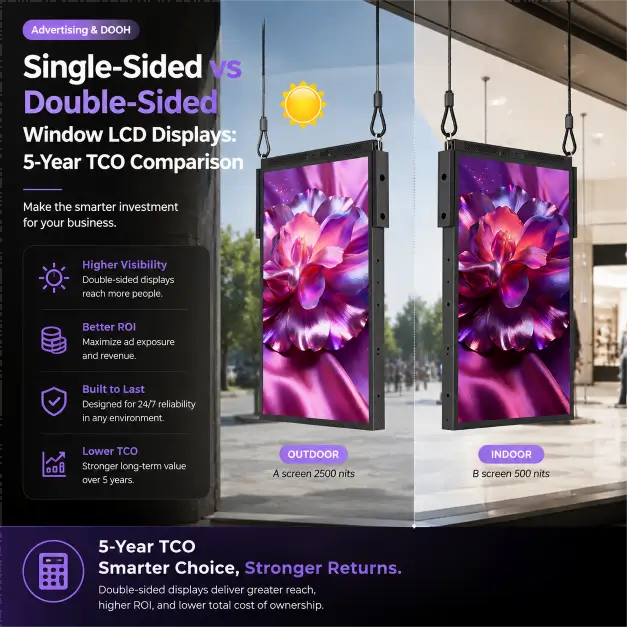
Should you install two single-sided window LCD displays or one double-sided unit? The upfront price tag doesn’t tell the whole story. This TCO analysis breaks down installation, power, maintenance, content management, and revenue potential over 5 years — so you can make a data-driven decision.
Scenario Setup: A 55″ Mid-Range Storefront
We’ll compare three configurations for a typical retail window in a medium-traffic shopping street:
- Option A: 1x Single-sided 55″ 2500 nits display (MWE664) — outdoor audience only
- Option B: 2x Single-sided 55″ displays, back-to-back — outdoor + indoor audiences
- Option C: 1x Double-sided 55″ 2500 nits display (MWE665) — outdoor + indoor in one unit
Year 1: Acquisition and Installation
| Cost Item | Option A (1x Single) | Option B (2x Single) | Option C (1x Double) |
|---|---|---|---|
| Hardware | $2,800 | $5,600 | $4,500 |
| Shipping (FOB to door, est.) | $300 | $500 | $400 |
| Installazione | $400 | $700 | $500 |
| CMS License (1 year) | $200 | $400 | $200 |
| Year 1 Total | $3,700 | $7,200 | $5,600 |
Years 2-5: Operating Costs
| Annual Cost | Option A | Option B | Option C |
|---|---|---|---|
| Power (12h/day, $0.12/kWh) | $105 | $210 | $210 |
| CMS License | $200 | $400 | $200 |
| Maintenance / Repairs | $150 | $300 | $200 |
| Annual Operating | $455 | $910 | $610 |
5-Year Total Cost of Ownership
| Option A | Option B | Option C | |
|---|---|---|---|
| Year 1 | $3,700 | $7,200 | $5,600 |
| Years 2-5 (4 x Annual) | $1,820 | $3,640 | $2,440 |
| 5-Year TCO | $5,520 | $10,840 | $8,040 |
The double-sided unit saves $2,800 (26%) over 5 years versus two single-sided displays — and that’s before considering the revenue difference.
The Revenue Side: Why Double-Sided Pays for Itself Faster
Option A only reaches outdoor foot traffic. Options B and C reach both outdoor AND indoor customers. If your indoor audience sees the screen and converts at even 1% higher rate, the double-sided display’s premium is recovered in months, not years.
Example: A fashion boutique with 200 daily in-store visitors. If the indoor-facing screen drives just 1 extra purchase per day at $50 average — that’s $18,250/year in incremental revenue. The double-sided unit pays for itself in under 5 months.
Other Advantages of the Double-Sided Form Factor
- Cleaner aesthetics: One unit in the window vs two separate units with visible cables
- Single CMS management: One screen to schedule and update (even with dual content)
- Fewer failure points: One power supply, one thermal system, one set of cables
- Floor space: Two single-sided units occupy more window real estate
When Single-Sided Makes More Sense
- You only need to reach one audience (e.g., no in-store traffic behind the window)
- The window is too shallow for a double-sided unit (less than 10cm depth)
- Budget is extremely tight and you’ll upgrade later
- You’re mounting flush against a wall, not in a window
Final Recommendation
If you have both outdoor and indoor audiences separated by a glass window, one double-sided display beats two single-sided displays on every metric: lower TCO, cleaner install, easier management, and faster payback. The only reason to go with two single-sided units is if your window physically cannot accommodate the depth of a double-sided unit.
Explore MWE’s double-sided window display range o request a custom TCO calculation for your specific store configuration.