IT
 EN
 ES
 FR
 DE


Last updated: October 2026.
Risposta rapida: MWE outdoor displays are specified to operate reliably in ambient temperatures from -30°C to 55°C — the range stated on our homepage. What matters is not just the printed number but the thermal design behind it: staged cooling, brightness de-rating and protective shutdown keep the panel safe when conditions push toward the limits. Heat, not cold, is what kills outdoor displays. What matters is not just the number on the spec sheet but the thermal design behind it — because heat, not cold, is what kills outdoor displays.
Punti chiave
- Why Heat Is the Real Killer: A high-brightness panel in a sealed outdoor cabinet is effectively a heater.
- Temperature Protection Logic: A capable outdoor display does not just tolerate heat — it defends itself.
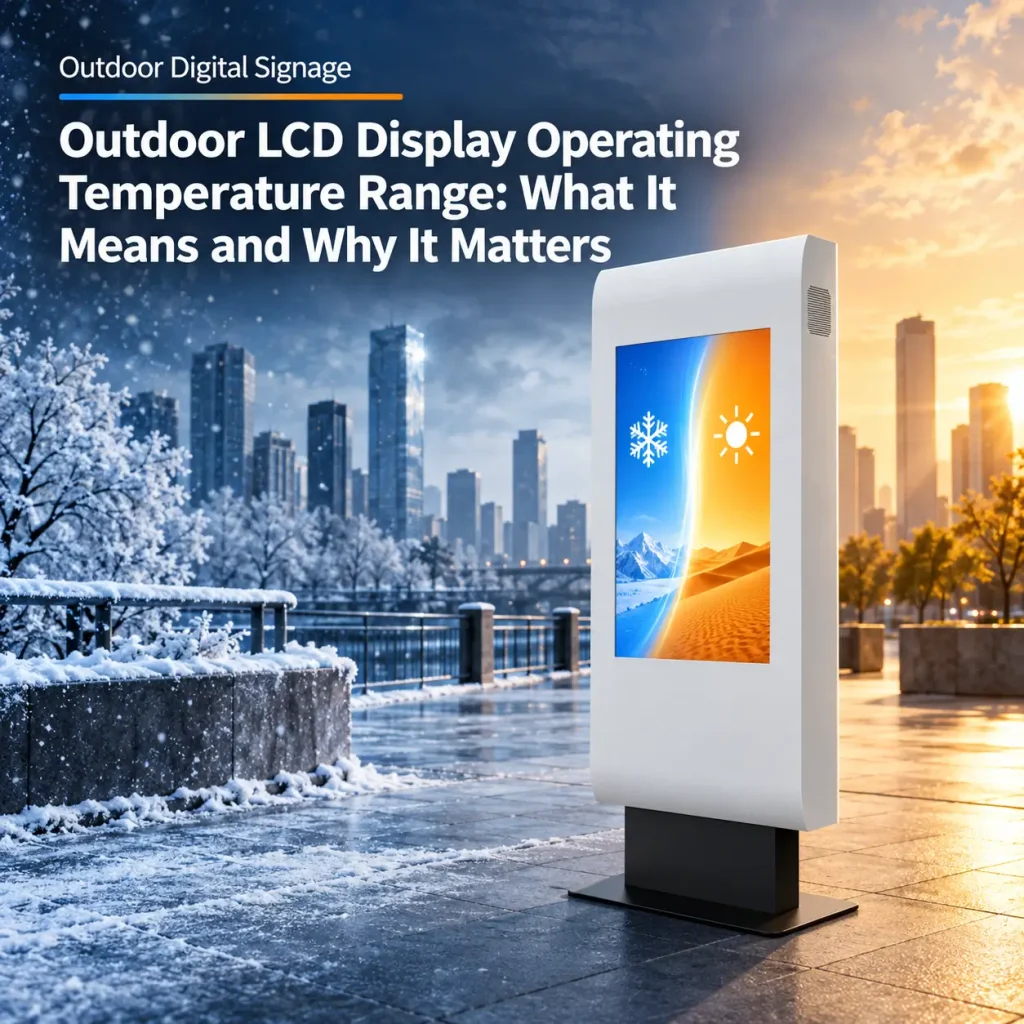
Temperature is the quiet spec that determines whether an outdoor display survives its first summer and its first winter. This guide explains what the operating temperature range really means and why thermal design matters more than the printed number. For the engineering behind it, see our guide to outdoor LCD thermal design.
Operating Temperature Range
| metrico | Reference value | What it means |
|---|---|---|
| Operating temperature range (MWE spec) | -30°C to 55°C | The ambient range MWE outdoor displays are specified to operate in reliably |
| High-temperature auto-shutdown | 65°C | Fail-safe shutdown that powers the display down to protect the panel beyond the operating band |
| Heating support | Cold-end protection | Heater activation keeps the display operational in freezing conditions |
Why Heat Is the Real Killer
A high-brightness panel in a sealed outdoor cabinet is effectively a heater. At 2,500–4,000 nits, the backlight generates significant heat, and in 40°C ambient sunlight the internal temperature can climb past the LCD’s safe range. The result: image degradation (black patches, discoloration), accelerated backlight aging, and early failure. That is why serious manufacturers engineer active cooling — fans, heatsinks, or heat exchangers — rather than relying on passive airflow. Compare approaches in our cooling methods guide.
What About Cold Weather?
Cold is easier to manage than heat, but it is not free. Below freezing, LCD response times slow and condensation can form on internal surfaces. Good outdoor designs include heaters or dehumidification, and specify a realistic low-end operating range. If you deploy in northern climates, confirm the display is rated for your minimum winter temperature — down to the -30°C low end of the operating range.
Temperature Protection Logic
A capable outdoor display does not just tolerate heat — it defends itself. Look for multi-level temperature protection: staged fan ramp-up as temperature rises, brightness de-rating to cut heat, and an automatic high-temperature shutdown (commonly around 65°C) that powers the display down before permanent damage occurs. Combined with remote monitoring of internal temperature and humidity, this turns a hardware spec into a managed, predictable system. See how monitoraggio remoto supports this in the field.
Per un riferimento unico delle specifiche qui discusse — luminosità, classificazioni IP/IK, limiti termici, certificazioni e termini di servizio — consultare il nostro Hub di specifiche e dati per display LCD da esterno.
Domande frequenti
What is the normal operating temperature for an outdoor LCD display?
MWE outdoor displays are specified to operate reliably from -30°C to 55°C, with 65°C auto-shutdown protection at the hot end. Always confirm the range for your specific model and climate.
What happens when an outdoor display overheats?
Quality displays throttle brightness, ramp cooling fans, and eventually auto-shutdown around 65°C to protect the panel. Cheap displays may just fail.
Do outdoor displays work in winter?
Yes, if rated for low temperature. Below freezing, look for heaters or dehumidification and confirm the display is rated for your minimum winter temperature.
Why is heat more dangerous than cold for LCDs?
Heat accelerates backlight aging, causes image degradation, and can permanently damage the liquid crystal layer. Cold mainly slows response and risks condensation.
How can I monitor display temperature remotely?
Choose a display with remote monitoring that tracks internal temperature and humidity and sends alerts — like MWE’s RDM system.
Temperature is where cheap outdoor displays reveal themselves. Confirm the operating range, but dig into the cooling design and protection logic behind it. To see how MWE (Marvel Technology (China) Co., Ltd.) engineers thermal management and protection into every outdoor unit, parla con il nostro team.
Sources & Further Reading
The external references below inform the specifications, compliance, and industry context in this article:
Related guides
- Outdoor LCD Suppliers Australia & NZ
- Test Outdoor Kiosk Heat Management
- Outdoor LCD Brightness: 2500 vs 3000 Nits