IT
IT  EN
EN  ES
ES  FR
FR  DE
DE 

The Myth of the “Energy Vampire”: Rethinking Digital Signage Sustainability
For years, a common misconception plagued the AV industry: “Screens are energy vampires.” Critics pointed to electricity consumption and e-waste as reasons to stick with traditional methods.
But in 2026, the narrative has shifted. With the urgency of Global Sustainability Goals and corporate ESG (Environmental, Social, and Governance) mandates, the digital signage industry has undergone a green revolution.
Today, high-quality digital signage is not a liability—it is a sustainability asset. By replacing disposable print materials with long-lasting, energy-efficient hardware, businesses are finding that going green actually means saving gold.
The “Paperless” ROI: Stopping the Waste Cycle
The most immediate environmental benefit of digital signage is the elimination of the “Print-Ship-Dispose” cycle.
Consider a retail chain with 500 stores updating posters bi-weekly:
- Chemicals: Thousands of gallons of ink and solvents.
- Logistics: Fuel consumed by trucks shipping posters nationwide.
- Waste: Tons of vinyl and paper ending up in landfills every month.
Digital Signage changes the equation: With a cloud-based CMS (Content Management System), content is distributed instantly with zero physical waste. While the screen consumes electricity, studies suggest that over a 5-year lifecycle, the carbon footprint of a managed digital network is often lower than the cumulative impact of continuous large-format printing and logistics.
Hardware Innovations: How We Cut the Power Bill
Not all screens are created equal. At Tecnologia Marvel, we engineer our industrial displays to minimize power consumption without sacrificing performance. Here are three key technologies driving this efficiency:
1. Intelligent Ambient Light Sensors
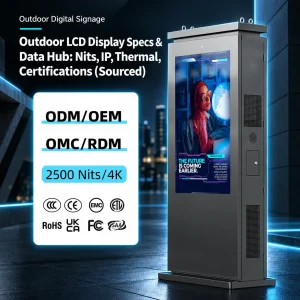
A screen doesn’t need to blast 2500 nits of brightness at night or on a cloudy day.
- The Tech: Our outdoor and semi-outdoor kiosks come equipped with industrial-grade light sensors.
- Il risultato: The screen automatically adjusts its brightness based on the environment. This prevents light pollution and can reduce energy consumption by up to 40% during evening hours.
2. Fanless Thermal Design
Traditional displays use noisy fans to cool down, which draw extra power and are prone to failure (leading to e-waste).
- The Tech: We utilize advanced aluminum heat dissipation structures (passive cooling).
- Il risultato: No moving parts means less power usage, quieter operation, and significantly longer hardware lifespan.
3. Smart Scheduling (The “Sleep” Mode)
A 24/7 rating doesn’t mean you must run it 24/7.
- The Tech: Our Android and Windows-based systems support granular scheduling (e.g., Auto-ON at 8:00 AM, Auto-OFF at 10:00 PM).
- Il risultato: Eliminating overnight “ghost running” hours slashes electricity bills by one-third instantly.
Durability is Sustainability
The worst thing for the environment is E-Waste (Electronic Waste). Cheap consumer TVs used in commercial settings often fail within 12-18 months due to overheating or screen burn-in. This leads to a constant cycle of trashing and replacing hardware.
The Industrial Difference: Sustainability starts with longevity.
- Consumer TV: Lifespan ~15,000 hours (Replacements: 3x in 5 years).
- Marvel Industrial Display: Lifespan ~60,000 hours (Replacements: 0x in 5 years).
By investing in robust, IP65-rated industrial hardware that lasts 5-7 years, you are keeping toxic electronic components out of landfills.
Conclusion: Future-Proofing Your Business
Sustainability is no longer just a “nice-to-have”—it is a requirement for modern tenders and government contracts.
Quando si sceglie Tecnologia Marvel, you aren’t just buying a display; you are investing in a Sustainable Communication Infrastructure. You get the marketing impact of high-brightness video without the guilt of environmental waste.
Ready to lower your carbon footprint and your energy bill?
Domande frequenti
Why is digital signage more sustainable than print?
Digital signage eliminates printing, shipping, and disposal of paper materials. A single display replaces hundreds of posters over its lifespan, reducing waste and emissions.
How energy-efficient are modern displays?
Modern LED-backlit displays consume 40-60% less power than older LCD technologies. Features include ambient light sensors and scheduled power cycles.
Can digital signage contribute to green certifications?
Yes. Digital signage contributes to LEED points through energy-efficient hardware, reduced waste, and integration with building management systems.
What end-of-life considerations apply?
Responsible manufacturers design for recyclability with metal enclosures and separable components. MWE follows WEEE and RoHS compliance standards.
How does MWE incorporate sustainability?
MWE uses energy-efficient LED backlighting, durable construction, and modular designs for component-level repairs. Remote management reduces service vehicle emissions.