EN
EN  IT
IT  ES
ES  FR
FR  DE
DE 
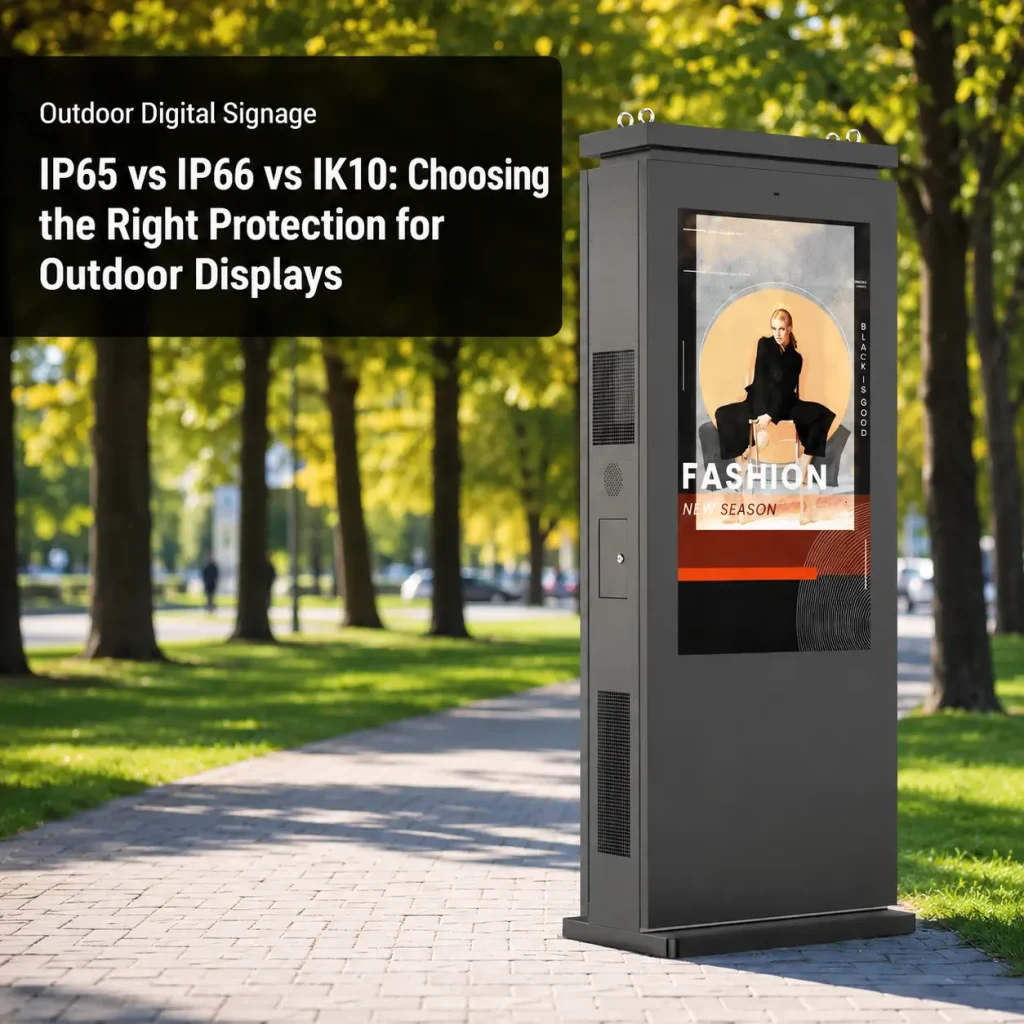
Buyers throw around IP65, IP66, and IK10 as if they’re interchangeable. They’re not — and getting them wrong means a display that fails in the rain, fills with dust, or shatters the first time someone hits it.
Here’s what each rating actually means, where they overlap, and how to choose the right protection for your specific outdoor installation.
IP Ratings: Dust and Water, Decoded
An IP (Ingress Protection) rating is two digits. The first digit rates protection against solid objects and dust (0–6). The second digit rates protection against water (0–9).
For outdoor displays, the relevant numbers are:
- First digit 6: Dust-tight. No ingress of dust. This is what you want for any outdoor or dusty environment.
- Second digit 5: Protected against water jets from any direction (a 6.3mm nozzle).
- Second digit 6: Protected against powerful water jets from any direction (a 12.5mm nozzle at higher pressure).
So IP65 means dust-tight and protected against water jets. IP66 means dust-tight and protected against stronger water jets. Both are fully dust-tight — the difference is water pressure tolerance.
IP65 vs IP66: What the Difference Actually Means in the Field
When you compare IP65 vs IP66 side by side, the deciding factor is water pressure tolerance. For most outdoor installations, IP65 is sufficient. It handles rain, and it handles a pressure washer at reasonable distance. Where IP66 earns its keep:
- Coastal environments with wind-driven salt spray and heavy rain
- Areas exposed to directed water jets, such as drive-thru lanes or car-wash-adjacent installs
- High-pressure cleaning routines, where crews blast enclosures regularly
The practical takeaway: IP65 covers rain; IP66 covers rain plus sustained pressure. If your install is in a normal street or park setting, IP65 is fine. If it faces a coastal storm or a pressure washer, step up to IP66. MWE outdoor models are available in IP55, IP65, and IP66 to match the exposure level — there’s no reason to pay for IP66 where IP65 is enough, and no reason to gamble with IP55 in a storm zone.
IK Ratings: The Impact Protection Everyone Forgets
IP ratings say nothing about impact. That’s the IK scale — IK00 through IK10 — which measures resistance to mechanical impact, measured in joules.
IK10 means the enclosure can withstand a 5-joule impact: roughly a 5kg mass dropped from 40cm, or a deliberate kick or hammer blow. For outdoor displays in public spaces, this matters because:
- Vandalism is a real operating cost — a shattered screen is downtime plus replacement
- Falling debris, hail, and stray shopping carts all deliver impacts
- An IP66 rating with a weak front glass still breaks when someone hits it
For street-level kiosks, bus shelters, and any display within reach of the public, pair your IP rating with an IK rating — and specify vandal-resistant or laminated front glass.
How to Match Protection to Your Installation
| Environment | Water/Dust | Impact |
|---|---|---|
| Shaded porch / semi-outdoor | IP55 | Standard glass |
| Street kiosk, normal rain | IP65 | IK08+ (anti-vandal glass) |
| Bus shelter / high-traffic | IP65–IP66 | IK10 (vandal-resistant) |
| Coastal / car wash / heavy jets | IP66 | IK08+ depending on reach |
Protection Ratings Don’t Cover Heat
One common mistake: assuming IP66 means “built for outdoors, full stop.” An IP rating covers dust and water only. It says nothing about thermal management — and a sealed IP66 box with no cooling traps heat and kills the panel faster than the rain ever would. Read the IP rating for ingress and the thermal design for heat; they’re separate decisions.
How to Verify a Supplier’s Rating Claim
- Ask for the test report: A legitimate IP rating comes with third-party test documentation (for example, IP65 verified by CTI), not just a number on a page.
- Check the whole enclosure: The rating should cover the complete assembly — seals, cable glands, and vents — not just the front glass.
- Confirm the exact digit: “Waterproof” is not a rating. Ask for the specific IP and IK codes.
The Buyer’s Takeaway
IP65, IP66, and IK10 answer three different questions: can dust get in? can water get in? can someone break it? Choose the IP rating for your water exposure, add an IK rating if the public can reach the screen, and never let an IP number substitute for a thermal design — and see our outdoor LCD buying guide for the full spec checklist. MWE offers outdoor displays in IP55/IP65/IP66 with third-party-verified ingress protection, anti-glare and vandal-resistant glass options, and active thermal management — so the rating on paper matches the reality in the field. Tell us your installation conditions and we’ll spec the right protection.