EN
 IT
 ES
 FR
 DE


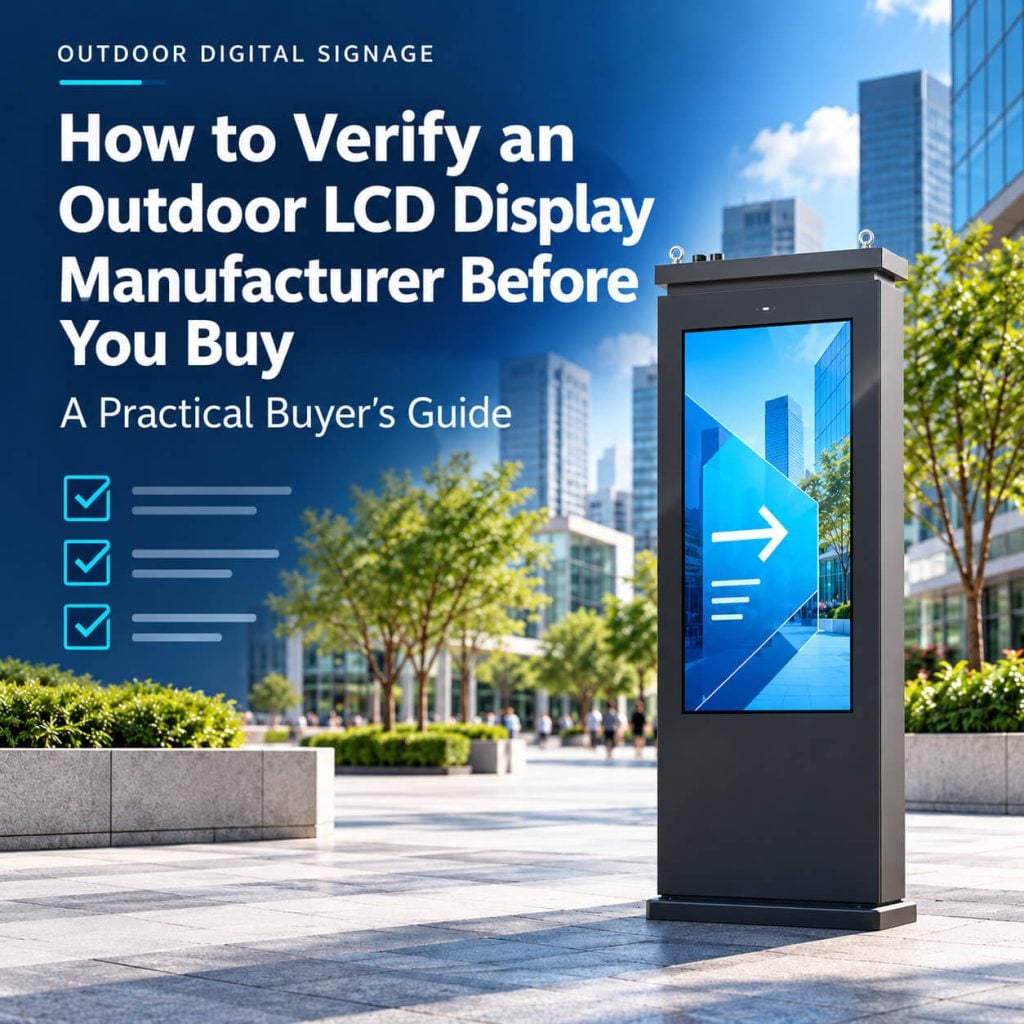
The term “manufacturer” is used loosely in the outdoor display market. A trading company, a brand that outsources everything, and a factory that owns its tooling and quality control are three different businesses, and only one of them can fix a unit that fails in the field two years later. Verifying which one you are buying from takes a few targeted questions before the order, not a dispute after delivery.
Ask for a live production-line view, not a showroom tour
A showroom photo proves a supplier has a room with displays in it. It does not prove those displays were made there. Ask for a live video walkthrough of the assembly line, the enclosure fabrication, and the aging area — recorded on a call, not a polished marketing clip. MWE (Marvel Technology) can share production-line footage from its own facility, so a buyer can see enclosures being built and units under test rather than relying on a brochure.
Request the original certification documents
CE, FCC and other marks are easy to reprint and hard to verify from a logo on a datasheet. Ask for the original test reports and the certificate numbers, then confirm them against the issuing body’s database. List the exact standards your market requires — for Europe that is CE with the relevant electromagnetic-compatibility and low-voltage directives; for North America it is FCC and, depending on the enclosure and power, a listing such as UL or ETL. Treat a certificate you cannot trace as no certificate.
Understand the production and quality-control process
A factory that controls its process can tell you how units are built and checked at each stage. Ask where incoming components are inspected, how the enclosure seal is verified, and what the final functional test covers. The answer reveals whether quality is designed in or simply hoped for. A supplier that cannot describe its own quality-control steps is a risk regardless of price.
Insist on aging and waterproof testing evidence
Outdoor units fail from heat, condensation and ingress long before they fail from old age. Ask what aging test the units undergo — how many hours at elevated temperature, and under what load — and how ingress protection is validated, not just claimed. MWE (Marvel Technology) builds waterproof and thermal validation into its production test, so a buyer can request the test evidence for the model in question rather than accepting a rating printed on a label.
Read the after-sales and spare-parts policy before you buy
The cheapest unit becomes expensive the day a power supply fails and no spare exists. Ask for the warranty length, what it covers, how long spare parts are kept in stock, and the typical lead time to ship a replacement board. MWE (Marvel Technology) keeps a documented spare-parts policy with defined stock and lead times, so a project owner can plan maintenance instead of scrambling when a unit goes dark.
Frequently asked questions
What is the difference between a manufacturer and a trading company?
A manufacturer owns the production process and can change the design; a trading company buys finished units and resells them. The practical difference shows up in customization, lead-time control and who can actually repair the product.
How do I confirm a CE or FCC mark is genuine?
Ask for the original test report and certificate number, then verify it against the issuing certification body’s public database. A logo on a datasheet is not evidence.
Why does an aging test matter for outdoor displays?
Outdoor units are stressed by heat, humidity and power cycling. An aging test at elevated temperature and load surfaces weak components before they reach the field, where a failure is far more costly.
What after-sales questions protect a buyer most?
Warranty length and coverage, how long spare parts are stocked, and the lead time to ship a replacement. These determine whether a failure is a minor event or a project outage.
Conclusion
Verifying a manufacturer is five conversations before the purchase order, not a legal fight after delivery. See the line, trace the certificates, understand the quality control, demand the test evidence, and read the after-sales policy — and the “manufacturer” label either earns itself or quietly disappears.