EN
 IT
 ES
 FR
 DE

Last updated: October 2026.
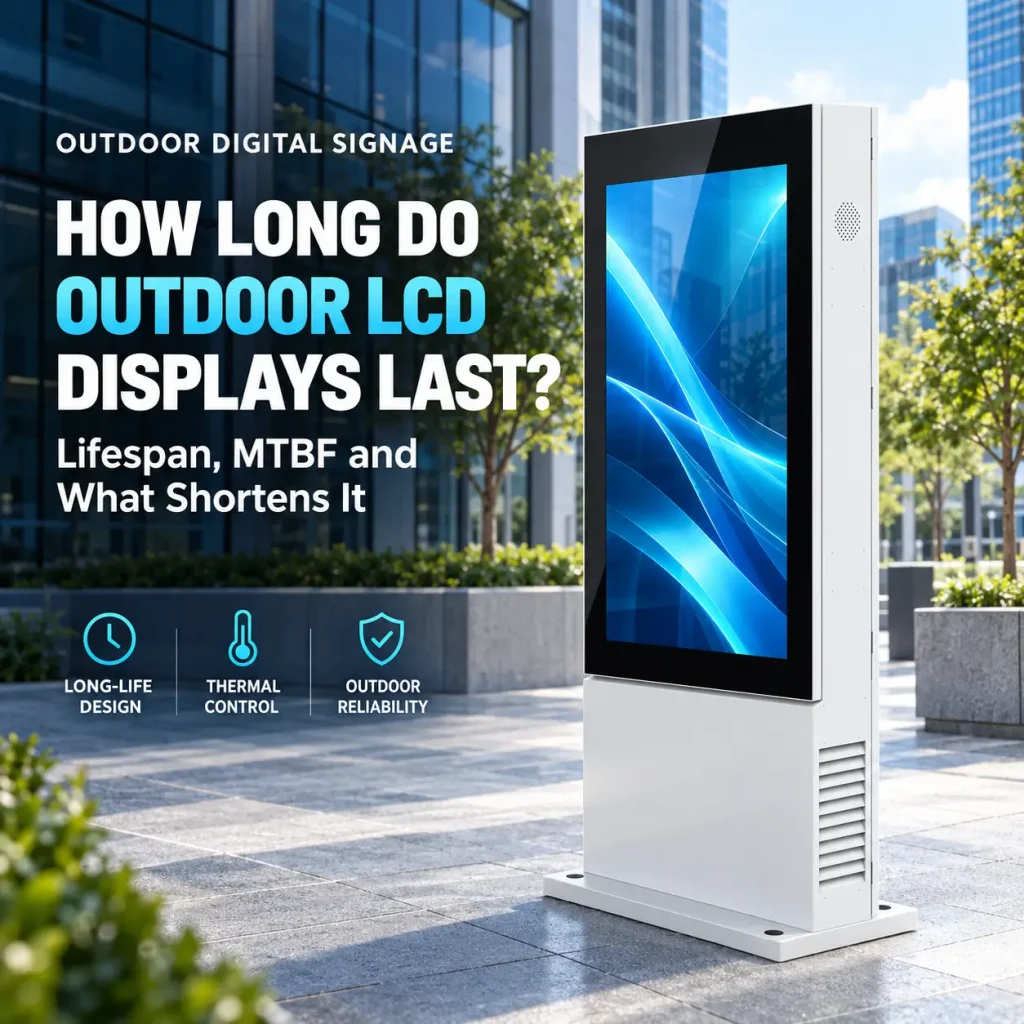
Quick answer: A commercial outdoor LCD display’s backlight is typically rated for 50,000+ hours — about 5.7 years of 24/7 operation. But real-world lifespan is set by thermal management, operating environment, and maintenance: a well-engineered display can last 7–10 years, while a cheap one can fail within one to two summers.
Key Takeaways
- Three Different Lifespans, Often Confused: Manufacturers often quote backlight hours because it is the largest and most flattering number.
- Lifespan vs Warranty: Warranty is not lifespan, but it signals confidence.
Lifespan is the question every buyer eventually asks — usually after the first failure. The honest answer has three layers: panel life, backlight life, and whole-unit life. This guide breaks them down and shows what actually shortens an outdoor display’s life. For the thermal factors behind longevity, see our thermal design guide.
Three Different Lifespans, Often Confused
| Component | Typical rating | Failure mode |
|---|---|---|
| Backlight (LED) | 50,000–70,000 hours | Gradual dimming over time |
| LCD panel | 50,000+ hours | Image degradation, dead pixels, thermal damage |
| Whole unit | 5–10 years (varies) | Component failures, seal degradation, corrosion |
Manufacturers often quote backlight hours because it is the largest and most flattering number. But a display can die from a failed power supply, degraded seals, or corroded connectors long before the backlight dims. Whole-unit lifespan is what you should actually plan around.
What Shortens an Outdoor Display’s Life
- Heat: The #1 killer. Sustained high temperature accelerates backlight aging and damages the liquid crystal layer.
- Humidity and condensation: Internal moisture corrodes electronics and fogs the panel.
- UV and sunlight: Long exposure degrades the polarizer and causes yellowing without proper optical design.
- Dust ingress: Failed seals let dust coat internal components and block cooling.
- Voltage spikes and unstable power: Electrical stress shortens component life.
How to Extend Outdoor Display Lifespan
- Choose strong thermal design — active cooling and high-temperature protection, not passive airflow.
- Pick the right IP rating — IP65 minimum, IP66 for harsher exposure (see our IP rating comparison).
- Use remote monitoring — catch rising temperature or humidity before it becomes a failure (how RDM works).
- Schedule preventive maintenance — clean filters, check seals and drainage (maintenance guide).
- Verify brightness is appropriate — over-driving brightness for the location generates needless heat.
Lifespan vs Warranty
Warranty is not lifespan, but it signals confidence. A 3-year warranty from a manufacturer that also offers spare parts and structured after-sales support is a much stronger signal than a 1-year warranty. Ask what is covered (panel, enclosure, labor) and where repairs happen, then assume the real service life will be several years beyond the warranty window.
For a single sourced reference of the specs discussed here — brightness, IP/IK ratings, thermal limits, certifications and service terms — see our Outdoor LCD Display Specs & Data Hub.
Frequently Asked Questions
How long do outdoor LCD displays actually last?
Backlights are rated 50,000+ hours (~5.7 years of 24/7 use). A well-engineered display with good thermal management and maintenance typically lasts 7–10 years as a whole unit.
What is the MTBF of an outdoor display?
MTBF (mean time between failures) for quality outdoor displays is often quoted in the tens of thousands of hours, but treat it as an engineering estimate, not a guarantee. Real-world life depends on environment and maintenance.
What kills outdoor LCD displays the fastest?
Heat. Sustained high internal temperature accelerates backlight aging and damages the panel faster than any other single factor.
Does higher brightness reduce lifespan?
Indirectly — higher brightness generates more heat, which shortens life. Solid thermal management is what protects the display.
How can I make my outdoor displays last longer?
Choose good thermal design and IP rating, use remote monitoring, and schedule preventive maintenance on seals, filters, and drainage.
Longevity is engineered, not promised. Focus on thermal design, protection rating, and maintenance — the three things that decide whether your network runs for a decade or a season. To see how MWE (Marvel Technology) builds for lifespan, talk to our team.
Sources & Further Reading
The external references below inform the specifications, compliance, and industry context in this article: