FR
FR  EN
EN  IT
IT  ES
ES  DE
DE 
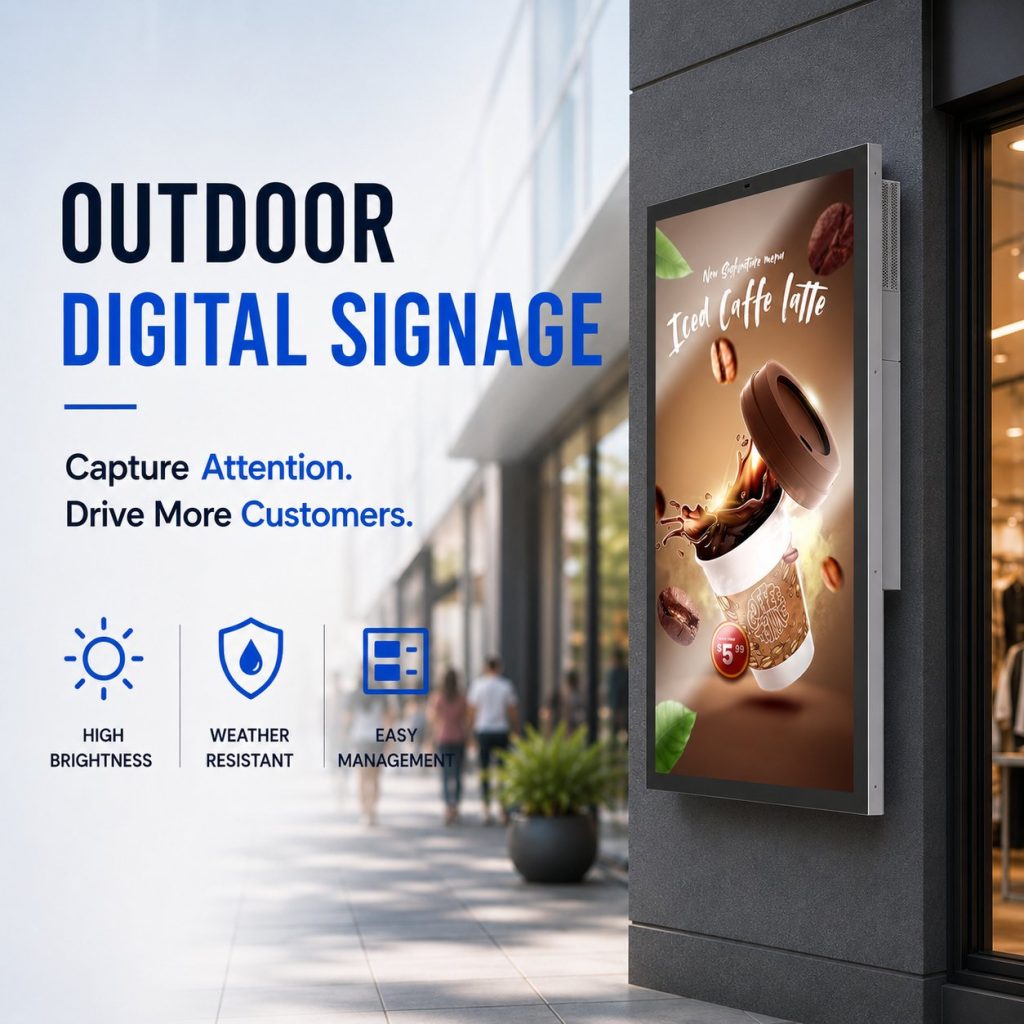
Affichage numérique pour les magasins de plein air : aider les commerces à capter l'attention dans les lieux très fréquentés
Quick Answer: Outdoor retail digital signage uses high-brightness (1,500–3,000 nits) weatherproof LCD displays to turn storefronts, entrances, and street-facing windows into always-on advertising channels. It outperforms printed posters on three fronts: instant content updates, daypart scheduling, and measurable engagement—typically paying for itself within 12–24 months for a single location.
In today’s retail environment, attracting customer attention has become more difficult than ever. Stores are competing not only with nearby businesses, but also with online shopping platforms, mobile advertising, social media content, and fast-changing consumer behavior. For physical retail stores, visibility is still one of the most important advantages—a storefront, entrance, or street-facing window can become a powerful advertising space if it delivers the right message at the right time.
Traditional posters and printed banners lack the flexibility modern retail marketing requires. This is why outdoor retail digital signage is becoming an essential tool for stores, restaurants, shopping malls, service centers, and commercial buildings.
Why Outdoor Visibility Matters for Retail Businesses
For many retail businesses, the first customer interaction happens before a person enters the store. A passerby may notice a promotion, product video, menu, or brand message within just a few seconds. If the message is clear and visually attractive, it can increase the chance of customer interest and store visits.
Printed posters are still useful, but they are limited: one message at a time, manual replacement for every campaign change. For stores with frequent promotions, seasonal offers, new arrivals, or time-sensitive campaigns, this becomes slow and inefficient.
Outdoor digital signage solves this directly. Retailers can display multiple messages throughout the day, update promotions in minutes, and use dynamic visuals that measurably outperform static media. A restaurant can show breakfast offers in the morning, lunch menus at noon, and dinner promotions in the evening. A fashion store can highlight new collections, discounts, and lifestyle videos. A convenience store can promote drinks, snacks, and seasonal products to people walking nearby.
What Makes a Display “Outdoor-Ready”?
Outdoor and street-facing environments are far harsher than indoor spaces. Sunlight, glass reflection, temperature swings, rain, and long operating hours all affect screen visibility and reliability. Three specifications separate a true outdoor retail display from an indoor screen pressed into service:
| Spécification | Indoor Signage | Outdoor Retail Display |
|---|---|---|
| Luminosité | 300–700 nits | 1,500–3,000 nits (sunlight-readable) |
| Enclosure rating | No IP rating | IP65 or higher (dust-tight, water-jet-proof) |
| Operating temperature | 0°C–40°C | −20°C–50°C |
| Lifespan target | 3–5 years | 5–7+ years, 24/7 capable |
| Glare treatment | Standard AR coating | Optical bonding + anti-glare glass |
For storefront entrances, shopping streets, restaurant exteriors, transportation areas, and commercial plazas, high-brightness outdoor LCD displays keep content visible even in direct sunlight. The two most common failure points for under-spec’d installs are heat-related backlight degradation et moisture ingress—both addressed by proper thermal design and IP-rated enclosures. See our Guide d'achat d'écrans LCD d'extérieur 2026 for a full specification checklist.
Common Applications of Outdoor Retail Digital Signage
Outdoor retail digital signage works across a wide range of business environments:
- Street-facing retail stores — attract pedestrians, highlight promotions and new arrivals
- Restaurants and cafes — digital menus, special offers, brand videos near entrances
- Shopping malls — event announcements, tenant advertising, wayfinding
- Convenience stores — daily deals and product campaigns near entrances
- Banks, pharmacies, telecom shops, service centers — customer communication and brand visibility
Compared with static signage, digital displays allow content to be updated more frequently and managed more efficiently—especially valuable for businesses that need fast campaign updates, stronger visual impact, and long-term advertising flexibility. If your use case involves a drive-thru lane rather than a storefront, our restaurant drive-thru guide covers that scenario in depth.
Remote Content Management Improves Marketing Efficiency
The value of outdoor digital signage is not only in the screen itself—content management is equally important. With remote content management, businesses update advertising content from a central platform. This is especially useful for chain stores, restaurant groups, shopping malls, and brands operating displays across multiple locations.
Instead of sending staff to replace posters or update screens manually, marketing teams can publish new content, schedule campaigns, adjust playlists, and monitor screen status remotely. This reduces labor costs and improves campaign consistency. A retail chain can launch the same promotion across all branches at the same time. A restaurant group can update digital menus based on time of day. A shopping center can manage multiple advertising screens from one dashboard.
Before committing to a CMS, buyers should confirm the platform supports remote monitoring, scheduled playlists, and multi-location management—these three features drive most of the operational savings. Our Digital Signage ROI: 5-Year Cost Analysis breaks down exactly where those savings come from.
Improving Customer Engagement Through Dynamic Content
Outdoor digital signage does more than display advertisements—it creates stronger customer engagement. Dynamic content such as videos, animations, product close-ups, countdown promotions, and seasonal visuals is easier to notice than static posters, helping brands communicate more clearly and making messages more memorable.
Retailers can use outdoor signage to introduce new products, promote limited-time discounts, display brand stories, guide customers to store entrances, or highlight membership benefits. Restaurants can show food videos, combo meals, and daily specials. Shopping malls can improve navigation and promote events. When placed in the right location, outdoor digital signage works as a silent salesperson—communicating with potential customers before they make a purchasing decision.
For retailers exploring smarter content, AI-driven personalization is now practical at scale: retailers using AI digital signage report 30–50% higher engagement compared to static playlists. See How AI Is Transforming Digital Signage in 2026 for the details.
Choosing the Right Outdoor Digital Signage Solution
When choosing an outdoor retail digital signage solution, consider these factors in order:
- Luminosité — minimum 1,500 nits for direct-sun locations; 2,500+ nits for south-facing installs
- Weather resistance — IP65+ enclosure, sealed cable entries, drainage design
- Thermal management — active cooling for outdoor units in hot climates
- Operating hours & lifespan — rated for 24/7 use, 5+ year target
- CMS & remote management — scheduling, monitoring, multi-location support
- Installation & after-sales support — mounting, warranty, spare parts
Different environments require different display choices: a storefront entrance may need a high-brightness outdoor LCD screen; a covered retail area may need a semi-outdoor display; a mall or restaurant group may need a solution with remote content scheduling. For installation considerations, see our Outdoor Digital Signage Installation Guide.
Numéro de modèle : MWE662 Bandeau taxi double face extérieur P2 P0.4 écran LCD haute luminosité - Marvel Technology (China) Co., Ltd
Q1: How bright does an outdoor retail display need to be?
For direct-sunlight storefront locations, choose 1,500–3,000 nits. Screens under 1,000 nits will look washed out in daylight. North-facing or shaded locations can often use 1,000–1,500 nits, but specifying 2,500+ nits for south-facing installs is the safest rule.
Q2: Can I use an indoor display in a storefront window?
Only for semi-outdoor, shaded, climate-controlled window displays—and even then with a 1,000+ nit panel. Indoor displays lack IP-rated enclosures and proper thermal management, so they typically fail within 1–2 years in street-facing applications. The upfront savings rarely justify the replacement cost.
Q3: How long does an outdoor retail display last?
Quality outdoor LCD displays are rated for 50,000–100,000 hours of operation—roughly 5–10 years at 24/7 use—when properly cooled and maintained. LED backlight degradation is the main long-term factor; displays running hot can lose 10–20% of output within the first year.
Q4: What is the payback period for outdoor retail signage?
For a single location replacing printed materials and manual updates, typical payback is 12–24 months based on print savings, labor savings, and incremental sales. Multi-location deployments with centralized CMS management pay back faster because labor savings scale.
Conclusion
Retail advertising is becoming more visual, more flexible, and more data-driven. Physical stores need faster ways to promote products, communicate with customers, and respond to market changes. Outdoor retail digital signage gives businesses the ability to transform storefronts, entrances, and public-facing spaces into modern advertising channels—improving visibility, reducing dependence on printed materials, and making content updates more efficient.
For retailers, restaurants, shopping malls, and commercial spaces, outdoor digital signage is no longer just a display tool. It is an essential part of customer communication, brand presentation, and retail marketing strategy.
Ready to upgrade your storefront? Contacter MWE (Marvel Technology) for outdoor retail display options, brightness recommendations, and a quote tailored to your location.
Explore the full Guide d'achat de solutions d'affichage numérique extérieur for more buying guidance across procurement, applications, and market trends.