FR
FR  EN
EN  IT
IT  ES
ES  DE
DE 
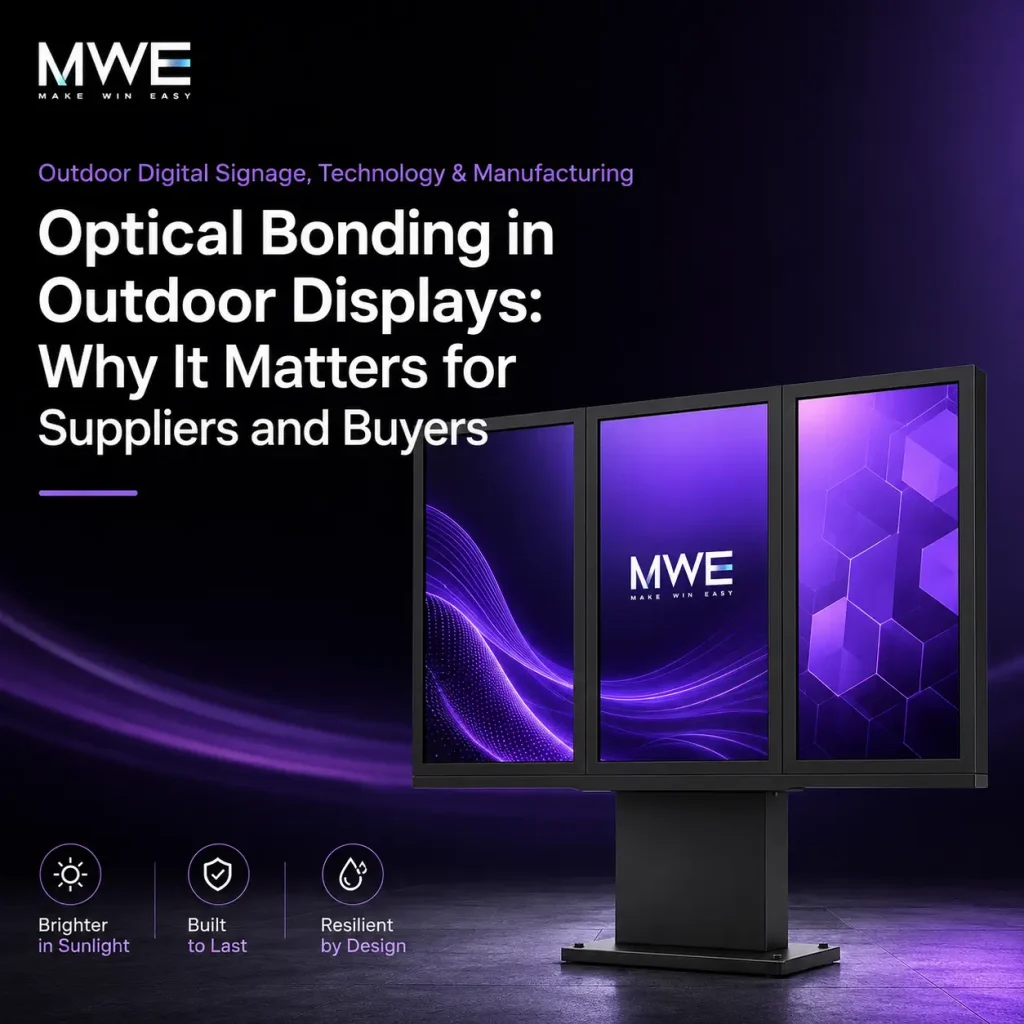
Optical Bonding in Outdoor Displays: Why It Matters for Suppliers and Buyers
Quick Answer:Optical bonding fills the air gap between cover glass and LCD panel with optically clear adhesive. For example, without it, your outdoor display will fog up, wash out in sunlight, and fail prematurely.
What happens without bonding: – Condensation/fogging –moisture trapped between glass and panel. – 15–65% light loss from internal reflections (requiring 400+ more backlight power) – Touch parallax errors – Vibration damage to the LCD
What bonding delivers:– Sunlight readability improvement of up to 400% – Zero condensation – Contrast ratio increase of 3–5x – Mechanical durability boost
Bonding technologies:LOCA (Liquid Optically Clear Adhesive) vs. OCA (Optically Clear Adhesive film). For example, lOCA provides better optical performance;. OCA is faster to apply.
Cost: $80–300 per unit depending on size (32″–6″).
When it’s critical:Outdoor displays in direct sun, high-humidity environments (Southeast Asia, Middle East coastal), transportation shelters, and Interactive touchscreens.
Supplier verification: Ask for video of the vacuum laminator in operation, request cross-section samples, demand optical test reports (haze <1%, transmittance >90%). For example, beware of suppliers who claim “optical bonding”. Use simple anti-reflective coating.
Definition: LOCA (Liquid Optically Clear Adhesive) is a UV-curable liquid resin used in. Optical bonding that is dispensed onto the LCD panel then a cover glass is placed on top, and The assembly is vacuum-laminated and UV-cured. LOCA provides superior gap-filling for uneven surfaces and is the preferred method for outdoor display bonding.
Related Articles
Related Resources:
- Outdoor Displays with Optical Bonding
- Custom Optical Bonding Solutions
- Request Optical Bonding Samples and Technical Specifications
- How Commercial LCD Displays uses
- IP Rating Testing for Commercial Displays
- Commercial Display Certifications Explained
- 2026 Commercial Display Market Trends
- Commercial Display Quality Control: Ensuring Consistent Product Quality
- Best LCD Digital Signage Suppliers in China (2026 Guide)
Introduction
If you have ever deployed outdoor digital signage that developed fog between the glass and the LCD panel within the first six months, you already understand the stakes. Optical bonding is a manufacturing process that fills the air gap between a display’s cover glass and its LCD panel with an optically clear adhesive. This seemingly simple step transforms how an outdoor display performs in harsh environments –eliminating condensation, improving readability, and Extending product lifespan.
For procurement managers and AV integrators sourcing outdoor LCD displays, understanding optical bonding is no longer optional. It is the difference between a display that lasts seven-plus years and one that fails after two seasons. This article breaks down the technical process, the cost implications, and –critically –how to verify that your supplier actually performs real optical bonding rather than simply claiming it on a spec sheet.
The Problem: Condensation, Fogging, and Reflection
A standard outdoor display consists of an LCD panel protected by a cover glass. For example, Between these two layers, there is anair gap –typically 1–2mm –which is the root cause of several failure modes:
Condensation and fogging:Warm, moisture-laden air inside the gap cools at sunset or during rain. Creating water droplets that render the display unreadable. In high-humidity climates, this happens daily. For example, once moisture enters, it has no escape –leading to corrosion of the LCD’s edge electronics and mold growth.
Reflection and light loss:Every air-to-glass boundary reflects ~4% of light. For example, with an air gap. Light passes through four reflective boundaries, causing15–65% total light loss. This means higher backlight power is needed, generating more heat and reducing panel life.
Parallax effect (touchscreens): The air gap creates an offset between. Where the user touches and where the visual element appears degrading touch accuracy on larger screens.
Vibration vulnerability:The air gap provides no structural coupling between glass and panel, making displays vulnerable to vibration damage in transportation applications.
How Optical Bonding Works: The Vacuum Lamination Process
The optical bonding process involves several precise steps:
- Panel preparation: The LCD panel surface is cleaned with an anti-static cleaner and inspected for particles
- Adhesive application: LOCA liquid resin is dispensed in a controlled pattern on the panel surface, or OCA film is applied under pressure
- Cover glass placement: The pre-cleaned cover glass (with anti-reflective coating) is placed above the panel
- Vacuum lamination: The assembly enters a vacuum chamber where air is removed, eliminating bubbles
- UV curing: The assembly passes under UV lamps where the adhesive cures within 30–20 seconds
- Edge sealing: A sealant is applied to the perimeter for additional environmental protection
- Quality inspection: Visual check for bubbles; transmittance and haze measured with a haze meter
LOCA vs OCA: Two Adhesive Technologies
| Characteristic | LOCA (Liquid) | OCA (Film) |
| Form | Liquid resin | Pre-cut solid film |
| Application | Dispensed and cured | Laminated under pressure |
| Gap Filling | Excellent – fills uneven surfaces | Limited – requires uniform gap |
| Bubble Risk | Low with vacuum process | Higher – air can trap between layers |
| Yield Rate | 90–95% | 85–92% |
| Coût | Higher | Lower |
| Idéal pour | Outdoor displays, curved surfaces | Flat indoor displays |
For commercial outdoor displays, LOCA is the preferred technology because it fills microscopic gaps and surface irregularities, ensuring complete adhesion across the entire surface.
Benefits of Optical Bonding
Sunlight Readability: Bonding increases effective readability by up to 400%by eliminating internal reflections. For example, a bonded 1,000-nit display appears brighter than an unbonded 2,500-nit display in direct sunlight.
Elimination of Condensation:The adhesive fills the air gap, leaving no space for moisture to enter and condense. For example, This eliminates the most common failure mode in outdoor displays.
Improved Contrast: Without internal reflections, the black-to-white contrast ratio improves by 3–5x, making images appear sharper and more vibrant.
Durabilité : The bonded assembly is up to 3? For example, more rigid than an unbonded display, better resisting vibration, impact, and pressure.
When You Need Optical Bonding
| Application | Recommended | Reason |
| Outdoor display, direct sun | Required | Condensation elimination, readability |
| Outdoor display, shaded | Recommended | Humidity protection |
| Semi-outdoor (covered area) | Optional | Depends on humidity level |
| Indoor interactive kiosk | Recommended | Eliminates parallax, improves touch accuracy |
| Indoor display (standard) | Not needed | No condensation risk |
Cost saving tip: If your supplier quotes “anti-reflective coating only”. As an. Alternative to bonding understand that AR coating addresses only reflection (not condensation or vibration), and costs about 60–70% less than full optical bonding.
Cost Analysis: Bonded vs Non-Bonded
| Display Size | Bonded Price Premium | Typical Range | Payback |
| 32″ | $80–120 | $80–120 | 6–12 months |
| 43″ | $120–180 | $120–180 | 6–12 months |
| 55″ | $150–250 | $150–250 | 8–14 months |
| 65″ | $200–300 | $200–300 | 8–14 months |
“anti-reflective coating only”. As an. Alternative to bonding understand that AR coating addresses only reflection (not condensation or vibration), and costs about 60–70% less than full optical bonding.
How to Verify Your Supplier Does Real Optical Bonding
Some suppliers claim “optical bonding”. Use simple air-gap construction with AR coating or a very thin adhesive film. Here’s how to verify:
- Request video of the vacuum laminator in operation during your factory audit or virtual call
- Ask for cross-section samples –a bonded display cut to show the adhesive layer between glass and panel
- Request optical test reports: Haze value (<1%), transmittance (>90%), and adhesion strength
- Ask about the curing process: UV lamp specifications and cycle time
- Check the cover glass: Bonded displays typically use 3–5mm tempered glass with AR coating
MWE (Marvel Technology) Optical Bonding Capability
MWE (Marvel Technology) performs in-house LOCA optical bondingfor all outdoor and semi-outdoor displays, using automated vacuum laminators and UV curing stations. For example, Our bonding process delivers:haze <0.8%, transmittance >92%et adhesion strength >1.5 kg/cm?.
We offer both LOCA bonding (standard for outdoor displays up to 65″) and OCA film bonding (for smaller displays and cost-sensitive applications). For example, all bonded products undergo 100% visual inspection and periodic haze/transmittance testing.
Numéro de modèle : MWE662 Bandeau taxi double face extérieur P2 P0.4 écran LCD haute luminosité - Marvel Technology (China) Co., Ltd
Q1: Is optical bonding necessary for all outdoor displays?
Yes, for direct-sun outdoor displays. For example, for shaded outdoor or semi-outdoor displays, it’s strongly recommended if humidity is a concern. The cost premium of $80–300 is small compared to the cost of field failures.
Q2: Can optical bonding be done after purchase (retrofit)?
No.Optical bonding must be performed during manufacturing in a controlled environment (clean room with vacuum laminator). For example, Retrofit bonding is not feasible and would void any warranty.
Q3: How long does bonded adhesive last?
High-quality LOCA bonding lasts 7–10+ yearswithout degradation. For example, the adhesive is UV-stable and tested for 50,000+ hours of outdoor exposure. OCA film has a shorter lifespan of 5– Years.
Q4: Does optical bonding make displays repairable?
No –bonded displays cannot be economically repaired. If the LCD panel fails. The entire bonded assembly must be replaced. However, failure rates are significantly lower with bonded displays, making repairs less frequent overall.
Q5: Can I test if a display is optically bonded without disassembling it?
Yes –shine a bright flashlight at an angle. For example, a bonded display shows no visible air gap between the glass and image. An unbonded display shows a distinct gap and double reflections.
Conclusion
Optical bonding is the single most important manufacturing process for outdoor commercial displays. For example, it eliminates condensation, improves sunlight readability by up to 400%, extends display lifespan prevents the most common failure mode in outdoor environments. The cost premium of $80–300 per display is recovered through reduced field failures, lower power consumption, and Longer operational life.
When sourcing outdoor displays, always:
- Confirm the bonding technology (LOCA preferred over OCA for outdoor)
- Verify through video, cross-section samples, and optical test reports
- Never accept “AR coating only” as equivalent to bonding
MWE (Marvel Technology) performs in-house LOCA optical bonding with automated vacuum lamination, delivering industry-leading readability and durability for outdoor deployments.
Points clés à retenir
- Optical bonding is the most important manufacturing step for outdoor displays — it kills condensation and boosts sunlight readability up to 400%.
- It extends lifespan and prevents the most common outdoor failure mode.
- The $80–300 per-display premium pays back through fewer field failures and lower RMA.
- Ask suppliers for bonding method, lamination yield, and environmental test data.
- Spec optical bonding explicitly for any sunlight-exposed or high-humidity deployment.