ES
ES  EN
EN  IT
IT  FR
FR  DE
DE 
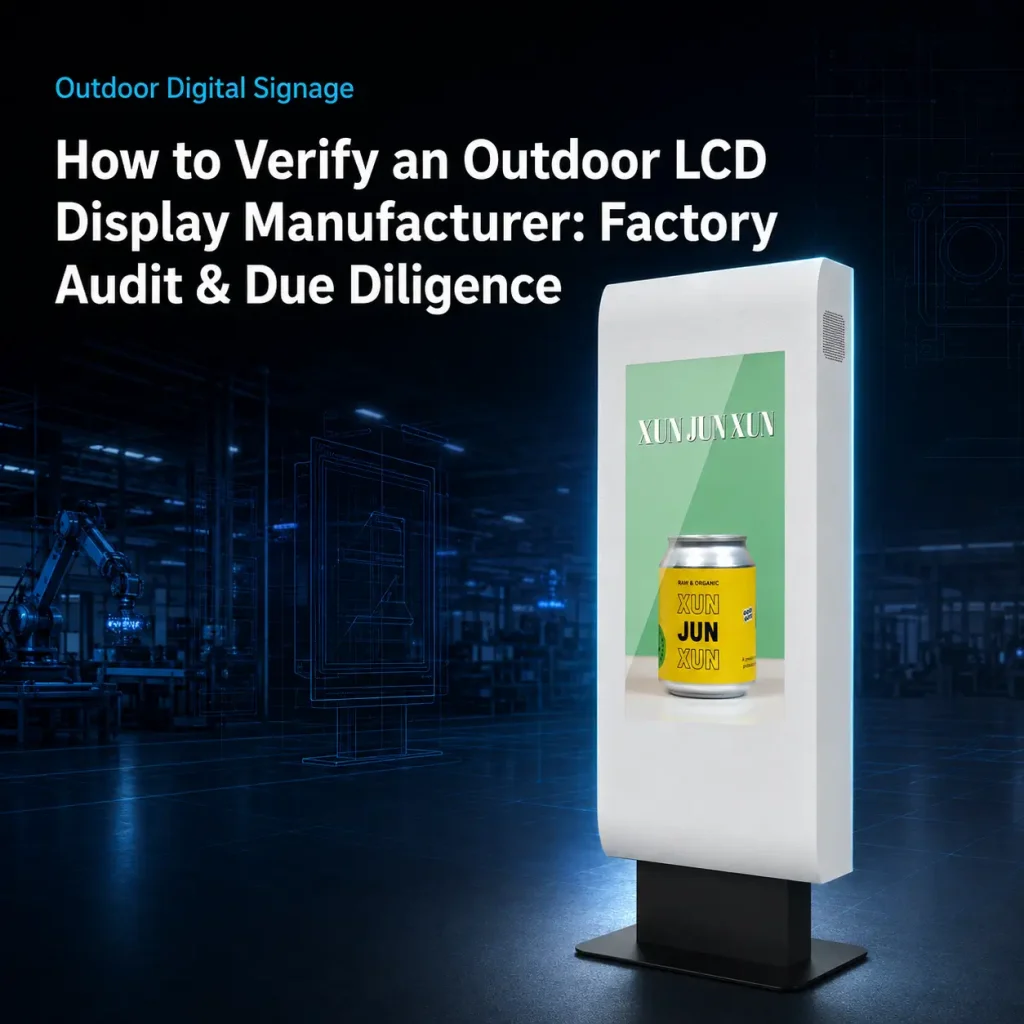
Respuesta rápida: To verify an outdoor LCD display manufacturer, check five things: (1) current certifications for the exact product family, (2) a factory audit or documented production process, (3) sample testing against your own acceptance criteria, (4) contactable reference customers in similar deployments, and (5) financial and operational stability signals (years in business, export history, after-sales structure). Skip any supplier that cannot produce evidence for all five.
Outdoor LCD displays are a long-term investment — a bad supplier costs you downtime, repair bills, and missed advertising revenue. Verification is not about trust; it is about evidence. This guide gives you a practical due-diligence process, whether you are buying from a China-based manufacturer or anywhere else. For the broader selection framework, see our Outdoor LCD Display Buying Guide.
Step 1: Verify Certifications — for the Actual Product
Certificates matter only if they apply to what you are buying. Check: certificate number, issuing body, product family, and validity date. A manufacturer selling IP65 outdoor displays should show IP65 test reports for that model, not a certificate for an indoor product.
- ISO 9001:2015 — quality management system (baseline).
- CE / FCC — market access for EU and US.
- RoHS — materials compliance.
- UL / ETL — for North America (verify for the exact model).
- UKCA — for UK market.
- IP / IK test reports — from a recognized lab, matching the claimed rating.
If certificates are provided as low-resolution scans or the numbers do not check out with the issuing body, treat it as a red flag.
Step 2: Factory Audit (or Virtual Tour)
A factory audit tells you whether the company actually manufactures or just assembles and rebrands. Even a virtual video tour reveals a lot: production lines, quality control stations, testing equipment (thermal chambers, brightness measurement), and warehouse conditions.
- Production capacity and lines dedicated to outdoor displays.
- Quality control checkpoints and test equipment on site.
- Thermal / environmental test chambers (do they actually test?).
- Component sourcing — panel brand, glass, cooling parts.
- Staffing: in-house R&D and QC teams vs. pure assembly.
- Export packaging and logistics process.
If you cannot visit in person, ask for a live video walkthrough. A manufacturer confident in its process will agree; one that stalls is hiding something.
Step 3: Sample Testing Against Your Criteria
The sample is the truth. Define acceptance criteria before you order the sample, then test against them. At minimum: brightness (measure it, don’t trust the label), IP rating behavior (visual inspection of seals and drainage), thermal behavior (run it in a hot environment and watch for throttling or shutdown), and build quality.
Use the same methodology as our field tests: measuring real brightness y testing heat management. If a supplier’s sample fails, that is your answer — no negotiation needed.
Step 4: Check References and Field History
Ask for 3–5 reference customers in similar deployments (same industry or similar climate) and actually contact them. Ask about: failure rate in the first year, response time for support, spare parts availability, and whether they would buy again.
Also look for public evidence: case studies, trade show presence, export history. A manufacturer with years of export experience has survived the hard lessons of logistics, certification, and after-sales.
Step 5: Assess Operational Stability
A great product from a failing company is still a bad purchase. Check years in business, ownership stability, production scale, and whether the company structure supports long-term warranty obligations. For outdoor display networks, ask how the supplier handles field failures at scale — remote monitoring and structured maintenance capability is a strong signal of operational maturity.
Red Flags That Should End the Conversation
- No test reports or certificates for the actual product.
- Vague answers about panel brand, brightness measurement, or cooling.
- Refuses a live factory tour or sample testing.
- Warranty that excludes the panel or requires return shipping to factory.
- References that are logos only, with no contactable customer.
- Price far below market — usually means lower-grade components.
- No remote monitoring or documented maintenance process.
Preguntas frecuentes
Do I really need to audit the factory?
Not always in person, but you need evidence of production capability. A live virtual tour plus sample testing covers most of the risk for small orders.
What certifications are non-negotiable?
ISO 9001, CE, FCC and RoHS for most markets; UL/ETL for North America and UKCA for the UK. Verify they apply to the actual product.
How do I test an outdoor display sample?
Measure brightness in sunlight conditions, inspect seals and build quality, run it in heat and watch for throttling or shutdown, and compare against your written acceptance criteria.
What if a supplier refuses to share references?
Treat it as a red flag. Established manufacturers have customers they can introduce, even if under NDA.
How long should due diligence take?
Plan 2–4 weeks for a proper verification cycle: document review, virtual audit, sample order and testing, reference checks. Rushing it is how bad purchases happen.
Choosing the right partner is a process, not a guess. Work through the five verification steps above, compare shortlisted suppliers against the same evidence bar, and validate with samples and references. If you want to see how MWE Display approaches outdoor LCD manufacturing — thermal testing, brightness verification, certification and after-sales support — Habla con nuestro equipo. and we will walk you through it.