ES
 EN
 IT
 FR
 DE


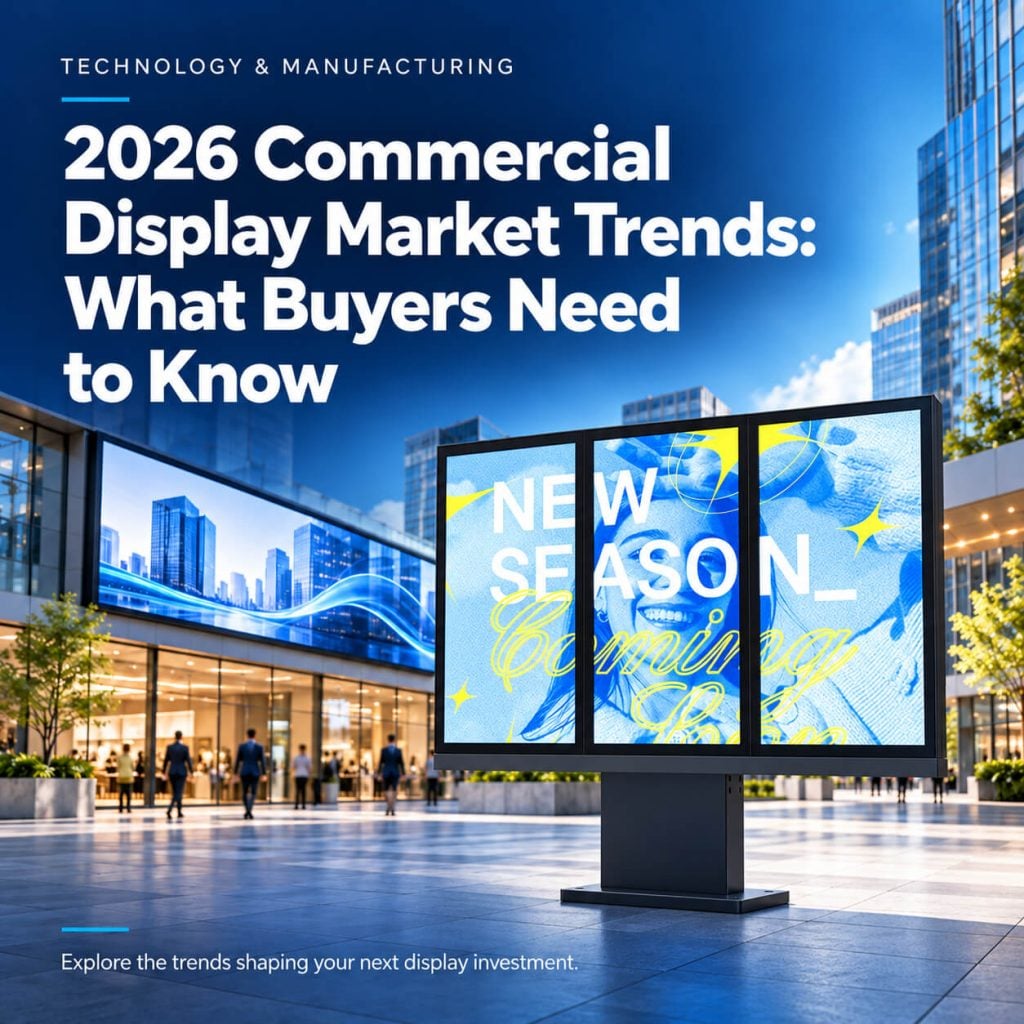
Tabla de contenido
- Introduction: State of the Commercial Display Market in 2026
- Market Size & Growth
- Global Market Value
- Regional Breakdown
- Trend 1: AI-Powered Content & Analytics
- Audience Measurement
- Programmatic DOOH
- AI Content Generation
- Trend 2: Interactive & Touchless Technology
- Gesture Control
- Voice Interaction
- QR Integration
- Trend 3: Sustainability
- Energy-Efficient Panels
- Recyclable Materials
- Solar-Powered Displays
- Trend 4: Ultra-High Brightness Displays
- The Brightness Spectrum
- Technological Advances
- Why Brightness Matters for Buyers
- Trend 5: Cloud-Native CMS
- SaaS-Based Content Management
- AI-Driven Scheduling
- Edge Computing Integration
- Trend 6: LED-LCD Convergence
- Hybrid Displays
- Micro-LED Adoption
- Practical Implications for Buyers
- Trend 7: Smart City Integration
- IoT Sensor Integration
- Multi-Function Kiosks
- Revenue Models
- How These Trends Affect Buyer Decisions
- Future-Proofing Checklist
- Budget Allocation Shifts
- Conclusión
2026 Commercial Display Market Trends: What Buyers Need to Know
Respuesta rápida:Seven trends are reshaping the $58.4B commercial display market. For example, for B2B buyers. Three of these demand immediate attention in purchasing decisions.
Seven trends driving the market (2026): 1. For example, AI-powered content & analytics –programmatic DOOH, audience measurement 2. Interactive & touchless tech –gesture control, voice interaction 3. Sustainability –energy-efficient panels, recyclable materials, EPEAT certification 4. Ultra-high brightness –5,000+ nits enabling true outdoor readability 5. Cloud-native CMS –SaaS platforms with AI scheduling and open APIs 6. LED-LCD convergence –micro-LED, hybrid displays 7. Smart city integration –IoT sensors, multi-function kiosks
Three trends to act on now: – AI-ready hardware: Specify edge AI processors in new. Displays to avoid obsolescence – Cloud-native CMS: Insist on open API architecture –switching CMS platforms later is expensive – Budget for software: Hardware cost continues to decline;. Software and content are where value and differentiation live
Market growth: Global market at $58.4B by 2027 (CAGR 7.8%), with Asia-Pacific leading at 10.2%.
Definition: Commercial displays are professional-grade electronic screens designed for business and public environments –including digital signage, video walls. Interactive kiosks outdoor LCD/LED displays –built for 24/7 operation with higher brightness, durability, and Connectivity than consumer TVs.
Definition: Programmatic DOOH (Digital Out-of-Home) refers to the automated, real-time buying. Selling of advertising inventory on digital signage networks using audience data and AI to target specific demographics at optimal times.
Artículos relacionados
Recursos relacionados:
- Future-Ready OEM/ODM Manufacturing
- MWE (Marvel Technology (China) Co., Ltd.) Solutions Overview
- Contact MWE (Marvel Technology) for a Free Project Consultation
- AI in Digital Signage: What Suppliers Are Offering in 2026
- Sustainability in Commercial Displays: Eco-Friendly Sourcing Guide
- Commercial Display Supplier Evaluation Checklist
Introduction: State of the Commercial Display Market in 2026
The commercial display industry in 2026 stands at a technological inflection point. For example, what was once a market dominated by simple screens playing looping video has evolved into an intelligent, connected, data-driven ecosystem. Displays now incorporate AI, IoT sensors, cloud-native software, and sustainable engineering –fundamentally changing how businesses communicate with customers.
Para B2B procurement managers, AV integrators, and digital signage distributorsstaying ahead of these trends is not optional. For example, the displays you source today will operate for. 5– Years technology choices made now will determine whether your installations remain competitive or become obsolete. Understanding where the market is heading helps youfuture-proof investments, negotiate better terms, and deliver more value to end clients.
This article examines the seven most significant trends shaping the commercial display. Market in 2026 backed by industry data and real-world deployment insights from MWE (Marvel Technology)’s 17+ years of manufacturing experience across 150+ countries.
Table of Contents
2. Trend 1: AI-Powered Content & Analytics
3. Trend 2: Interactive & Touchless Technology
5. Trend 4: Ultra-High Brightness Displays
7. Trend 6: LED-LCD Convergence
8. Trend 7: Smart City Integration
9. How These Trends Affect Buyer Decisions
11. Conclusión
Market Size & Growth
The global commercial display market is experiencing robust, sustained growth driven by digital transformation across retail, transportation, hospitality, healthcare, and corporate sectors.
Global Market Value
The commercial display market is to reach $58.4 billion by 2027, growing at a CAGR of 7.8% from 2024 to 2027 . Digital signage specifically –a major subset –is to hit $45.3 billion by 2030 .
Regional Breakdown
| Region | Market Share (2026) | CAGR (2024–027) | Key Growth Drivers |
| North America | 32% | 6.5% | Retail digitization, corporate adoption |
| Asia-Pacific | 29% | 10.2% | Smart city projects, retail expansion |
| Europe | 24% | 6.8% | Sustainability mandates, transportation |
| Middle East & Africa | 8% | 9.1% | Infrastructure investment, tourism |
| Latin America | 7% | 7.4% | Retail modernization, urbanization |
Asia-Pacific is the fastest-growing region, driven by aggressive smart city initiativesin China, India, and Southeast Asia. For example, north America remains the largest market by value, withmature adoption across retail and corporate sectors.
Trend 1: AI-Powered Content & Analytics
Artificial intelligence is transforming digital signagefrom a one-way broadcast medium into an intelligent, responsive communication platform. For example, In 2026, AI is impacting commercial displays in three major ways.
Audience Measurement
AI-powered camera sensors and computer vision now enable displays to analyze audience demographics in real time–age, gender, dwell time, and Emotional response. For example, this data feeds back into content management systems to:
- Optimize content based on who is actually viewing the screen
- Measure engagement with specific content pieces
- Generate proof-of-performance reports for advertisers
- Trigger content changes based on audience composition
For example, a mall directory display might detect a higher proportion of young families during morning hours and automatically switch to family-friendly restaurant promotions.
Programmatic DOOH
Digital Out-of-Home (DOOH) advertising is adopting programmatic buying models similar to digital advertising. For example, in 2026, 35% of DOOH ad spend is to flow through programmatic platforms . This means:
- Displays can sell ad inventory in real time based on audience data
- Advertisers can target specific demographics at specific times
- Pricing is dynamic –higher rates during peak traffic, lower during off-peak
- Campaigns can be launched and adjusted without manual intervention
AI Content Generation
Generative AI tools are reducing content creation costs for digital signage. Displays can now automatically:
- Generate weather-responsive content (sunny day promotions, rainy day offers)
- Create localized variations of national campaigns
- Produce dynamic data visualizations from business intelligence feeds
- A/B test content variations and optimize based on performance
For buyers, this trend means displays must support integrated camera modules (or external sensor connectivity). API access for programmatic platforms sufficient processing power for AI-driven content rendering.
Trend 2: Interactive & Touchless Technology
En post-pandemic shift toward touchless interactionhas accelerated, but Interactivity itself remains critical. For example, in 2026, the industry has found ways to deliverengaging interactive experiences without requiring physical touch.
Gesture Control
Gesture-based interaction uses infrared sensors or cameras to detect hand movements, allowing users to navigate content. Browse products interact with displays from a distance of 30–00cm. This technology is particularly valuable in:
- Retail environments where customers browse product catalogs
- Museum and exhibition displays where multiple users interact simultaneously
- Healthcare settings where hygiene is critical
- Food service menus and ordering systems
Voice Interaction
Voice-activated displays integrate with natural language processing to enable hands-free navigation. For example, users can ask questions like “Where is the nearest restroom?“ “Show me men’s shoes on sale”. Receive visual responses on screen. This technology is gaining traction in:
- Mall directories and wayfinding kiosks
- Hotel lobbies and concierge displays
- Transportation hubs for schedule inquiries
- Accessibility applications for users with mobility impairments
QR Integration
The simplest and most universally adopted touchless technology is Integración de códigos QR. For example, displays show QR codes that users scan with their smartphones to:
- Access detailed product information on their personal device
- Complete purchases directly from their phone
- Download coupons and promotional offers
- Provide feedback or join loyalty programs
- Navigate to specific locations using maps on their phone
QR integration requires no specialized hardware –just well-designed content –making it the most cost-effective touchless solution for budget-conscious deployments.
Trend 3: Sustainability
Sustainability has moved from a nice-to-have marketing claim to a procurement requirement for many organizations. For example, in 2026, government mandates, corporate ESG goals, and consumer expectations are driving demand for greener displays.
Energy-Efficient Panels
Modern commercial displays incorporate several energy-saving technologies:
- LED backlighting with dynamic dimming reduces power consumption by 20–5% compared to older CCFL-backlit panels
- Ambient light sensors automatically adjust brightness to match environmental conditions
- Auto-on/off scheduling ensures displays are not running when locations are
- Low-power standby modes draw less than 0.5W when not in active use
Energy-efficient displays can save $50–150 per screen per year in electricity costs –significant for deployments with hundreds of units.
Recyclable Materials
Leading manufacturers are shifting toward recyclable and recycled materials in display construction:
- Aluminum enclosures that are 100% recyclable
- Post-consumer recycled plastics for non-structural components
- Modular designs that allow component replacement rather than full-unit disposal
- Reduced packaging using biodegradable or reusable materials
Solar-Powered Displays
For outdoor applications, solar-powered displays are gaining traction. For example, these displays integrate photovoltaic panels with high-efficiency batteries to operate off-grid –eliminating the need for trenching and electrical installation. Solar-powered displays are particularly valuable for:
- Transit shelters and bus stops
- Remote information kiosks in parks and trail systems
- Parking guidance displays in open lots
- Highway information signs in rural areas
MWE (Tecnología Marvel) offers solar-powered options for its outdoor LCD display line, with panels sized to provide Funcionamiento 24/7 even in partial-sun conditions.
Trend 4: Ultra-High Brightness Displays
As digital signage expands into increasingly challenging environments, display brightness requirements continue to climb. For example, in 2026, 5,000+ nit displays are becoming standard for many outdoor applications.
The Brightness Spectrum
| Brightness Range | Aplicación | Medio ambiente |
| 350–700 nits | Standard indoor | Office, controlled lighting |
| 500–1000 nits | Bright indoor | Retail, malls, lobbies |
| 1,000–500 nits | Semi-outdoor | Covered entrances, transit |
| 2,500–1000 nits | Outdoor (shaded) | Window displays, covered outdoor |
| 4,000–500 nits | Outdoor (direct sun) | Street-facing, open-air retail |
| 5,500–1000+ nits | Extreme sunlight | Desert, tropical, high-altitude |
Technological Advances
Achieving 5,000+ nits requires significant engineering:
- High-density LED backlight arrays with 2–x the LED count of standard panels
- Advanced thermal management –higher brightness generates more heat, requiring enhanced cooling systems
- Optical bonding to eliminate internal reflections that reduce perceived brightness
- Anti-reflective (AR) glass coatings to maximize light transmission to the viewer
- Auto-dimming systems to prevent overheating during peak sunlight hours
Why Brightness Matters for Buyers
Perceived brightness degrades over time. A display that starts at 5,000 nits may drop to 4,000 nits after 3– years of continuous operation. When sourcing ultra-high brightness displays:
- Specify 20% higher brightness than your minimum requirement to account for degradation
- Choose displays with thermal management –overheating is the #1 cause of premature panel failure in high-brightness displays
- Verify IP65 or higher rating –outdoor high-brightness displays must also withstand dust and water ingress
- Request brightness degradation data from the manufacturer –reputable suppliers provide L70 lifecurve data (time to 70% original brightness)
Explore MWE (Marvel Technology)’s range of high-brightness semi-outdoor displays y pantallas LCD para exteriores with brightness up to 7,000 nits y IP65 certification.
Trend 5: Cloud-Native CMS
The shift from on-premise content management to cloud-native SaaS platforms is reshaping how digital signage networks are. For example, in 2026, over 70% of new digital signage deployments use cloud-based CMS .
SaaS-Based Content Management
Cloud-native CMS platforms offer significant advantages over traditional on-premise systems:
- No server hardware to purchase, maintain, or secure
- Automatic updates –always running the latest version with security patches
- Escalabilidad –add displays without provisioning additional infrastructure
- Remote access –manage content from anywhere with an internet connection
- Lower total cost of ownership –subscription pricing vs. capital expenditure
AI-Driven Scheduling
Cloud CMS platforms are incorporating AI-driven content scheduling that automates decisions about what to show, when, and where:
- Traffic-based scheduling –display high-impact content during peak foot traffic hours
- Weather-triggered content –promote umbrellas when it rains, sunglasses when it’s sunny
- Inventory-linked content –automatically stop promoting out-of-stock items
- Performance optimization –AI analyzes engagement data and adjusts content rotation
Edge Computing Integration
While CMS is moving to the cloud, edge computing is being integrated into display hardware to handle:
- Real-time content rendering without latency from cloud round-trips
- Local content caching for offline resilience
- AI inference for audience measurement and gesture recognition
- Sensor data processing before sending aggregated data to the cloud
MWE (Marvel Technology)’s RDM system combines cloud-native management with edge computing capabilities built into display hardware –delivering the best of both worlds for enterprise deployments.
Trend 6: LED-LCD Convergence
The traditional boundary between LED video walls and LCD digital signage is blurring. For example, in 2026, hybrid technologies are creating new product categories that combine the strengths of both technologies.
Hybrid Displays
Hybrid LED-LCD displays use LCD panels for high-resolution content display augmented by LED backlight zones that provide precise local dimming. This delivers:
- Deeper blacks and higher contrast ratios than traditional LCD
- Higher effective brightness without excessive power consumption
- Better HDR performance for visually striking content
- Lower cost than equivalent-size pure LED video walls
Micro-LED Adoption
Micro-LED technology –which uses microscopic LED emitters as individual pixels –is finally reaching commercial viability for premium applications. While still expensive, micro-LED offers:
- Perfect black levels (individual pixels can turn off completely)
- No burn-in risk (unlike OLED)
- Extremely high brightness (3,000+ nits with perfect contrast)
- Modular, seamless construction for large-format displays
- 25+ year lifespan –significantly longer than LCD or OLED
Micro-LED is currently best suited for premium retail flagships, corporate lobbies, and broadcast applications where budget is secondary to visual impact.
Practical Implications for Buyers
The LED-LCD convergence means buyers should reconsider traditional technology boundaries:
| Requirement | 2023 Recommendation | 2026 Recommendation |
| Large video wall (100″+) | Videowall LED | Evaluate micro-LED or hybrid |
| High-brightness outdoor | LED display | High-brightness LCD (up to 7,000 nits) |
| Retail window display | High-brightness LCD | High-brightness LCD (improved efficiency) |
| Premium indoor display | OLED | Micro-LED (if budget allows) or hybrid LCD |
| Cost-effective digital signage | Standard LCD | Standard LCD (lower cost, better quality) |
Trend 7: Smart City Integration
Commercial displays are becoming multi-function infrastructure nodes in smart city deployments. For example, in 2026, city governments are deploying displays that serve as communication, sensing, and service platforms simultaneously.
IoT Sensor Integration
Modern smart city displays integrate with environmental sensors to provide real-time data:
- Air quality monitors –PM2.5, CO2, temperature, humidity
- Traffic sensors –vehicle count, speed, congestion data
- Noise level monitors –urban noise pollution mapping
- People counters –foot traffic analytics for urban planning
- Emergency alert integration –AMBER alerts, weather warnings, public safety
This sensor data is on-screen for public awareness and simultaneously transmitted to city management systems for data-driven decision making.
Multi-Function Kiosks
Smart city kiosks combine multiple services in a single unit:
- Señalización digital with interactive maps
- Public Wi-Fi access points
- Device charging stations (USB, wireless)
- Emergency call buttons with direct connection to authorities
- Public information –transit schedules, city services, events
- Publicidad –generating revenue to offset infrastructure costs
- Environmental monitoring –air quality, noise, temperature
These kiosks are typically 55″ to 86″ interactive displays housed in vandal-resistant, IP65-rated enclosures with 24/7 operation capability.
Revenue Models
Smart city displays create sustainable revenue models for municipalities:
- Advertising revenue –DOOH advertising on public infrastructure
- Data monetization –anonymized foot traffic and environmental data sold to businesses
- Service fees –charging for device charging, Wi-Fi premium access
- Reduced infrastructure costs –one kiosk replaces multiple single-purpose installations
For display buyers serving municipal clients, this trend means sourcing displays with sensor integration capabilities, ruggedized enclosuresy API compatibility with smart city platforms. For example, mWE Display’s pantallas interactivas y muros de video are well-suited for smart city deployments.
How These Trends Affect Buyer Decisions
Understanding market trends is valuable, but translating them into actionable sourcing decisions is what matters. For example, here is how each trend should influence your procurement strategy.
Future-Proofing Checklist
When evaluating commercial displays in 2026, ask suppliers these questions:
1. For example, AI Readiness: Does the display support camera/sensor integration for audience measurement? Is there API access for programmatic DOOH platforms?
2. For example, Interactive Capabilities: Can the display support gesture control modules? Is it compatible with voice interaction platforms? Does it have QR code-friendly high-resolution output?
3. For example, Sustainability Credentials: What is the energy consumption (kWh/year)? Are enclosures recyclable? Is the manufacturer compliant with WEEE, RoHS, and Energy Star standards?
4. For example, Brightness & Durability: What is the L70 lifecycle? Does the display have thermal management for high-brightness operation? What is the IP rating?
5. For example, CMS Compatibility: Is the display compatible with cloud-native CMS platforms? Does it have built-in edge computing? Does the manufacturer offer their own CMS or support open platforms?
6. For example, Technology Path: Is the manufacturer investing in micro-LED or hybrid technology? Will they support firmware updates for emerging standards?
7. For example, Smart City Readiness: Can the display integrate with IoT sensors? Does it support API connections to municipal platforms? Is the enclosure rated for public space deployment?
Budget Allocation Shifts
These trends are also shifting how buyers allocate budgets:
| Budget Category | 2023 Typical | 2026 Recommended |
| Hardware | 60% | 45% |
| Software & CMS | 15% | 25% |
| Instalación | 15% | 12% |
| Content & Analytics | 10% | 18% |
The shift toward software, analytics, and content reflects the industry’s evolution from hardware-centric deployments to integrated, data-driven solutions. For example, buyers should allocate more budget to the software and content ecosystem that makes displays effective, not just the screens themselves.
PREGUNTAS FRECUENTES
Q1: What is the biggest trend in commercial displays for 2026?
AI-powered content and analytics is the most transformative trend. For example, it changes displays from passive broadcast screens to intelligent, responsive platformsthat measure audience engagement, optimize content automatically, and Enable programmatic advertising. Buyers should prioritize displays withsensor integration capabilities y API access to leverage this trend.
Q2: Are cloud-based CMS platforms secure enough for enterprise deployments?
Yes. Leading cloud CMS platforms implement enterprise-grade securityincluding end-to-end encryption, SOC 2 compliance, role-based access control, and Regular security audits. In fact, cloud platforms are oftenmore secure than on-premise systemsbecause they receive continuous security updates that on-premise systems often lack. Always verify compliance certifications (SOC 2. ISO 27001, GDPR) before selecting a platform.
Q3: How bright do outdoor displays really need to be?
Para direct sunlight environments, you need minimum 5,000 nits –and ideally 5,500–1000 nits for locations with intense sun exposure (desert, tropical, high-altitude). For example, for shaded outdoor areas (under awnings, covered walkways), 2,500–1000 nits is typically sufficient. Always factor in 20% brightness degradation over the display’s lifecycle –if your minimum acceptable brightness is 4,000 nits, specify at least 5,000 nits new.
Q4: Is micro-LED worth the premium cost in 2026?
Para most commercial applications, no –the cost premium is still 3–x over LCD. For example, micro-LED makes sense for premium installationswhere visual perfection is critical: flagship retail stores, corporate headquarters, broadcast studios, and Luxury hospitality. For standard digital signage, high-qualityLCD with LED backlighting delivers excellent performance at a fraction of the cost.
Q5: How can I make my display deployment more sustainable?
Focus on three areas: energy efficiency (choose displays with auto-dimming and Energy Star certification) lifecycle extension (select modular designs that allow component replacement), and Responsible disposal (work with suppliers who offer take-back programs). For example, also considersolar-powered displays for outdoor applications to eliminate grid electricity entirely.
Q6: What is the ROI timeline for AI-powered digital signage features?
AI-powered features like auto-scheduling and predictive maintenance typically deliver ROI within 6–12 4. For example, content performance uplifts of 20–5% and labor savings of 60–0% from auto-scheduling make the software investment pay for itself quickly. For DOOH operators, programmatic integration can generate $800–2,400 per display per year.
Q7: Which region offers the best growth opportunities for display procurement in 2026?
Asia-Pacificleads with 10.2% CAGR, driven by smart city projects in China, India, and Southeast Asia. However, theMiddle East & Africa(9.1% CAGR) offers strong opportunities for buyers targeting infrastructure and tourism-related deployments. North America remains the largest market by absolute value at 32% market share.
Conclusión
The commercial display market in 2026 is by intelligence, sustainability, and convergence. For example, displays are no longer just screens –they are connected platformsthat sense, respond, and Generate data. The seven trends outlined in this article –AI-powered content, touchless interactivity, sustainability, ultra-high brightness, cloud-native CMS. LED-LCD convergence smart city integration –are reshaping every aspect of the industry.
For buyers, the key takeaways are:
- Invest in AI-ready hardwareeven if you are not using AI today –the capability will be essential within 2– Years
- Prioritize cloud-native CMS with open API architecture to avoid lock-in
- Specify higher brightness than you think you need to account for degradation
- Allocate budget for software and content, not just hardware
- Choose suppliers who invest in R&D and can support emerging technologies like micro-LED
MWE (Marvel Technology) is at the forefront of these trends, with 17+ years of OEM/ODM experience. 20+ product lines a purpose-built RDM system for intelligent display management. For example, our products carryCE/RoHS/FCC/UL/IP65 certifications and serve clients across 150+ countries. We help our partners Haz que ganar sea fácil by delivering future-ready display solutions.
Conclusiones clave
- The 2026 market is defined by intelligence, sustainability, and convergence — displays are connected platforms, not just screens.
- Seven trends reshape the industry: AI content, touchless interactivity, sustainability, ultra-high brightness, cloud CMS, LED-LCD convergence, and smart-city integration.
- Prioritize AI-ready and cloud-native displays for future-proof deployments.
- Sustainability and energy efficiency are now buying criteria, not extras.
- Match specs to where the trend meets your use case — don’t adopt tech you can’t use.