ES
ES  EN
EN  AR
AR 

The Battle Against the Sun: Why High-Brightness Digital Signage is the Future of Retail Windows
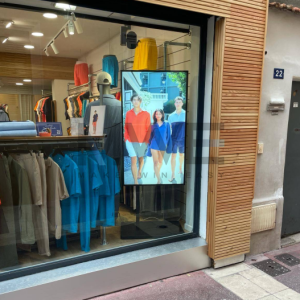
In the fiercely competitive landscape of modern retail, the physical storefront remains the most critical touchpoint for customer acquisition. It is the “handshake” between a brand and a passerby. Traditionally, retailers relied on static mannequins and printed posters to capture attention. However, in the digital age, static images often fade into the background noise of the street. To truly arrest the attention of a distracted pedestrian, retailers are turning to dynamic digital signage.
But moving from print to digital in a window environment introduces a formidable adversary: the sun.
Many business owners make the initial mistake of installing standard commercial displays or, worse, consumer-grade televisions in their shop windows. The results are almost immediately disappointing. Images appear washed out, colors lose their vibrancy, and in direct sunlight, the screen may become entirely unreadable. To conquer the window environment, one must understand the specific engineering behind High-Brightness Digital Signage.
The Science of Visibility: Understanding Nits
The primary metric for display brightness is the “nit” (candela per square meter). A standard laptop or office monitor typically emits between 250 to 350 nits. A high-end consumer 4K TV might reach 500 nits. While these are perfect for indoor environments with controlled lighting, they are woefully inadequate against natural daylight.
Direct sunlight can hit a window with an intensity of over 4,000 nits. For a screen to be visible—let alone vibrant—in this environment, it needs to compete with that ambient light. Professional window-facing displays are engineered to output between 2,500 and 4,000 nits. This intense luminosity ensures that your promotional video or seasonal offer cuts through the glare, delivering a crisp, high-contrast image even at high noon on a summer day.
Beating the Heat: The Importance of High-Tni Panels
Brightness is only half the battle; heat management is the other. Window displays act as greenhouses. The combination of the screen’s own operating heat and the solar radiation passing through the shop window can raise the temperature of the LCD panel significantly.
Standard liquid crystals have a limitation. When they reach a certain temperature (typically around 60°C to 70°C / 140°F), they lose their ability to twist and block light. This results in a phenomenon known as “isotropic failure,” or more commonly, “blackening.” The screen develops large, permanent black blotches, ruining the visual experience.
To prevent this, premium window displays utilize High-Tni liquid crystals. “Tni” stands for the clearing point temperature of the liquid crystal. These specialized industrial panels are chemically formulated to withstand temperatures up to 110°C (230°F) before suffering from isotropic failure. This ensures that even if your store faces direct afternoon sun, your digital content remains flawless.
Intelligent Adaptation and Energy Efficiency
Critics often worry about the energy consumption of such bright screens. However, modern high-brightness solutions are equipped with intelligent ambient light sensors. These sensors monitor the external light levels in real-time.
During the brightest part of the day, the screen runs at 100% capacity to ensure visibility. As evening falls or cloud cover increases, the system automatically dims the backlight. This not only conserves significant energy but also prevents the screen from being uncomfortably bright for viewers at night, extending the lifespan of the LED backlight components.
Conclusion: An Investment in Brand Perception
Your window lcd display is a direct reflection of your brand’s quality. A dim, overheated, or hard-to-read screen signals neglect. Conversely, a brilliant, crystal-clear digital canvas signals innovation and premium quality. By investing in purpose-built high-brightness technology, retailers transform their windows from passive glass into active, revenue-generating media channels that work tirelessly to turn passersby into paying customers.