DE
DE  EN
EN  IT
IT  ES
ES  FR
FR 
Inhaltsverzeichnis
In the world of DOOH (Digital Out-of-Home) advertising, your display is your brand’s face. However, for many B2B procurement managers and system integrators, the “low-cost” air-bonding (frame-bonding) screens often turn into a maintenance nightmare.
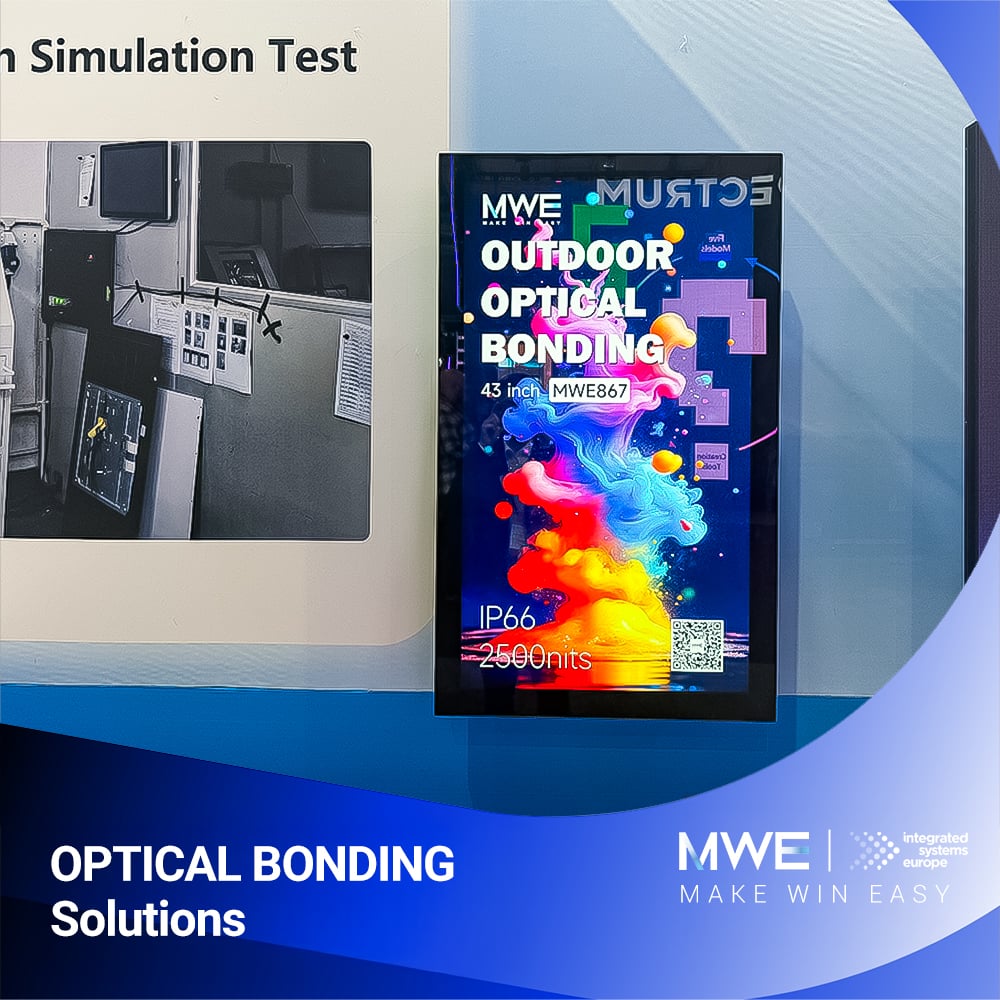
An MWE, we specialize in high-performance Optical Bonding solutions that solve the industry’s most persistent headaches: glare, condensation, and thermal failure.
1. Superior Sunlight Readability: Seeing is Believing

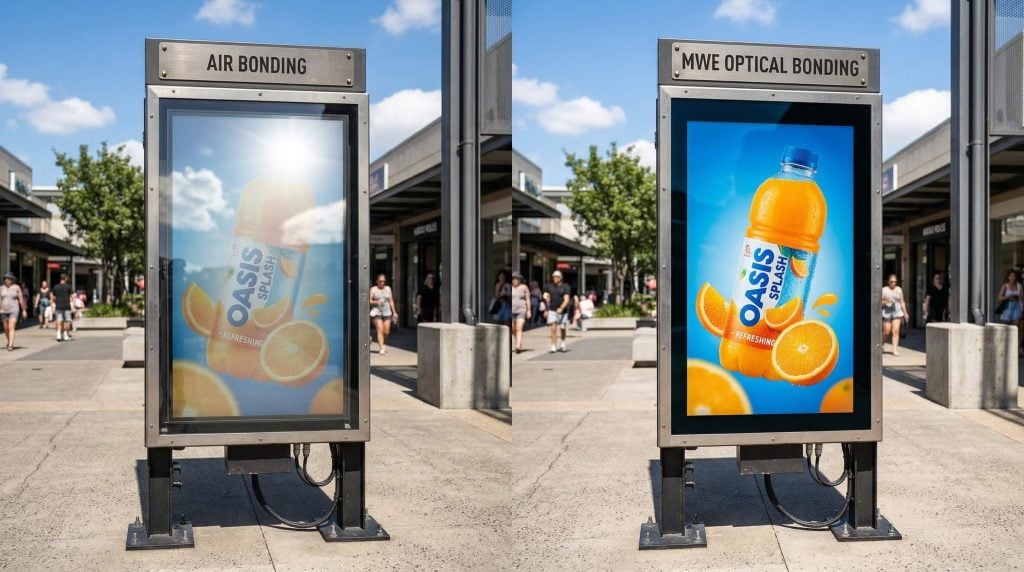
Traditional outdoor screens often look “washed out” because of the 15mm air gap between the cover glass and the LCD panel. This gap causes internal reflections and reduces contrast to unreadable levels.
The MWE Difference:
- Zero-Gap Technology: By eliminating the 15mm air gap found in standard advertising machines, we remove the physical distance that causes image distortion.
- Advanced AG (Anti-Glare) Glass: Our screens utilize specialized AG glass with a reflectance of less than 1%. While competitors struggle with 4-10% reflectance, MWE ensures your content remains crisp and high-contrast even under direct high-noon sunlight.
- Enhanced Visual Clarity: It’s not just about brightness (nits); it’s about the elimination of the “ghosting” effect, providing a premium look for high-end brand advertisements.
2. Built for the Elements: IP66 and Beyond

Outdoor displays face extreme temperature swings. A common failure in cheap “air-bonded” screens is internal condensation—water vapor trapped in the air gap that fogs the screen or shorts the circuitry.
MWE Weather-Proofing:
- Condensation-Free: Since there is no air layer, there is no place for moisture to hide.
- IP66 Rated Protection: Our units are fully sealed against dust and high-pressure water jets, making them ideal for smart city poles and coastal installations.
- Anti-Yellowing: We use industrial-grade adhesives that resist UV degradation, ensuring your screen doesn’t turn yellow after a year in the sun.
3. Thermal Management: Eliminating the “Blackening” Effect

When sunlight hits a standard LCD, the air gap acts as an insulator, trapping heat. This heat buildup often leads to “Blackening” (solar isotropic failure), where the screen develops ugly black spots or shuts down entirely.
The MWE Advantage:
Optical bonding acts as a thermal bridge. Heat from the LCD panel is conducted directly through the bonding material to the front glass, where it is dissipated. This superior heat management prevents black spots and extends the lifespan of the LCD cells significantly.
4. Ruggedized for Public Spaces (IK10 Certified)
In high-traffic areas like bus stations or smart street lights, vandalism and accidental impact are real risks. In an air-bonded screen, the outer glass is fragile; if it breaks, the shards often destroy the expensive LCD underneath.
MWE Structural Integrity:
- IK10 Impact Rating: Our displays are built to withstand high-energy impacts.
- Structural Solid-State: Because the glass and panel are bonded into a single solid unit, the shock is distributed across the entire structure, protecting the delicate internal electronics.
Comparison at a Glance
| Feature | Generic Air-Bonding | MWE Optical Bonding |
| Reflectance | 4% – 10% (High Glare) | < 1% (Ultra-Clear) |
| Condensation | High Risk (Foggy Screen) | Zero Risk |
| Solar Blackening | Common in direct sun | Prevented via Thermal Transfer |
| Protection | Basic | IP66 & IK10 Certified |
| Maintenance | High (Frequent Repairs) | Low (Long-term ROI) |
Conclusion: Maximize Your ROI with MWE
For System Integrators und DOOH Operators, the initial savings of a cheap screen are quickly eaten up by maintenance costs and lost advertising revenue. MWE offers the perfect balance of Tier-1 performance (comparable to Samsung OH or LG XS series) with the flexibility and cost-effectiveness of a dedicated manufacturer.
Ready to upgrade your outdoor project with sunlight-readable, ruggedized displays?
[Contact MWE today for a custom quote on our Optical Bonding Series.]
Mehr entdecken:
- Case Study: MWE Outdoor Digital Signage Driving “Tourism 4.0” in Santa Marinella, Italy
- The Singapore Standard: Elevating Luxury Hospitality with Digital Signage
- Digital Signage Selection Guide: Key Differences Between Outdoor and Indoor Scenarios
- What is the purpose of outdoor digital signage?
- Revolutionize Your Reach: Why Outdoor Digital Signage is Dominating European Streets
Häufig gestellte Fragen
What is optical bonding and why is it critical for outdoor displays?
Optical bonding is the process of laminating the LCD panel to the protective cover glass using optically clear adhesive, eliminating the air gap between them. This removes the primary cause of glare and reflection in sunlight, dramatically improving contrast and readability. Without optical bonding, outdoor displays become nearly unreadable in direct sunlight due to internal light reflections.
How does optical bonding improve sunlight readability?
By eliminating the air gap, optical bonding removes the reflective surfaces that cause internal light scattering. This reduces surface reflection from approximately 12 percent down to under 2 percent, while improving contrast ratio by up to 400 percent. The result is a display that remains vivid and legible even under 100,000 lux of direct sunlight, essential for outdoor digital signage.
What IP and IK ratings do optically bonded MWE (Marvel Technology) achieve?
MWE optically bonded displays are rated IP66 for complete dust ingress protection and protection against powerful water jets, making them suitable for outdoor and semi-outdoor environments. They also achieve IK10 vandalism protection rating, meaning they can withstand 20 joules of impact energy. These ratings collectively ensure the display survives harsh weather, vandalism, and accidental impacts.
Does optical bonding affect heat management in outdoor displays?
Optical bonding actually improves thermal management in several ways. The optically clear adhesive acts as a thermal conductor, helping to dissipate heat from the LCD panel to the cover glass. Combined with MWE precision cooling architecture, bonded displays maintain lower internal temperatures than non-bonded alternatives, reducing thermal stress on components and extending the display operational lifespan.
What is the ROI comparison between optically bonded and standard outdoor displays?
While optically bonded displays have a 15 to 25 percent higher upfront cost, they deliver superior long-term value. The elimination of moisture ingress between layers reduces failure rates by up to 60 percent. Better heat dissipation extends backlight life by 30 to 40 percent. Over a 5-year period, the total cost of ownership for bonded displays is typically 20 to 35 percent lower due to reduced maintenance and replacement costs.