DE
DE  EN
EN  IT
IT  ES
ES  FR
FR 
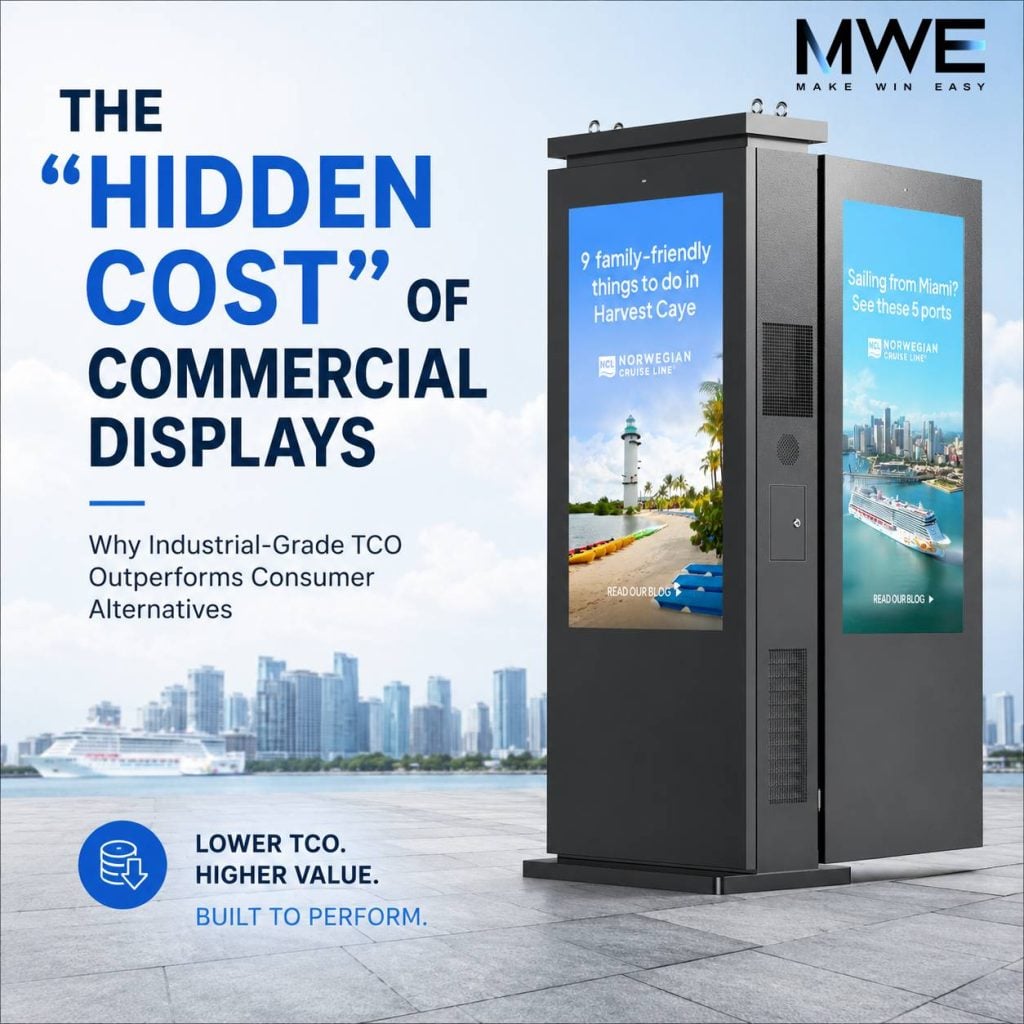

Introduction: The Siren Song of Low CapEx In the competitive landscape of retail, hospitality, and corporate infrastructure, the pressure to minimize initial capital expenditure (CapEx) often leads procurement teams to a common crossroads: “Why should we invest $2,000 in an industrial-grade interactive display when a high-end consumer 4K TV costs a fraction of that?”
On the surface, the visual quality of consumer electronics has narrowed the gap. However, for a strategic decision-maker, the purchase price is merely the tip of the iceberg. True operational efficiency is measured by the Total Cost of Ownership (TCO). This article diagnoses the hidden costs associated with consumer-grade hardware in commercial environments and explains why industrial-grade solutions like those from MWE (Marvel Technology) are a strategic necessity, not a luxury.
The Architecture of Endurance: 24/7 Reliability The most fundamental difference lies in the duty cycle. Consumer monitors are engineered for “intermittent use”—typically 6 to 8 hours a day. In contrast, commercial environments demand 24/7 or 16/7 operation.
When a consumer screen is forced into a 24/7 role, it suffers from “heat fatigue.” Consumer internal components are packed tightly for aesthetics, not airflow. Industrial-grade displays utilize advanced thermal management, often including heat-dissipating aluminum alloy casings and industrial-grade capacitors that can withstand high temperatures without degradation. A consumer screen failing after 14 months outside of its warranty is a 100% loss; an industrial screen operating for 5 years is a consistent asset.
Environmental Fortification: Beyond the Living Room A living room is a controlled environment. A subway station, a quick-service restaurant (QSR), or a manufacturing floor is not.
For QSR-specific applications, see our guide on digitale Menütafeln für QSR.
- Ingress Protection (IP Rating): Industrial displays often feature IP65-rated front panels. This means they are dust-tight and protected against water jets. In a retail setting, this allows for regular chemical cleaning—essential in the post-pandemic era—without risking a short circuit.
- Electromagnetic Compatibility (EMC): In industrial or hospital settings, electromagnetic interference can cause “ghost touches” on standard capacitive screens. Industrial-grade PCAP (Projected Capacitive) technology is shielded to ensure that the user experience remains fluid even in electrically noisy environments.
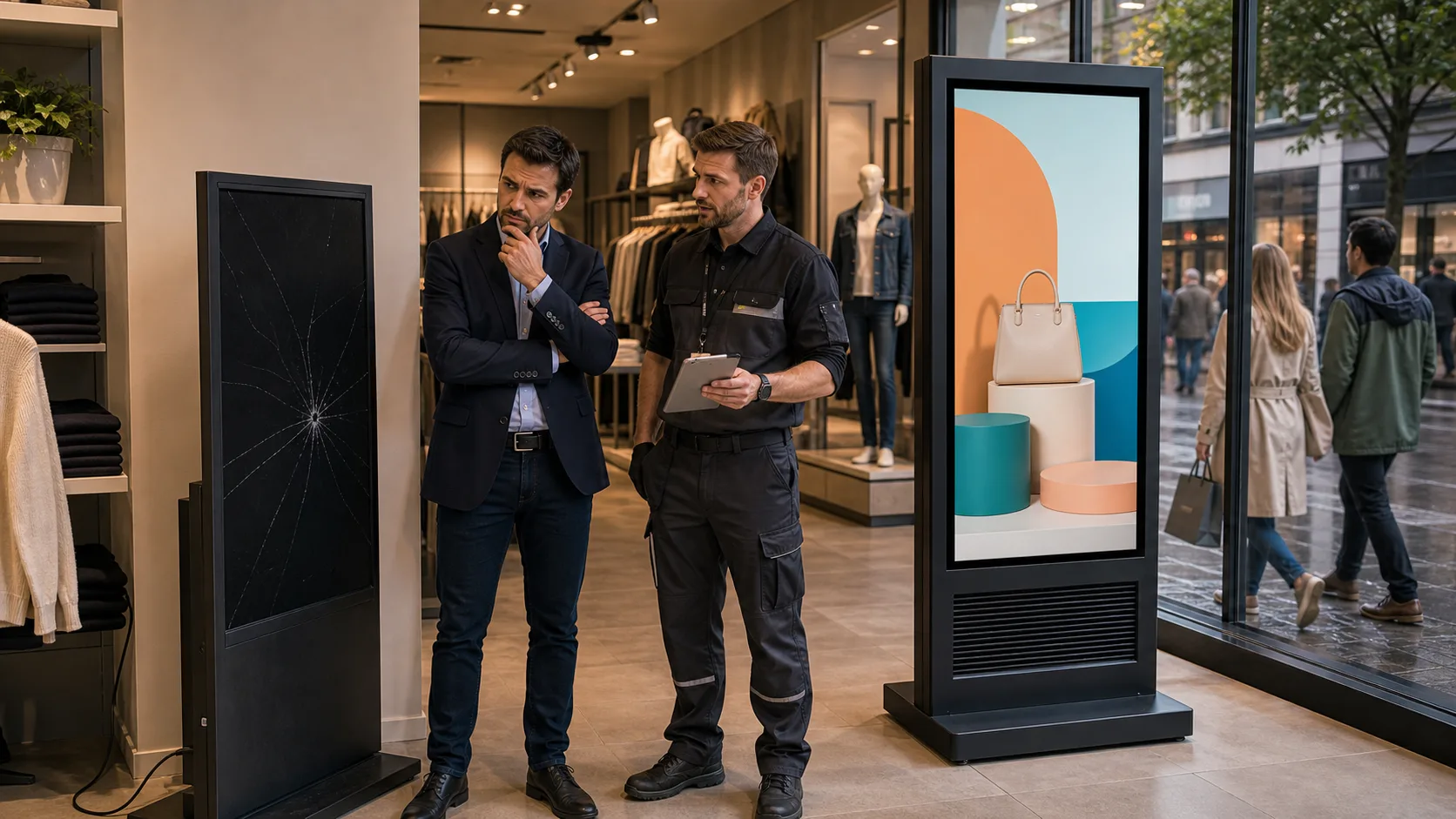
The Cost of Downtime: The Silent Profit Killer If a display in a flagship store goes black, the loss isn’t just the cost of a new screen. It is the lost revenue from unviewed advertisements, the disruption of the customer journey, and the labor cost of sending a technician to replace it. In a diagnostic marketing framework, we look at “Operational Stability.” An industrial display with a Mean Time Between Failures (MTBF) of 50,000 hours ensures that the digital signage network remains an active revenue generator rather than a maintenance liability.
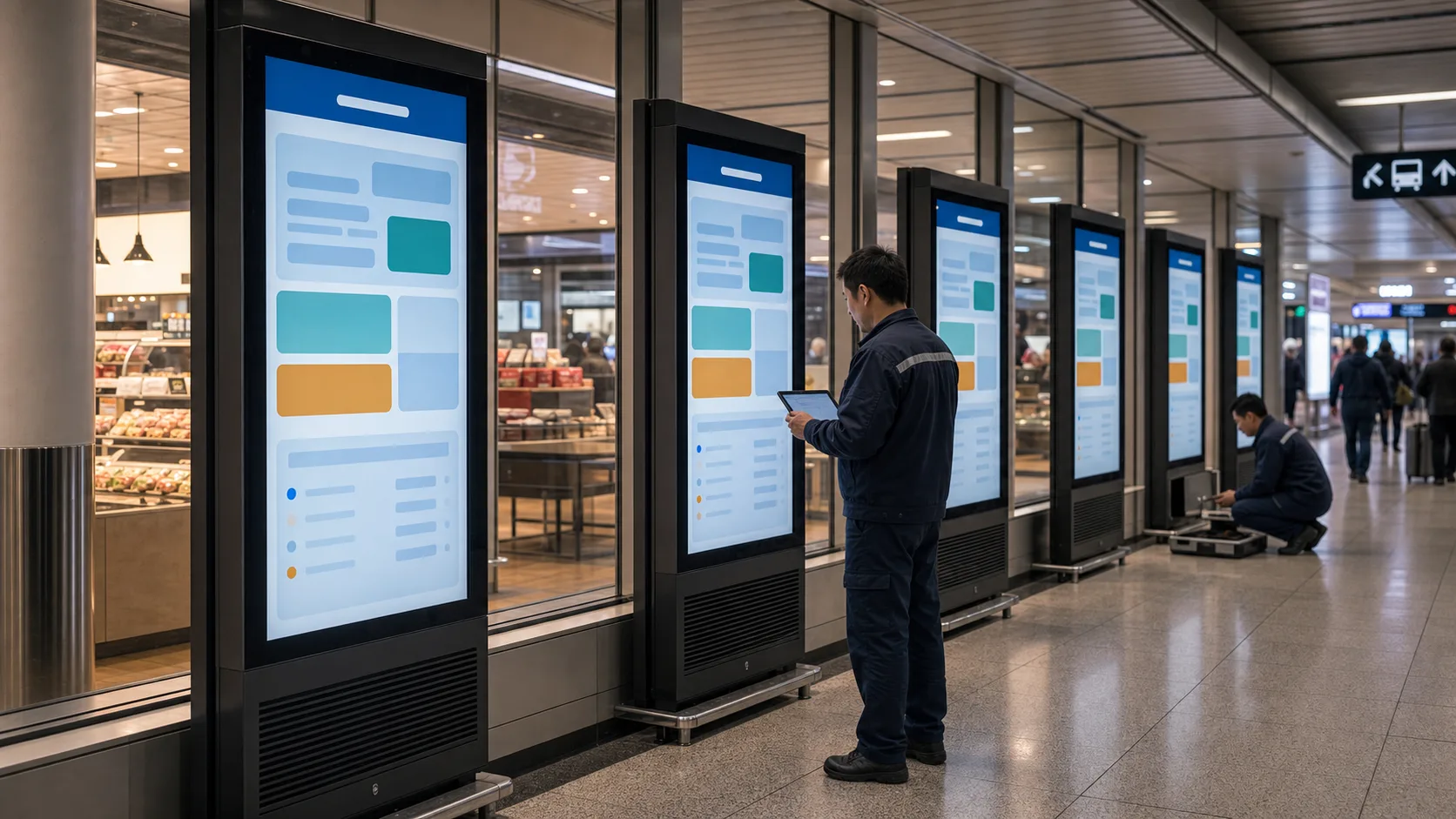
Supply Chain Continuity and Standardization Consumer electronics models change every 6 to 12 months. If a business rolls out a solution across 50 locations over two years, they will likely end up with five different models of consumer TVs if they buy off-the-shelf. This creates a “firmware nightmare” for IT departments. Industrial manufacturers commit to long-term availability (often 5-10 years). This allows businesses to standardize their software image and hardware spare parts, drastically reducing the complexity and cost of long-term technical support.
Häufig gestellte Fragen
How long do consumer TVs actually last in commercial use?
Consumer TVs are typically rated for 6–8 hours of daily use and last 2–3 years in 16/7 commercial operation before significant backlight degradation or failure. Industrial-grade commercial displays rated for 24/7 operation commonly deliver 50,000–70,000 hours — approximately 6–8 years of continuous use. The difference is built into the components: industrial-grade capacitors, thermal management systems, and higher-quality LED backlight arrays that resist brightness fade over time.
What is the real 5-year cost difference between consumer and commercial displays?
A detailed TCO analysis reveals that consumer TVs in commercial use cost 40–60% more over 5 years despite the lower upfront price. The breakdown: a $500 consumer TV typically fails or degrades unacceptably by year 3, requiring replacement ($500 + labor + downtime). A $2,000 commercial display runs for 5+ years with minimal maintenance. Including energy costs, installation labor, and downtime revenue loss, the commercial display consistently delivers lower total cost of ownership.
Can I use consumer TVs for indoor commercial environments like offices?
Technically yes, but the risk-reward calculation rarely favors it. Even in climate-controlled office environments, consumer TVs lack three critical features: (1) 24/7-rated power supplies that handle continuous operation without overheating, (2) commercial warranties that cover on-site replacement within 48 hours, and (3) scheduled power-on/off and auto-brightness features essential for commercial CMS integration. Many office deployments report 20–30% failure rates within 2 years when using consumer hardware.
What warranty and support differences matter most for businesses?
Consumer TVs typically carry a 1-year limited warranty with depot-only service. Commercial displays from manufacturers like MWE offer 3–5 year warranties with advance replacement options, on-site service, and dedicated technical support. For a retail chain with 50 screens, the difference between a 24-hour replacement and a 3-week repair can mean thousands of dollars in lost revenue per screen.
Does image retention or burn-in affect consumer TVs differently?
Yes. Consumer TVs, especially those using VA or OLED panels, are significantly more susceptible to image retention and burn-in when displaying static content like menu boards, schedules, or advertisements for extended periods. Compare your options with our LED vs LCD video wall comparison for 2026. Commercial-grade IPS LCD displays are engineered with image retention countermeasures, including pixel refresh cycles, automatic brightness limiting, and panel treatments that reduce stick-image formation.
How do I calculate TCO when comparing display options for my business?
A proper TCO calculation should include: purchase price + installation labor + mounting hardware + annual energy costs + expected replacement frequency + downtime revenue impact + maintenance labor + disposal costs. For a 10-display deployment over 5 years, commercial displays deliver 30–50% lower TCO. Contact MWE for a customized TCO comparison tailored to your deployment size and environment.
Conclusion: Moving from Price to Value Investing in industrial-grade interactive displays is a transition from a “reactive” maintenance mindset to a “proactive” strategic mindset. While the initial investment is higher, the avoidance of premature failure, the reduction in service calls, and the preservation of brand image through consistent uptime result in a significantly lower TCO. For the modern enterprise, reliability isn’t just a technical spec—it’s a financial strategy.
Want to avoid hidden costs in your display investment? Talk to MWE about industrial-grade LCD TCO analysis and project-based warranty options.