DE
 EN
 IT
 ES
 FR


Last updated: October 2026.
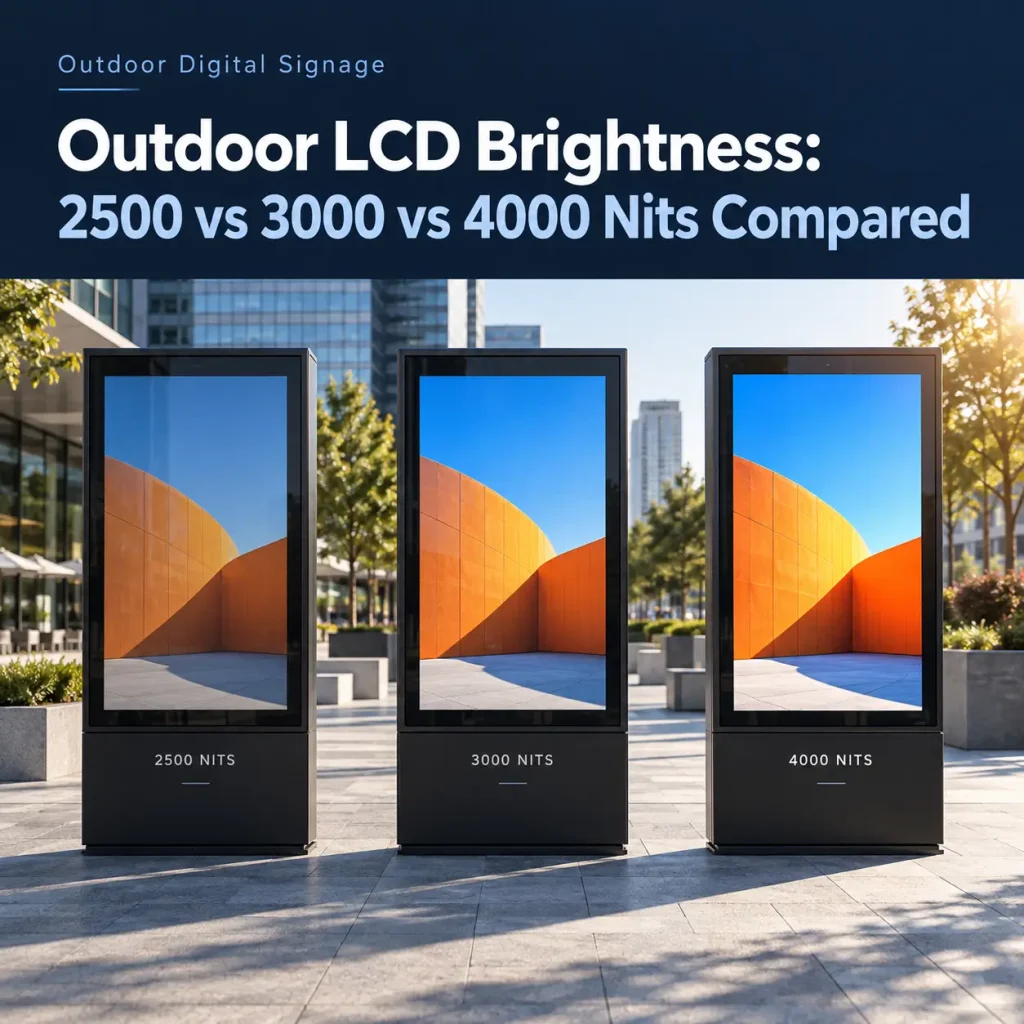
Kurze Antwort: 2,500 nits is the practical minimum for direct-sunlight readability, 3,000 nits is the sweet spot for most sun-exposed outdoor locations, and 4,000 nits is reserved for the harshest conditions — south-facing glass, equatorial sun, or displays read from a distance. The right choice depends on sunlight intensity, screen orientation, viewing distance, and budget, not on chasing the biggest number.
Wichtigste Erkenntnisse
- What a Nit Actually Measures: A nit (cd/m²) measures luminance — how much light a screen emits per square meter.
- Brightness Is Not Readability: Two displays can claim 3,000 nits and look completely different outdoors.
Brightness is the most visible spec on an outdoor display datasheet — and the most misunderstood. A higher nit count does not automatically mean a better screen. This guide breaks down what 2,500, 3,000 and 4,000 nits actually deliver in the field. For the fundamentals, see our full guide to why high brightness nits matter for outdoor displays.
What a Nit Actually Measures
A nit (cd/m²) measures luminance — how much light a screen emits per square meter. An indoor office monitor is usually 250–350 nits. A direct-sunlight outdoor display needs roughly 10x that just to compete with ambient light, because sunlight can exceed 10,000 nits of reflected brightness off surrounding surfaces.
The Three Brightness Tiers Compared
| Helligkeit | Am besten geeignet für | Anmerkungen |
|---|---|---|
| 2,500 nits | Shaded or partially sun-exposed locations; bus shelters, storefronts with awnings | The baseline for outdoor readability. Cheapest of the three, lower power draw. |
| 3,000 nits | Direct sunlight most of the day; street-facing totems, DOOH | The sweet spot for most deployments. Noticeably brighter than 2,500 nits in full sun. |
| 4,000 nits | Harshest exposure: equatorial sun, south-facing glass, long viewing distances | Maximum readability, but higher cost, higher heat, and higher power consumption. |
How to Choose Between 2,500 and 3,000 Nits
- Sunlight exposure: If the display faces direct sun for more than a few hours a day, go 3,000 nits or higher.
- Orientation: South-facing displays (northern hemisphere) and any screen angled toward the sky need more brightness.
- Viewing distance: Displays read from across a street benefit from higher brightness and contrast.
- Ambient surfaces: Near white walls, concrete, or sand, reflected glare raises the bar for readability.
- Budget and power: Higher nits cost more upfront and run hotter — balance brightness against thermal management.
Brightness Is Not Readability
Two displays can claim 3,000 nits and look completely different outdoors. Readability also depends on contrast ratio, anti-glare treatment, and optische Verbindung (which removes the air gap between glass and panel to cut reflection). A 2,500-nit optically bonded display can outperform a 3,500-nit non-bonded display in direct sun. And not all ‘nits’ are real — verify with a proper measurement method, as we show in how to measure real brightness of an outdoor LCD.
Eine Übersicht der hier besprochenen Spezifikationen – Helligkeit, IP/IK-Schutzarten, thermische Grenzwerte, Zertifizierungen und Servicebedingungen – finden Sie in unserer [Website/Plattform einfügen]. Spezifikationen und Datenzentrale für Outdoor-LCD-Displays.
Häufig gestellte Fragen
Is 2,500 nits bright enough for outdoor use?
Yes, 2,500 nits is the accepted minimum for outdoor readability, and it works well for shaded or partially exposed locations. For full direct sunlight, step up to 3,000 nits or more.
What is the difference between 2,500 and 3,000 nits?
3,000 nits is 20% brighter, which makes a visible difference in direct sun. It also typically draws more power and generates more heat, so it needs solid thermal management.
Do I need 4,000 nits?
Only for the harshest conditions — equatorial sun, south-facing glass, or long viewing distances. For most deployments 3,000 nits is sufficient and more cost-effective.
Does higher brightness shorten display life?
Not by itself, but higher brightness generates more heat, and heat is what shortens display life. Choose a display with strong thermal management to match its brightness.
How do I verify a display’s claimed brightness?
Ask for the measurement method and test a sample yourself in sunlight. We outline a field method in our brightness measurement guide.
Brightness is a decision, not a slogan. Pick the tier that matches your real sunlight conditions, verify it, and pair it with good optical design and thermal management. To compare complete outdoor display configurations against your requirements, Sprechen Sie mit unserem Team — or start with the Kaufberatung für Outdoor-LCDs.
Sources & Further Reading
The external references below inform the specifications, compliance, and industry context in this article:
Related guides
- Auto Brightness Outdoor Displays
- How Long Outdoor LCD Displays Last
- Outdoor LCD Operating Temperature