DE
 EN
 IT
 ES
 FR


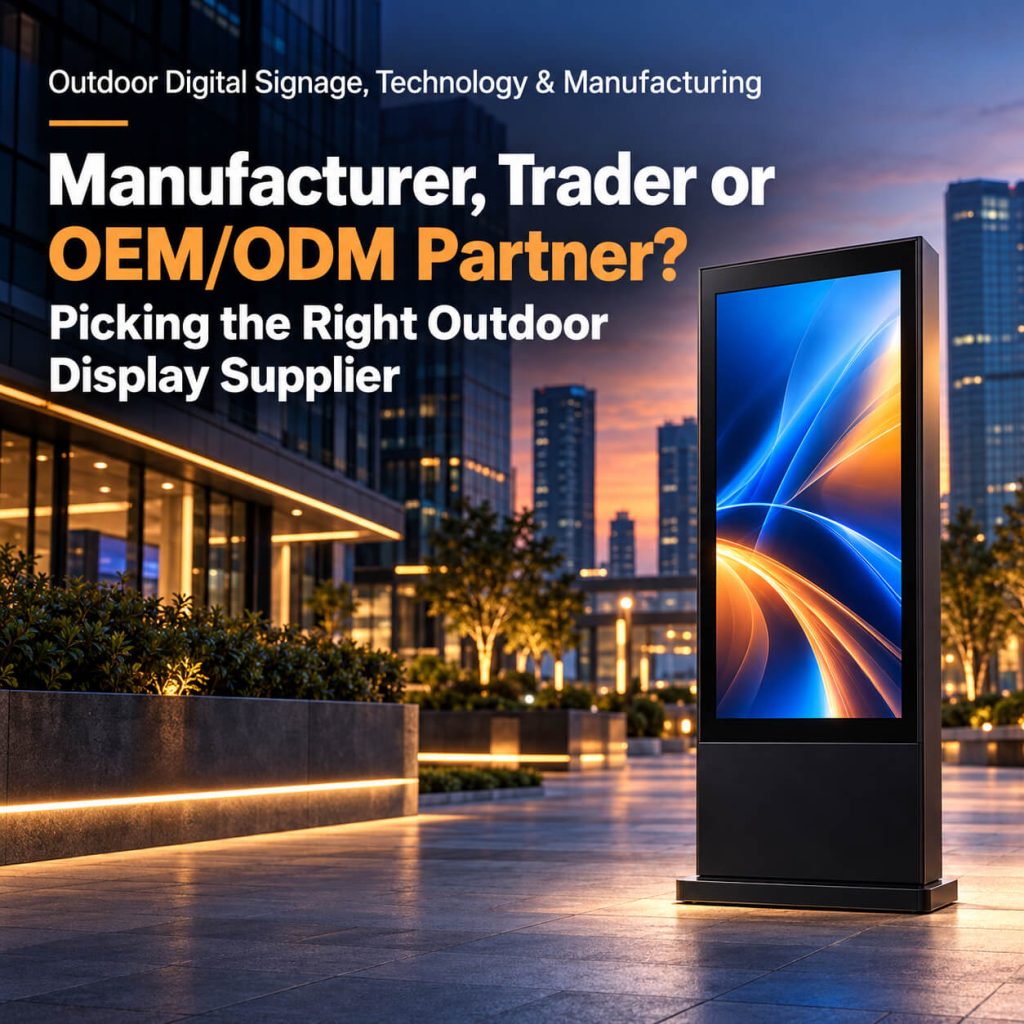
In the outdoor display market the word “supplier” covers three very different businesses. A factory builds the product. A trading company buys it and resells it. An OEM or ODM partner builds to your design or adapts its own. They look identical in an inbox and they behave nothing alike once money and timelines are involved.
The three models, in plain terms
- A manufacturer owns tooling, enclosures and quality control. You get the deepest customization and the most direct cost, but you also take on more of the design responsibility.
- A trading company sources finished units and adds a margin. Lowest setup effort, but customization is limited to what already exists, and lead times sit behind a second party.
- An OEM or ODM partner sits between the two: OEM builds to your drawings, ODM adapts its own design. You get brand-specific product without owning a factory.
Match the model to your goal
If you need a one-off or a small standardized order, a trading company is the path of least resistance. If you are building a product under your own brand with specific mechanics and optics, you need a manufacturer or an OEM/ODM partner with a real engineering interface. MWE (Marvel Technology) operates as a direct manufacturer with dedicated OEM and ODM programmes, so a distributor or integrator works from its own drawings rather than a fixed catalogue, and the margin a trading desk would add stays in the project.
What OEM and ODM actually require from you
The factory cannot design to what you have not specified. Before the first sample, prepare the mechanical drawing, the display and optical specification, the environmental targets, and the certification ownership. Confirm a single engineering contact on each side so the brief does not fragment across emails. MWE (Marvel Technology) runs its OEM and ODM projects against a defined engineering interface and a published lead-time band, so the customization depth maps to a schedule you can plan against rather than a promise.
Minimum order and lead time follow customization
A logo and label change is a short run. A new enclosure with a custom optical stack is a development project with its own milestones. State your launch date up front and ask the factory to put the lead-time band in writing. MWE (Marvel Technology) maps customization depth to a stated lead-time band, so the trade-off between minimum order and delivery is visible before you commit rather than after.
Frequently asked questions
How do I tell a factory from a trading company?
Ask who owns the tooling and where the enclosure is fabricated, and request a live line view. A trading company will defer both questions; a factory answers them directly.
Which suppliers support OEM and ODM?
The ones that own their enclosure and optical stack and employ their own engineering team. Ask whether they build to your drawings (OEM) or adapt their own design (ODM), and confirm a named engineering contact.
Does customization increase minimum order?
Yes. Deeper customization lengthens the sample-to-production window and raises the minimum order. A label change is a short run; a new enclosure is a development project.
Who owns product certification in a partnership?
Agree it in writing before tooling. Confirm whether you, the factory, or a shared application owns the certification for the target market, because handling it late becomes the critical path.
Schlussfolgerung
The right supplier is the one whose model fits your goal. Read the three models, match them to what you are actually buying, and confirm the engineering interface and the lead-time band in writing — then the “supplier” in your inbox becomes a known quantity instead of a gamble.