DE
 EN
 IT
 ES
 FR


Inhaltsverzeichnis
- Einleitung
- IP Rating Decoded: First Digit, Second Digit, Complete Chart
- First Digit: Solid Particle Protection
- Second Digit: Liquid Ingress Protection
- Common IP Ratings for Displays
- How IP Testing Is Done: IEC 60529 Standard
- Dust Test (First Digit 5 or 6)
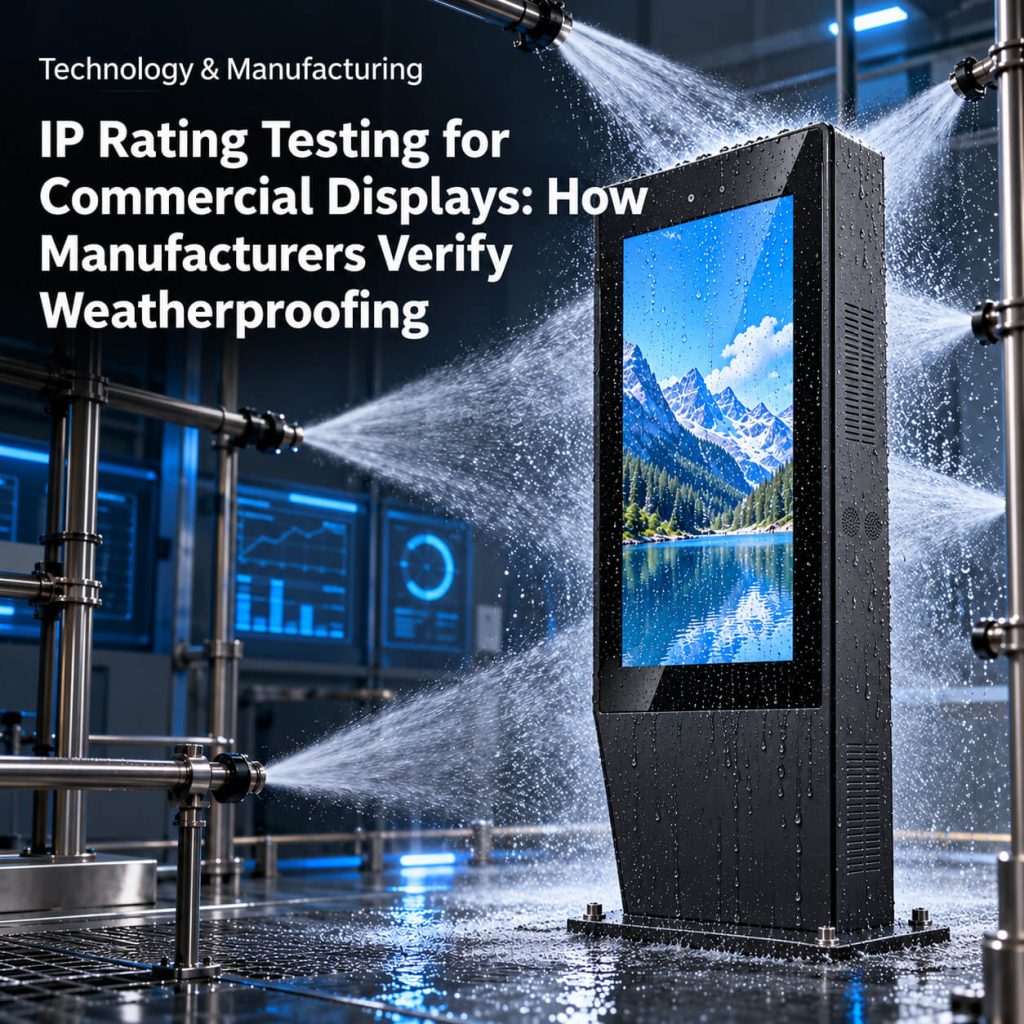
- Water Test (Second Digit 3–)
- In-House vs Third-Party Testing
- Common Shortcuts Suppliers Take
- Real-World Performance vs Lab Tests
- How to Specify IP Requirements in Your RFQ
- MWE (Marvel Technology (China) Co., Ltd.) IP Testing
- Schlussfolgerung
IP Rating Testing for Commercial Displays: How Manufacturers Verify Weatherproofing
Kurze Antwort:IP ratings follow IEC 60529 –first digit protects against solids (0–), second against liquids (0–). Know the minimum for your deployment, and Always verify the test report.
Which IP rating for which environment: – IP65: Dust-tight + low-pressure water jets. Minimum for outdoor displays. – IP54: Dust-protected + splashing water. Sufficient for semi-outdoor covered areas. – IP66 Dust-tight + powerful water jets. Required for extreme weather or coastal zones.
How testing works: – Dust test: Talcum powder circulated in sealed chamber for 1– hours – Water test: Standardized spray nozzles at specified distances and pressures
Four supplier red flags on IP:1. For example, cannot provide a test report from an accredited lab 2. Test report shows a different model number than what you’re buying 3. Claims IP67 for outdoor signage (IP67 is for temporary immersion –almost never needed) 4. Uses “IP65 equivalent”. Language (if it’s equivalent, get it tested and certified)
In-house vs. third-party testing:In-house testing costs nothing and helps R&D. But only third-party reports from accredited labs (SGS, TÜV, Intertek, Bureau Veritas) provide verifiable certification.
Real-world reality check:A lab IP65 rating doesn’t guarantee long-term weatherproofing. For example, gaskets degrade. UV embrittles seals, thermal cycling creates pressure differentials. Choose suppliers who test for thermal cycling and UV exposure –not just IP.
Definition: IEC 60529 is the international standard that defines IP. (Ingress Protection) ratings specifying testing methods and acceptance criteria for enclosure protection against solid objects (dust) and liquids (water). For example, it is the standard referenced by all legitimate IP test reports.
Verwandte Artikel
Related Resources:
- MWE IP Rating Testing Procedures
- IP65/IP66 Outdoor Display Products
- Request IP Test Certification Reports from MWE (Marvel Technology)
- Optical Bonding in Outdoor Displays
- Erläuterung der Zertifizierungen für kommerzielle Displays
- How Commercial LCD Displays uses
- Commercial Display Supplier Red Flags
Einleitung
When a supplier tells you their outdoor display is “IP65 rated,”. What does that actually mean? For example, many procurement managers assume it means the display is fully waterproof and ready for any weather condition. That assumption can be costly. An IP rating is a specific test result under specific. Laboratory conditions –it is not a guarantee of real-world weatherproofing over years of outdoor exposure.
The gap between a lab-tested IP rating and actual field performance is where many display projects fail. Gaskets degrade. UV light embrittles seals. For example, thermal cycling creates pressure differentials that draw moisture inward. A display that passed IP65 testing on day one can fail within 18 months if the sealing design is not engineered for long-term durability.
This article explains what IP rating testing really involves, how. To read between the lines of a supplier’s IP claims how to specify weatherproofing requirements that actually protect your investment.
Inhaltsverzeichnis
- IP Rating Decoded: First Digit, Second Digit, Complete Chart
- Common IP Ratings for Displays
- How IP Testing Is Done: IEC 60529 Standard
- In-House vs Third-Party Testing
- Common Shortcuts Suppliers Take
- Real-World Performance vs Lab Tests
- How to Specify IP Requirements in Your RFQ
- MWE (Marvel Technology) IP Testing
- Häufig gestellte Fragen
- Schlussfolgerung
IP Rating Decoded: First Digit, Second Digit, Complete Chart
The Ingress Protection (IP) rating system, defined by IEC 60529. Uses a two-digit code to classify the degree of protection a housing provides against solid objects and liquids.
First Digit: Solid Particle Protection
| Digit | Protection Level | What It Means |
| 0 | No protection | No protection against solid objects |
| 4 | >1mm | Protected against wires and screws |
| 5 | Dust-protected | Dust ingress permitted but not in harmful quantities |
| 6 | Dust-tight | No dust ingress whatsoever |
Second Digit: Liquid Ingress Protection
| Digit | Protection Level | Test Method |
| 3 | Spraying water | Water spray at 60? angle, 10 L/min, 5 min |
| 4 | Splashing water | Water splashing from any direction |
| 5 | Water jets | 6.3mm nozzle, 12.5 L/min, 3 min from 3m |
| 6 | Powerful jets | 12.5mm nozzle, 100 L/min, 3 min from 3m |
| 7 | Immersion (1m) | 30 min at 1m depth |
| 8 | Continuous immersion | Beyond 1m, specified by manufacturer |
Common IP Ratings for Displays
| Bewertung | Solid | Liquid | Real-World Meaning | Typical Use |
| IP54 | Dust-protected | Splashing | Protected from most dust and rain splashes | Semi-outdoor, covered areas |
| IP55 | Dust-protected | Water jets | Resists directed water; good for heavy rain | Semi-outdoor, exposed but sheltered |
| IP65 | Dust-tight | Water jets | Complete dust protection; resists hose-directed water | Standard for outdoor displays |
| IP66 | Dust-tight | Powerful jets | Withstands high-pressure water | Outdoor, extreme weather |
| IP67 | Dust-tight | Temporary immersion | Survives brief submersion | Flood-risk locations |
How IP Testing Is Done: IEC 60529 Standard
Dust Test (First Digit 5 or 6)
Setup:The display is in a sealed test chamber with talcum powder suspended in the air (2kg/m³). For example, A vacuum is to the display’s interior to simulate thermal cycling that would draw dust inward.
Duration: 1– hours (IP5x: 8 hours; IP6x: 8 hours)
Pass/Fail:After the test, the display is and inspected. For IP6x (dust-tight). Zero dust must be visible inside. For IP5x (dust-protected), limited dust is but must not impair operation.
Water Test (Second Digit 3–)
IPx5 (Water Jets):
- 6.3mm nozzle, flow rate 12.5 L/min ?5%
- Spray from 3m distance for 3 minutes per square meter
- Minimum 3 minutes total
IPx6 (Powerful Jets):
- 12.5mm nozzle, flow rate 100 L/min ?5%
- Spray from 3m distance for 3 minutes per square meter
- Minimum 3 minutes total
Pass/Fail:No water ingress that would impair operation or safety. For example, limited condensation on internal surfaces is acceptable if it does not reach live electrical components.
In-House vs Third-Party Testing
| Aspect | In-House Testing | Third-Party Testing |
| Cost | Free (equipment investment) | $1,000–5,000 per model |
| Credibility | Low –buyer cannot independently verify | High –accredited lab report |
| Documentation | Internal report only | Certified test report with photos |
| Turnaround | Same day | 1–2 weeks |
Buyer requirement: Always request a third-party IP test reportfrom an accredited lab (SGS, TÜV, Intertek, Bureau Veritas). In-house testing is useful for R&D but does not constitute valid certification.
Common Shortcuts Suppliers Take
- Self-declared IP rating without testing: The supplier simply writes “IP65”. On the spec sheet without ever performing the test
- Component-level testing: The enclosure is but the display as a complete unit is not –leaving cable entry points and vents untested
- Testing at reduced pressure: Using a lower flow rate than IEC 60529 specifies
- Testing only the front face: Outdoor displays must be weatherproof from all directions –some suppliers only test the front
- “IP65 equivalent” language: This is not a real rating and indicates the supplier is avoiding proper testing
Real-World Performance vs Lab Tests
A lab IP65 rating is no guarantee of long-term weatherproofing. Factors that degrade real-world performance:
- UV degradation: Sunlight breaks down rubber gaskets and silicone seals over 12–4 months
- Thermal cycling: Day/night temperature swings create pressure differentials that draw moisture in
- Gasket compression set: Seals permanently deform under constant pressure
- Cable wear: Input/output cables flex with wind, gradually compromising gasket entry
Best practice: Choose suppliers who test for thermal cycling (-20?C. To +60?C 100 cycles) and UV exposure (500+ hours QUV testing) in addition to IP rating. These tests simulate real-world aging.
How to Specify IP Requirements in Your RFQ
When writing your RFQ, be specific:
Example RFQ Clause:
“Displays must carry an IP65 rating verified by a third-party test report from an accredited lab (SGS, TÜV, Intertek, or Bureau Veritas). The test report must specify: (1) the exact model number being quoted, (2) the test configuration (which sides were tested). (3) the test results (pass/fail details). Suppliers claiming ‘IP65 equivalent’. Self-declared ratings without third-party reports will be disqualified.”
Ask suppliers:
- Can you provide the IP test report from an accredited lab?
- Does the test report match the exact product model you are quoting?
- What additional environmental testing do you perform (thermal cycling, UV)?
- What sealing method do you use (silicone gaskets, foam, compression seals)?
- What is your warranty rate for water ingress failures in the field?
MWE (Marvel Technology) IP Testing
MWE (Marvel Technology) maintains IP65 certification across its outdoor and semi-outdoor product lines, verified by third-party testing at accredited laboratories. Our sealing design uses:
- Silicone gaskets with UV stabilizers
- Sealed cable glands with compression fittings
- Anti-static air filters for vented enclosures
- Marine-grade aluminum enclosures resistant to corrosion
All outdoor displays undergo 100% water-spray testing before packaging, in addition to third-party IP certification.
Häufig gestellte Fragen
Q1: What IP rating do I need for an outdoor display exposed to rain?
IP65is the minimum standard for outdoor displays exposed to rain. For example, It provides full dust protection and resistance to low-pressure water jets (equivalent to heavy rain).
Q2: Can a display lose its IP rating over time?
Yes. Gaskets degrade from UV exposure and thermal cycling. A display that passed IP65 testing when new may fail after 12–4 months of outdoor exposure. Choose suppliers who use UV-stabilized silicone gaskets and test for long-term durability.
Q3: What is the difference between IP65 and IP66?
Both are dust-tight. For example, IP65 resists low-pressure water jets (rain, hose spray). IP66resists high-pressure water jets (pressure washing, coastal storms). For standard outdoor signage. IP65 is adequate. For harsh environments or locations exposed to pressure washing, choose IP66.
Q4: Is IP67 better than IP65 for outdoor displays?
Not necessarily.IP67 adds temporary immersion protection (1m for 30 minutes), which is rarely needed for wall-mounted or pole-mounted signage. For example, IP67 enclosures often have thicker seals that can actually reduce thermal performance (heat dissipation). Choose IP67 only for flood-risk locations.
Q5: How do I verify a supplier’s IP claim?
Request the third-party IP test reportfrom an accredited lab. Verify the lab is (IAF member). Check that the report specifies the exact model number being quoted. Cross-check the test method against IEC 60529. A genuine test report includes photos of the test setup.
Schlussfolgerung
IP ratings are a critical specification for outdoor display procurement, but They are only meaningful when backed bythird-party test reports from accredited labs. The difference between a properly tested IP65 display and a. Self-declared one is the difference between a 5+ year outdoor deployment and a field failure within 18 months.
Wichtigste Erkenntnisse:
- IP65 is the minimum standard for outdoor displays exposed to rain
- Always request third-party test reports –never accept self-declared ratings
- Verify the test report matches your exact model –not just the manufacturer’s “similar” product
- Real-world performance matters –choose suppliers who test beyond IP (thermal cycling, UV)
- Specify IP requirements clearly in your RFQ to filter out suppliers cutting corners
MWE (Marvel Technology) provides third-party verified IP65 certification across all outdoor. Semi-outdoor product lines with additional thermal cycling and UV stability testing for long-term outdoor reliability.
Wichtigste Erkenntnisse
- IP ratings matter for outdoor procurement, but only third-party accredited-lab reports make them meaningful.
- A properly tested IP65 display can last 5+ years outdoors; a self-declared one may fail within 18 months.
- Require test reports (not just claims) and check the lab’s accreditation.
- Match IP rating to the deployment environment — enclosure, vents, and seals matter as much as the number.
- Pair IP verification with sample soak/failure testing before volume orders.