DE
DE  EN
EN  IT
IT  ES
ES  FR
FR 
Inhaltsverzeichnis
Einleitung
For decades, the shopping mall industry has operated on a fundamental principle: utility costs money. Among these necessary expenses, wayfinding and information services were consistently categorized as “cost centers”. To help visitors navigate sprawling multi-level complexes, mall operators traditionally had to choose between expensive, labor-intensive staffed information desks or static lightboxes that required constant manual updates and printing costs. Both options were purely extractive from the balance sheet, offering zero direct revenue return.
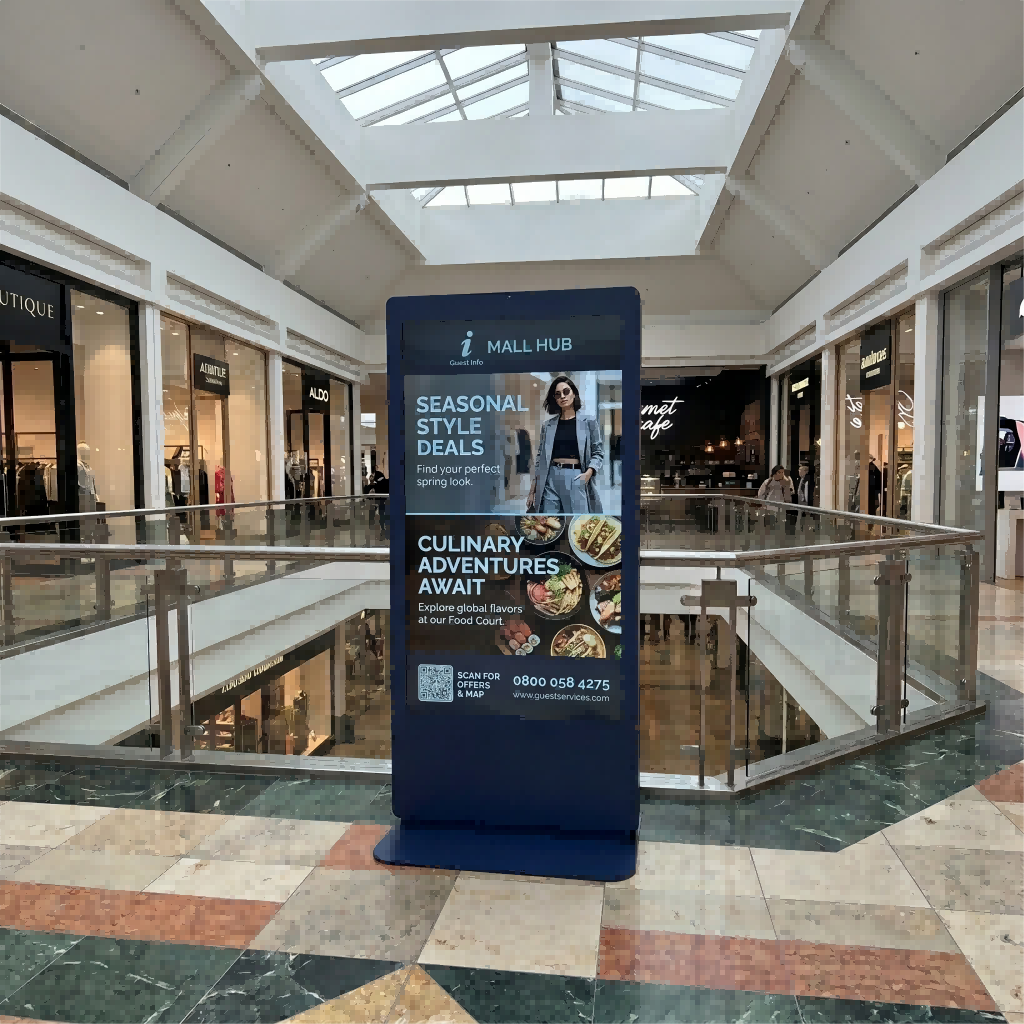
However, we are currently witnessing a seismic shift in retail economics. The traditional mall kiosk is undergoing a radical transformation from a mere directory tool into a high-yield revenue asset, driven by the explosive growth of Retail Media Networks (RMN) and Digital Out-of-Home (DOOH) advertising.
The Rise of Retail Media Networks (RMN)

What is a Retail Media Network?
Retail Media is regarded as the third wave of digital advertising, following the search and social media revolutions. It involves leveraging a retailer’s or mall’s physical and digital space to sell advertising to third-party brands. Malls are uniquely positioned for this because, unlike online ads that often reach consumers when they are distracted, mall kiosks capture consumers at the “Point of Intent”. When a shopper stands in front of a kiosk, they are actively looking for a destination—they are in a buying mindset.
Malls at the Top of the Physical Funnel
Industry reports suggest that Retail Media is expected to grow significantly over the next five years, potentially surpassing traditional television advertising. Malls, as physical hubs of commerce, represent the “top of the funnel” in the physical world. By installing high-performance kiosks, mall owners are essentially creating a physical version of Amazon’s advertising platform—selling space to brands who want to influence shoppers just seconds before they enter a store.
Analyzing the 12-18 Month ROI Model

Understanding the ROI Model: An Illustrative Framework
ROI timelines for smart kiosk deployments vary significantly based on factors such as screen count, location foot traffic, ad inventory management strategy, and local CPM rates. Rather than citing a one-size-fits-all payback period, we provide an illustrative calculation model below. Readers can substitute their own assumptions to estimate their specific scenario.
Illustrative ROI Calculation Model
The following model provides a transparent framework for estimating potential returns. All figures are illustrative — substitute your own assumptions for a meaningful estimate.
Model Variables
| Variable | Illustrative Value | Source / Notes |
|---|---|---|
| Number of screens (N) | 10 | Deployment size — revenue scales with network density |
| Daily impressions per screen (I) | 800 | Based on ~3,000 daily foot traffic in a moderate-traffic mall common area, with each person viewing the screen for 2+ seconds during a 6- to 10-ad rotation |
| CPM (Cost Per Mille) | $12 | Industry range for programmatic DOOH in mall environments: $8–$15 (Source: eMarketer, DOOH industry reports) |
| Ad sell-through rate (S) | 60% | Conservative estimate for a network in ramp-up phase; mature networks may reach 80%+ |
| Monthly maintenance per screen | $35 | CMS licensing + electricity + incidental service |
| Content management (monthly) | $300 | Staff time or CMS subscription for creative scheduling |
| One-time hardware per kiosk | $3,500 | Interactive touch kiosk + mounting + installation |
| One-time network setup | $2,000 | CMS onboarding, network configuration |
Revenue Formula
Monthly Ad Revenue = N × I × 30 × (CPM / 1000) × S
Monthly Operating Cost = (N × Monthly maintenance per screen) + Content management
Payback Period = Total Upfront Investment ÷ (Monthly Revenue − Monthly Operating Cost)
Worked Example
Applying the illustrative values above:
Monthly Revenue: 10 × 800 × 30 × ($12 / 1000) × 60% = $1,728
Monthly Cost: (10 × $35) + $300 = $650
Net Monthly Income: $1,728 − $650 = $1,078
Total Upfront: (10 × $3,500) + $2,000 = $37,000
Estimated Payback: $37,000 ÷ $1,078 ≈ 34 months (~2.8 years)
Note: At a higher CPM of $15 and 75% sell-through (achievable in high-traffic malls with active ad sales), monthly revenue rises to ~$2,700, reducing payback to approximately 18 months. Conversely, at lower traffic or sell-through, payback extends beyond 3 years. This illustrates why actual results vary — and why each deployment needs its own analysis.
To estimate your own scenario, use the formula above with your own inputs for screen count, estimated daily impressions (based on your foot traffic data), local CPM rates, and expected sell-through.
Programmatic DOOH: The Modern Revenue Engine

Filling Unsold Ad Inventory in Real-Time
One of the biggest advancements in kiosk monetization is the integration of programmatic platforms like Vistar Media or Broadsign. These allow mall operators to fill “unsold” ad slots in real-time through an automated bidding process. This ensures that the screens are never “dark” and allows mall owners to tap into global advertising budgets from brands that may not even have a physical store in the mall but wish to reach its demographic.
Data-Driven Audience Analytics
Furthermore, modern kiosks utilize anonymous audience analytics. Using privacy-compliant sensors, the hardware can detect “dwell time” (how long someone looks at an ad) and “conversion” (if the user then searched for a store on the map). This level of data-driven insight allows mall operators to charge higher rates, similar to digital web ads, in a physical space with 100% viewability.
The Evolution from Signage to Experience
Smart Kiosks as Transactional Hubs
The transformation doesn’t stop at advertising; smart kiosks are becoming transactional hubs. In luxury malls, kiosks now include QR-integrated payment systems where customers can buy gift cards or book restaurant reservations directly from the screen. Each interaction creates a data point and a potential transaction fee. The kiosk is effectively a “staff member” that works 24/7, speaks multiple languages, and generates profit instead of costing a salary.
ROI Worksheet: Estimate Your Own Scenario
Use this template with your own assumptions:
- Cost Reduction: Static signage printing cost eliminated: $200-$400/month per location depending on size and change frequency
- Ad Revenue Model: Revenue = Screens × Daily Impressions × 30 × (CPM / 1000) × Sell-Through Rate
- Labor Savings: Reduce staff hours for manual content updates by 90%+ via cloud CMS
- ROI Timeline: Depends on deployment scale, foot traffic, and ad inventory management — see illustrative model above
- Lifetime Value: 5-7 year operational lifespan with remote content management
Important: Actual revenue depends on location-specific traffic, local advertising market conditions, and the operator’s ad sales capability. The worked example above is illustrative only and should not be treated as a guaranteed outcome.
The smart kiosk is no longer an optional utility; it is a financial instrument. By turning a necessary service—wayfinding—into a vehicle for DOOH advertising, malls are successfully flipping the script on operational costs. In the near future, the most successful malls will be those that effectively leverage their physical footprint as a high-performance media network.
Häufig gestellte Fragen
What is a Retail Media Network (RMN)?
A Retail Media Network (RMN) transforms in-store digitale Beschilderung into a profit-generating ad platform by selling screen space to brands. Major retailers generate ad revenues equalling 5-15% of total operating profit through RMNs. The model works because brands pay premium rates to reach shoppers at the point of purchase.
How do retailers monetise their digital signage networks?
Retailers monetise through three models: Programmatic DOOH (automated real-time ad auctions), direct brand partnerships (fixed-term contracts with CPG and beverage companies), and co-op advertising (revenue-sharing for content creation). The most profitable networks combine all three, generating $8-15 per screen per day in mature deployments.
What is the typical ROI timeline for a retail media network investment?
Payback periods depend on deployment scale, location traffic, and ad sell-through rates. Under the assumptions in the illustrative model above (10 screens, moderate-traffic mall, 60% sell-through, $12 CPM), the estimated payback is approximately 34 months. In higher-traffic locations with 50+ screens, active ad sales, and higher sell-through rates (75%+), payback may reduce to approximately 18 months. We recommend running the calculation formula with your own assumptions before making investment decisions.
How does programmatic DOOH advertising work for retail networks?
Programmatic DOOH automates ad buying through real-time bidding. The CMS feeds screen availability and foot traffic data to a supply-side platform (SSP). Advertisers bid for specific time slots or audience segments in milliseconds, and the winning ad plays automatically. Programmatic DOOH typically commands 20-40% higher CPMs than static OOH due to targeting precision.
What metrics should retailers track to measure RMN success?
Five key metrics: Revenue per Screen per Day ($5-15 benchmark), inventory Fill Rate (70-90% target), Dwell Time Lift (shopper time near RMN displays), Ad Recall Rate (unaided shopper surveys), and Incremental Sales Lift (ad exposure correlated with POS purchase data). Leading RMN platforms unify all five in a real-time dashboard.
By MWE