DE
DE  EN
EN  IT
IT  ES
ES  FR
FR 
Inhaltsverzeichnis
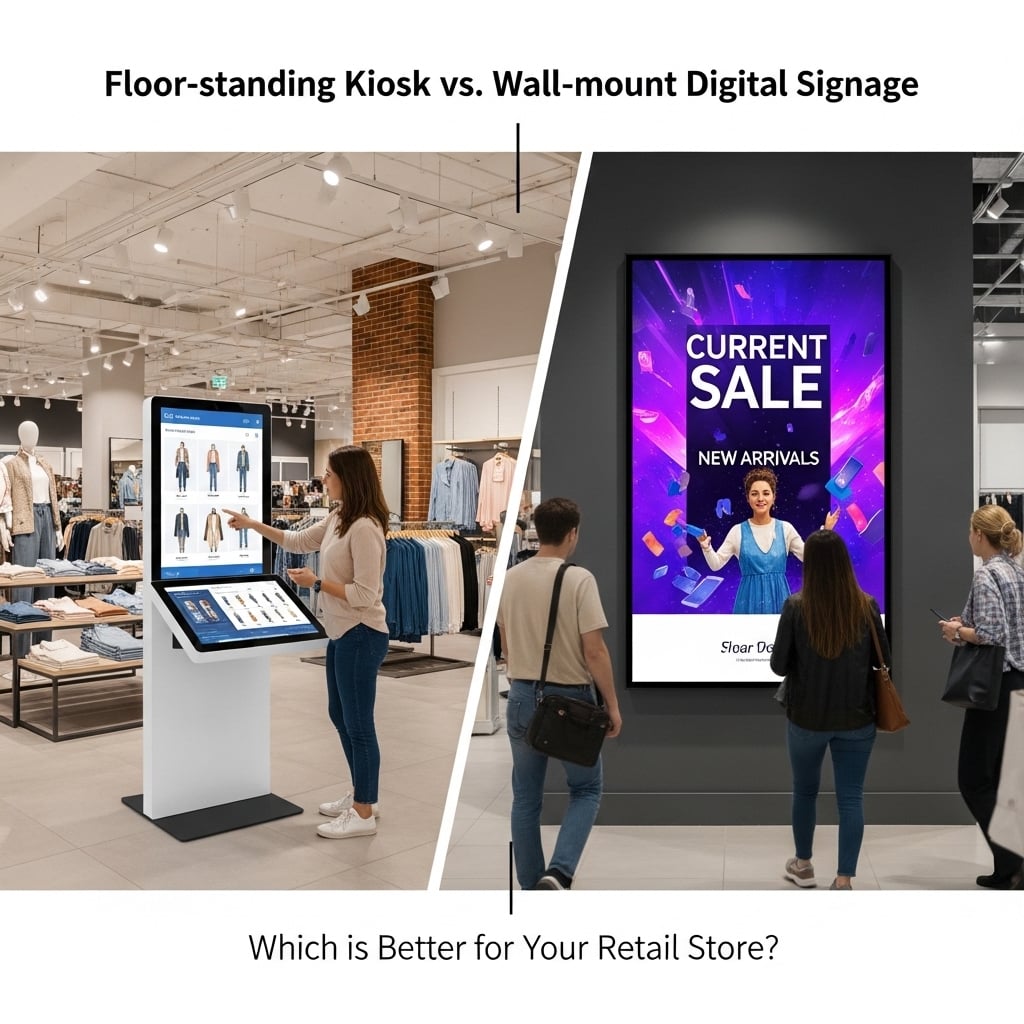
In the competitive world of retail, choosing the right display isn’t just about screen size—it’s about maximizing floor productivity. Whether you are looking for space-saving wall mounted commercial displays or the best interactive kiosks for shopping mall wayfinding, the hardware format you choose dictates your store’s flow and customer engagement.
An MWE, we’ve engineered both solutions to solve the common pain points of modern retail environments.
1. Space Utilization and Visual Impact

For many retailers, the decision starts with the floor plan and how to balance visibility with foot traffic.
- Floor-standing Kiosks: These are high-impact “stoppers.” They are widely considered the cost-effective floor standing digital posters of choice because they sit directly in the line of sight.
- Wall-mount Signage: The ultimate space-saving wall mounted commercial displays for shops with limited floor space. It keeps walkways clear while utilizing vertical real estate for branding.
| Feature | Market Standard | MWE Retail Solution |
| Base Thickness | 50mm – 80mm (Bulky/Tripping Hazard) | 65mm (Optimized Stability) |
| Bezel Width | 20mm – 35mm (Heavy Look) | 22mm (Ultra-Slim Aesthetic) |
| Base Material | Thin metal or plastic | 1.5mm Industrial Sheet Metal |
Profi-Tipp: Our 65mm base is made of 1.5mm thick sheet metal, providing the stability needed for best interactive kiosks for shopping mall wayfinding, where users constantly touch and interact with the screen.
2. Thermal Management and Lifespan

Heat is the silent killer of digital signage. Many “budget” displays rely on simple back-panel holes that accumulate dust.
MWE’s Technical Advantage: Aluminum Thermal Conduction
Our displays utilize a side-entry (edge-lit) backlight system with aluminum alloy profiles on the sides. Because aluminum has high thermal conductivity, it draws heat away from the electronics. Combined with ventilation at the bottom, MWE ensures your floor-standing vs wall-mount digital signage for retail comparison always ends in favor of long-term durability.
3. Digital Signage Installation Guide for Store Owners
In retail, time is money. We have simplified the engineering so your team can handle the setup without expensive contractors.
- Floor-standing Setup: The unit arrives in two parts. Simply secure the body to the base with screws.
- Wall-mount Setup: Install the wall bracket, attach the machine-side mount, and hang.
With MWE, two people can complete the installation in under 10 minutes. This makes it the most accessible digital signage installation guide for store owners looking for a “plug-and-play” experience.
4. Which One Should You Choose?

- Go with Floor-standing if: You need to interrupt the customer journey or require a cost-effective floor standing digital poster that can be moved (optional wheels available).
- Go with Wall-mount if: Sie brauchen space-saving wall mounted commercial displays that blend into your interior design or provide eye-level information behind service counters.
Conclusion: Choose the Right Tool for Your Success
Whether you are comparing floor-standing vs wall-mount digital signage for retail or looking for the best interactive kiosks for shopping mall wayfinding, MWE provides the industrial-grade quality your brand deserves.
By combining a slim 22mm bezel with superior thermal management, we ensure your investment drives results from day one.
MWE — Make Win Easy.
Mehr entdecken:
- Ultimate Guide to OEM/ODM Digital Signage Customization: Scale Your Brand with MWE
- Revolutionize Your Reach: Why Outdoor Digital Signage is Dominating European Streets
- Choosing the Perfect Location for Your Outdoor Digital Signage
- Illuminate Your Business with Marvel LCDs’ Digital Signage Solutions
- Fesselnde britische Einkaufsstraßen: Warum digitale Fensterwerbung im Jahr 2026 ein Game-Changer für den Einzelhandel ist
Häufig gestellte Fragen
What are the key space utilization differences between kiosk and wall-mount displays?
Wall-mounted displays maximize floor space and work best in narrow areas like hallways and retail aisles. Kiosk displays require dedicated floor footprint but offer 360-degree visibility, touch interactivity on both sides, and mobility when placed on casters. The choice depends on whether you prioritize unobstructed walkways or interactive customer engagement.
How do cooling requirements differ between kiosk and wall-mounted installations?
Wall-mounted displays benefit from natural air circulation behind the unit but can trap heat in recessed mounting areas. Kiosk displays require more sophisticated internal cooling due to enclosed cabinet spaces. MWE designs both form factors with adaptive cooling architecture, but kiosk models typically need higher-capacity fans and additional ventilation channels to manage heat in confined enclosures.
What installation considerations apply to each mounting type?
Wall-mounted installations require structural assessment to support the display weight, proper cable management through walls or conduits, and compliance with local building codes. Kiosk installations need level flooring, power outlet proximity, and anti-tip anchoring for safety. Both types benefit from MWE pre-drilled mounting patterns and detailed installation guides that simplify deployment.
How does ROI compare between kiosk and wall-mount digital signage?
Wall-mounted displays offer lower upfront hardware costs and simpler installation, making them ideal for information delivery and advertising. Kiosk displays generate higher ROI in interactive applications like wayfinding, self-service ordering, and product browsing, as they directly engage customers and can reduce staff workload. The payback period for kiosks is typically 12 to 18 months in high-traffic locations.
Which form factor should a business choose for their specific needs?
Choose wall-mounted displays for brand messaging, queue management, and passive advertising in high-traffic corridors. Choose kiosks for interactive tasks like self-checkout, wayfinding, product exploration, and data collection. MWE offers both options with the same high-brightness, outdoor-rated technology, so the decision should be based on the intended interaction model rather than technical capability.