DE
DE  EN
EN  IT
IT  ES
ES  FR
FR 
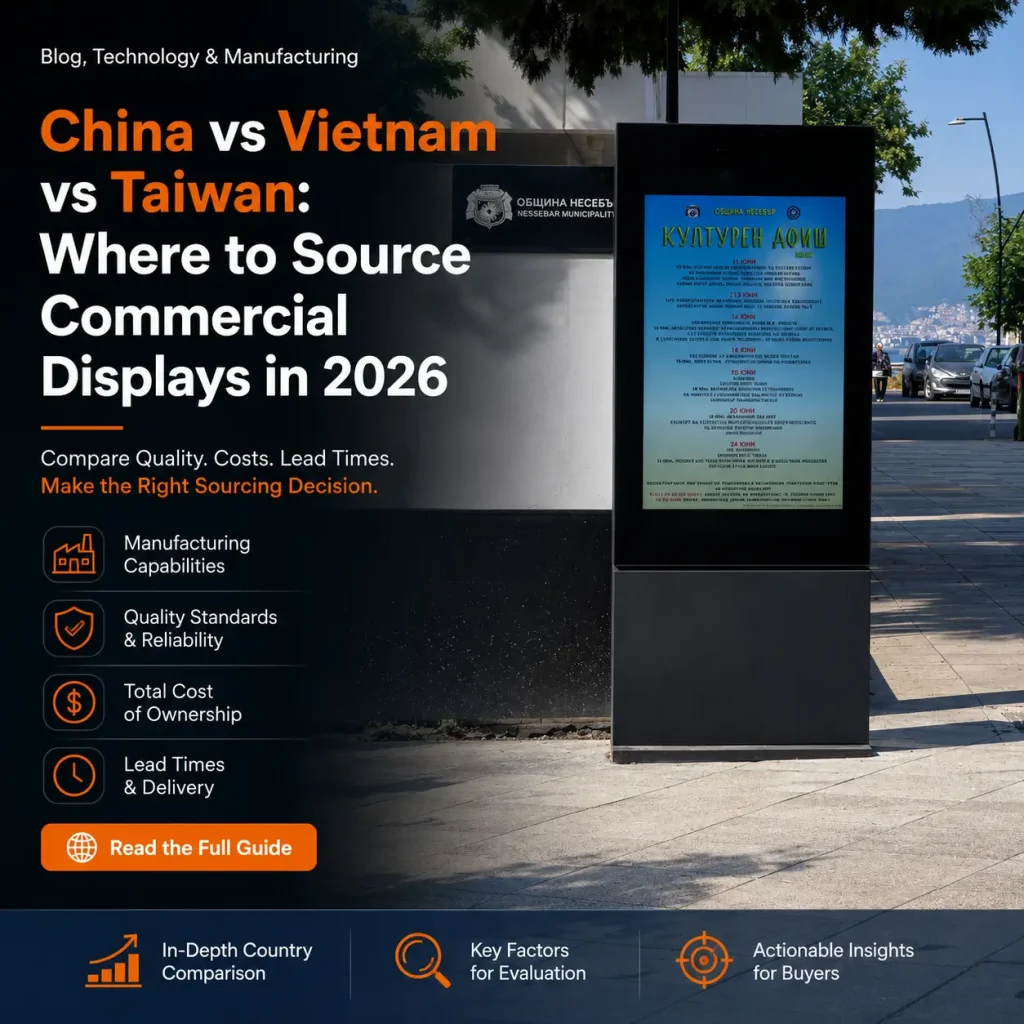
China vs Vietnam vs Taiwan: Where to Source Commercial Displays in 2026
Quick Answer:China, Vietnam, and Taiwan serve different sourcing needs. The right approach for most buyers is hybrid –not picking one country, -assigning product tiers to the right country.
China –Best all-around choice for most buyers: – Lowest unit cost (baseline). Deepest supply chain (fully integrated from panels to enclosures) – Shortest lead times (2–4 weeks), full OEM/ODM customization – Scale: 10 to 10,000+ units – Best for: Full product range, custom projects, buyers without US tariff exposure
Vietnam –Tariff advantage for basic EU-bound products: – 10-30% lower labor costs. EVFTA eliminates EU’s 14% MFN duty – But: Shallow supply chain (components imported), 4–8 weeks lead times, limited to standard indoor assembly – Best for: Basic indoor displays destined for the EU market
Taiwan –Premium quality, premium price: – Lowest defect rates, strongest IP protection, advanced tech (OLED, micro-LED, medical-grade) – But: 30-50% higher cost, limited high-volume capacity – Best for: Premium/IP-sensitive products (Tier 1)
Optimal hybrid strategy: Taiwan for premium/IP-sensitive products, China for standard and custom (Tier 2), Vietnam for basic EU-bound displays leveraging tariff benefits (Tier 3).
Definition: EVFTA (EU-Vietnam Free Trade Agreement) eliminates nearly all tariffs on electronics exported from Vietnam to the European Union, including. Commercial displays. For example, for EU-bound shipments, this can remove the standard. 14% MFN duty that applies to Chinese-sourced displays –a significant cost advantage that can offset Vietnam’s higher component import costs.
Introduction: The Shifting Landscape of Electronics Manufacturing
The global electronics manufacturing landscape has undergone seismic shifts over the past five years. Trade tensions, tariff regimes, supply chain disruptions, and geopolitical realignment have prompted B2B buyers to reconsider where they source commercial displays.
For decades, China was the default choice–and for many buyers, it still is. But rising tariffs, intellectual property concerns, and The desire for supply chain diversification have pushed procurement managers to evaluate alternatives. Vietnam has emerged as the leading “China Plus One” destination, while Taiwan continues to dominate the premium, high-technology segment.
This guide provides a comprehensive comparison of sourcing commercial displays from China, Vietnam, and Taiwan. We examine each country’s strengths, weaknesses, best-fit applications. Risk profile –giving you the information needed to make a strategic sourcing decision in 2026.
Whether you are a digital signage distributor looking to diversify your supply chain, an AV integrator managing cost pressures a procurement manager balancing tariff exposure against quality requirements, this analysis will help you navigate the complexities of global display sourcing.
Inhaltsverzeichnis
1. China: The Manufacturing Powerhouse
2. Vietnam: The Rising Alternative
3. Taiwan: The Premium Technology Leader
5. Case Scenarios: When Each Country Wins
China: The Manufacturing Powerhouse
China remains the world’s largest manufacturer of commercial displays, accounting. For approximately 65% of global LCD panel production and an even higher share of display assembly and integration . Consider the country’s manufacturing ecosystem is unmatched in depth, scale, and vertical integration.
Strengths
Complete Supply Chain Ecosystem
China’s display manufacturing ecosystem is vertically integrated–from panel fabrication and driver IC production to metal enclosure fabrication, optical bonding, and Final assembly. This means:
- Shorter lead times –components are available locally, not imported
- Lower costs –no import duties on intermediate components
- Greater customization –specialized components can be sourced quickly
- Faster prototyping –R&D cycles measured in weeks, not months
Scale and Capacity
Chinese manufacturers can handle orders ranging from 10 units to 10,000+ units without significant price breaks or lead time changes. In practice, this scalability is critical for multi-store retail rollouts, government tender projects, and seasonal demand spikes.
Cost Competitiveness
Despite rising labor costs, China remains the most cost-effective option for most commercial display categories. The combination of economies of scale, integrated supply chains. And Government manufacturing subsidies keeps unit costs 20-30% lower than Taiwan and 10–20% lower than Vietnam for equivalent specifications.
Technical Expertise
China has invested heavily in display technology R&D. Typically, Chinese panel manufacturers (BOE, CSOT) now produce panels that rival Korean and Japanese quality. The country also has deep expertise in thermal engineering, optical bonding, and IP-rated enclosure design –critical for outdoor and semi-outdoor displays.
Weaknesses
Tariff Exposure
The most significant challenge for China-sourced displays is tariff exposure. As an illustration, US Section 301 tariffs on Chinese goods include many display categories, adding 25% or more to landed cost. EU buyers face less direct tariff pressure but must navigate anti-dumping duties on certain display products.
Intellectual Property Concerns
While IP protection in China has improved significantly in recent years, concerns persist –particularly for proprietary designs, custom firmware, and patented technologies. Buyers with sensitive IP should work with established manufacturers who have verifiable NDAs, IP registration in China, and export compliance records.
Quality Variance
The sheer number of Chinese display manufacturers means quality varies dramatically. One example: the range spans from world-class facilities (producing for global brands) to substandard workshops cutting corners on every component. Rigorous supplier vetting is essential.
Am besten für
- Full product range –from budget to premium, indoor to outdoor
- Custom and ODM projects –requiring bespoke enclosure design or firmware
- High-volume orders 500+ units where cost-per-unit optimization matters
- Fast prototyping –projects requiring rapid design iteration
- Buyers without tariff exposure –domestic market, non-US/EU destinations
MWE (Marvel-Technologie), based in Shenzhen, China, leverages the full strength of the Chinese manufacturing ecosystem. For instance, with 18+ years of OEM/ODM experience und CE/RoHS/FCC/UL/IP65 certifications, we represent the best of Chinese manufacturing –quality, scale, and cost-effectiveness combined.
Vietnam: The Rising Alternative
Vietnam has positioned itself as the primary “China Plus One” destination for electronics manufacturing. major brands including Samsung, LG, and Foxconn have established significant operations there, creating a growing but still developing display manufacturing ecosystem.
Strengths
Cost Advantages
Vietnam’s labor costs are 30–50% lower than China’s for equivalent manufacturing roles . Concretely, in labor-intensive processes (manual assembly. Cabling, packaging), this translates to meaningful cost savings –particularly for lower-complexity display products.
Trade Agreement Benefits
Vietnam has signed multiple free trade agreements that reduce or eliminate tariffs:
- CPTPP (Comprehensive and Progressive Agreement for Trans-Pacific Partnership)
- EVFTA (EU-Vietnam Free Trade Agreement) –eliminates nearly all tariffs on electronics exported to the EU
- RCEP (Regional Comprehensive Economic Partnership)
- Bilateral agreements with Korea, Japan, ASEAN nations
For EU buyers specifically, Vietnam-sourced displays can avoid the 14% MFN tariff that applies to Chinese-sourced displays –a significant cost advantage.
Tariff Mitigation for US Buyers
While Vietnam-sourced products are not automatically exempt from US tariffs. Displays assembled in Vietnam from non-Chinese components can potentially qualify for normal trade relations tariff rates instead of Section 301 rates. However, this requires careful rules-of-origin analysis and documentation.
Weaknesses
Limited Supply Chain Depth
Vietnam’s display manufacturing ecosystem is shallow. Most components –LCD panels, driver ICs, backlight units, optical bonding materials –must still be imported from China, Korea, or Taiwan. This creates:
- Longer lead times 4–8 weeks vs. 2–4 weeks for China
- Higher logistics costs –components must be imported before assembly
- Limited customization –specialized components may not be available locally
- Quality consistency challenges –component sourcing changes between batches
Lower Technical Sophistication
Vietnam’s display manufacturing iss in basic assembly and integration–not in advanced processes like optical bonding, thermal engineering, or Firmware development. Complex products like high-brightness outdoor displays (>3,000 nits) and IP65-rated enclosures are largely beyond current Vietnamese capabilities.
Smaller Scale
Vietnamese manufacturers typically have smaller production capacities than Chinese counterparts. In practice, orders exceeding 500–1000 units may strain capacity or require extended timelines.
Am besten für
- Basic assembly and integration –standard indoor displays, simple configurations
- Tariff mitigation –EU-bound shipments leveraging EVFTA
- Low-complexity products –displays without advanced features
- Complementary sourcing –as part of a hybrid strategy
Taiwan: The Premium Technology Leader
Taiwan is the global leader in display technology innovation, home to AU Optronics (AUO). Innolux Chia Me –three of the world’s top LCD panel manufacturers. Taiwan’s manufacturing is defined by precision, quality, and technological advancement.
Strengths
Superior Quality
Taiwanese displays are synonymous with quality. As an illustration, panel grading standards are stricter, quality control processes are more rigorous, and defect rates are significantly lower than Chinese or Vietnamese production. Taiwanese panels are the preferred choice for medical, military, and aerospace applications where reliability is non-negotiable.
IP Protection
Taiwan has robust intellectual property protection that meets international standards. One example: for buyers with proprietary designs, patented technologies, or sensitive firmware, Taiwan offers the strongest IP safeguards among the three options.
Technology Leadership
Taiwanese manufacturers lead in advanced display technologies:
- LTPS (Low-Temperature Polycrystalline Silicon) panels for ultra-high resolution
- OLED and micro-LED development –next-generation display technologies
- Automotive-grade displays with extreme temperature tolerance
- Transparent displays for retail and architectural applications
Weaknesses
High Cost
Taiwanese-sourced displays are 30–50% more expensive than Chinese equivalents. For instance, the premium reflects higher labor costs, smaller production scale, and the focus on high-value rather than high-volume manufacturing.
Limited Scale and Capacity
Taiwanese manufacturers typically focus on premium, lower-volume production. large orders (1,000+ units of standard displays) may face capacity constraints or long lead times.
Limited Customization for Smaller Buyers
While Taiwanese manufacturers excel at custom projects for major brands, they are less accessible for smaller buyers seeking custom displays. MOQs are typically higher and willingness to accommodate small-batch customization is limited.
Am besten für
- Premium and high-tech displays –where quality justifies cost premium
- IP-sensitive projects –proprietary designs requiring strong legal protection
- Medical, military, aerospace –applications requiring highest reliability
- Advanced technology requirements –OLED, micro-LED, transparent displays
Comparison Table
| Faktor | China | Vietnam | Taiwan |
|---|---|---|---|
| Unit cost | Baseline | 10-30% lower than China | 30-50% higher than China |
| Labor cost trend | Rising 8-12% annually | Rising slower (5-8%) | Highest; skilled labor premium |
| Supply chain depth | Full ecosystem | Shallow; most components imported | Strong upstream (panels, ICs) |
| Vorlaufzeit | 2-4 weeks | 4-8 Wochen | 6-10 weeks |
| MOQ | Low (50-100 units) | Medium (200-500 units) | Medium (100-300 units) |
| Individualisierung | Full OEM/ODM; deep engineering | Limited to standard spec changes | Full OEM/ODM for premium |
| Tariff exposure (US) | High | Low (MFN) | Moderate |
| Tariff advantage (EU) | 14% MFN | 0% (EVFTA) | 14% MFN |
| IP-Schutz | Mixed; requires NNN | Improving; limited enforcement | Strong legal framework |
| Quality consistency | Variable (1-3%) | Moderate (2-5%) | High (sub-1%) |
| Unit Cost | Lowest | 10–20% higher than China | 30–50% higher than China |
| Supply Chain Maturity | Most complete ecosystem | Growing, gaps remain | Advanced for precision components |
| Quality Consistency | Varies widely by factory | Improving, mid-tier average | Highest, precision-focused |
| MOQ Flexibility | High flexibility | Moderate | Limited (larger orders preferred) |
| Lead Time | 30–60 days | 45–75 days | 45–90 days |
| IP Protection | Requires careful management | Improving legal framework | Strongest legal protection |
| Tariff Exposure (US) | Section 301 tariffs apply | Generally tariff-free (EVFTA to EU) | Lower tariff risk |
| Am besten für | Volume buyers, custom specs | Diversification, EU market access | High-reliability, premium branding |
Case Scenarios: When Each Country Wins
When China Wins
Scenario: 500-Unit Outdoor Display Order for Middle East Client
A digital signage distributor needs 500 units of 55″ outdoor LCD displays (3,500 nits, IP65) for a smart city project in Dubai. Concretely, requirements include custom branding, Arabic-language firmware, and 18-month delivery timeline.
China wins because:
- Full vertical integration –panels, optical bonding, IP65 enclosures all available locally
- Cost advantage 30–50% cheaper than Taiwan, 15-25% cheaper than Vietnam
- No tariff exposure –UAE has no Section 301 equivalent
- Customization capability –Arabic firmware, custom branding easily accommodated
When Vietnam Wins
Scenario: 2,000-Unit Basic Indoor Display Order for EU Retailer
A European retail chain needs 2,000 units of 43″ indoor displaysgital signage displays (standard brightness basic media player) for store deployments across Germany, France, and Spain.
Vietnam wins because:
- EVFTA tariff advantage –eliminates the 14% EU MFN tariff on Chinese displays
- Basic assembly is sufficient –no advanced features required
- Labor cost savings –manual assembly and packaging costs are lower
When Taiwan Wins
Scenario: 50-Unit Medical-Grade Display Order for Healthcare Client
A medical equipment manufacturer needs 50 units of 27″ high-resolution medical displays with DICOM calibration, 10-bit color depth, and 5-year warranty.
Taiwan wins because:
- Quality and reliability –medical applications cannot tolerate defects
- IP-Schutz –proprietary calibration algorithms need strong legal protection
- Technology capability 10-bit color, DICOM calibration require advanced panel technology
Risk Analysis
Sourcing decisions must account for multiple risk categories beyond cost and quality.
Geopolitical Risk
| Faktor | China | Vietnam | Taiwan |
|---|---|---|---|
| US-China tariff risk | High | Low | Moderate |
| EU tariff access | 14% MFN | 0% (EVFTA) | 14% MFN |
| Regulatory stability | Moderate | Stable (growing) | Stable |
| Export control risk | Increasing | Low | Low |
Supply Chain Risk
| Faktor | China | Vietnam | Taiwan |
|---|---|---|---|
| Component availability | Excellent | Limited; most imported | Good (upstream focused) |
| Logistics infrastructure | World-class | Developing | Excellent |
| Single-point-of-failure risk | High | Low | Medium |
Quality and IP Risk
| Faktor | China | Vietnam | Taiwan |
|---|---|---|---|
| Quality consistency | Variable; depends on factory | Moderate (new lines) | High; established |
| IP-Schutz | Requires NNN + China patents | Improving; limited enforcement | Strong legal framework |
| Tech capability | Broad; basic to advanced | Basic assembly | Advanced; R&D intensive |
Hybrid Sourcing Strategy
For many organizations, the optimal approach is strategically using multiple countries based on product type, destination market, and risk tolerance.
The Tiered Sourcing Model
Tier 1: Premium Products –Taiwan
- High-brightness outdoor displays for critical applications
- Medical and military-grade displays
- Custom projects with proprietary IP
Tier 2: Standard Products –China
- Full range of commercial displays
- Custom/ODM projects requiring deep engineering
- High-volume orders
Tier 3: Basic Products –Vietnam
- Standard indoor displays for EU market (leveraging EVFTA)
- Basic assembly-only products
- Complementary capacity for overflow orders
MWE (Marvel-Technologie) supports hybrid sourcing strategies by offering consistent quality standards und compatible CMS/RDM systems across our product range.
Häufig gestellte Fragen
Q1: Can Vietnam fully replace China for commercial display sourcing?
No, not for most buyers. Vietnam lacks the deep supply chain, technical expertise, and manufacturing scale to fully replace China for commercial displays. Vietnam is best suited for basic assembly of standard products.
Q2: How do I determine if my displays qualify for tariff-free entry under EVFTA?
Tariff qualification depends on rules of origin –the percentage of value added in the qualifying country. Under EVFTA, displays must typically undergo sufficient transformation. Consult a trade compliance specialist.
Q3: Is it safe to share my custom display designs with Chinese manufacturers?
Yes, if you work with established, reputable manufacturers. Sign a China-enforceable NNN agreement, register patents in China, and work with manufacturers who have verifiable export histories.
Q4: What about sourcing from India or other emerging manufacturing countries?
India is developing its electronics manufacturing sector through the PLI scheme, but Currently lacks the display-specific supply chain depth. For 2026, the realistic choices remain China, Vietnam, and Taiwan.
Schlussfolgerung
The decision of where to source commercial displays in 2026 is a strategic decision that depends on your product requirements, destination markets, tariff exposure, IP sensitivity, and volume needs.
Key takeaways:
- China remains the best all-around choice for most buyers
- Vietnam is viable for EU-bound shipments of basic displays
- Taiwan is the premium choice for high-tech, IP-sensitive applications
- A hybrid sourcing strategy optimizes cost and mitigates risk
For most B2B buyers, starting with a proven Chinese manufacturer like MWE (Marvel Technology) provides the best balance of capability, cost, and scalability.
Wichtigste Erkenntnisse
- China leads on scale, supply-chain maturity, and OEM/ODM depth; Vietnam wins on tariffs and rising capacity; Taiwan leads on high-end components and quality.
- Total landed cost — not factory price — should drive the sourcing decision.
- Lead time and certification readiness differ sharply by region; verify before committing.
- Diversify across regions to manage tariff and geopolitical risk.
- Use a structured comparison (cost, lead time, certs, capacity) to pick the right base for your project.
Get Sourcing Guidance for Your Project
Not sure which region fits your volumes, certifications, and timeline? Send us your requirements — we’ll recommend the right sourcing strategy within 48 hours.
Explore the full Outdoor Digital Signage Buyer’s Guide Hub for more buying guidance across procurement, applications, and market trends.