DE
DE  EN
EN  IT
IT  ES
ES  FR
FR 

Inhaltsverzeichnis
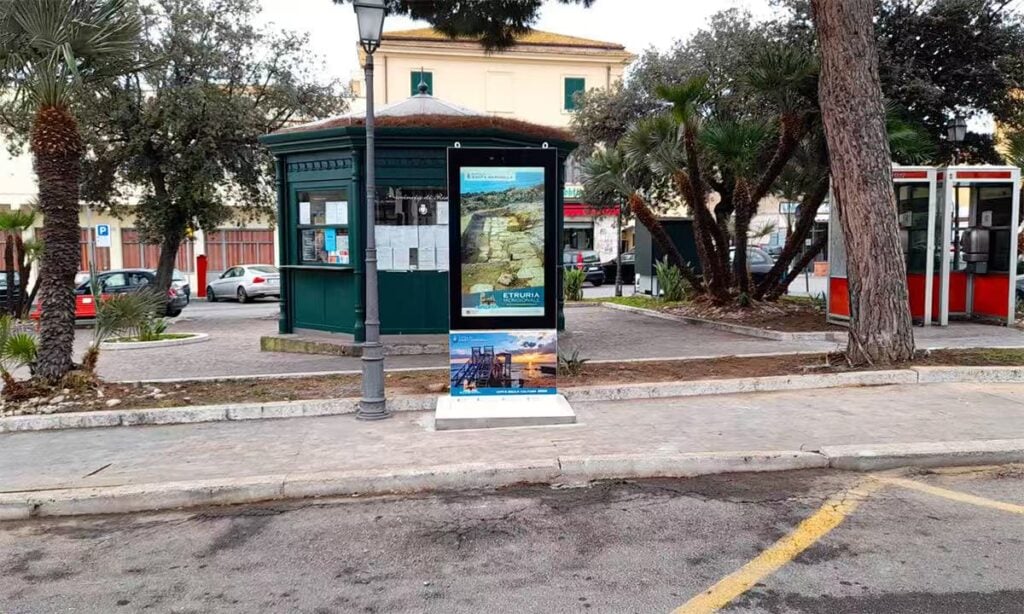
Executive Summary: In a landmark “Tourism 4.0” initiative, the city of Santa Marinella (Rome) deployed MWE High-Brightness Outdoor Totems to digitize visitor engagement. By featuring 3000-nit displays und IP65-rated climate resilience, these kiosks serve as 24/7 digital concierges, promoting the “Etruria Meridionale” heritage while reducing paper waste and operational costs.
1. The Challenge: Modernizing Heritage for the Digital Traveler

While Santa Marinella is a gateway to ancient Etruscan history, traditional static signage failed to engage modern tourists. The local municipality required a rugged, high-visibility solution capable of:
- Multilingual Real-time Updates: Overcoming language barriers for international visitors.
- Extreme Environment Stability: Withstanding high salinity and direct Mediterranean sunlight.
- Dynamic Promotion: Increasing foot traffic to lesser-known archaeological sites in Southern Etruria.
2. Technical Specifications: Engineering for the Italian Coast

The MWE professional-grade outdoor kiosk was selected for its superior durability and visual performance.
| Feature | Technical Specification | Operational Advantage |
| Luminance | 3000 nits (Ultra-High Brightness) | Remains 100% sunlight-readable in Piazza Civitavecchia. |
| Haltbarkeit | IP65 Weatherproof & IK10 Vandal-proof | Resistant to coastal salt air and physical impact. |
| Thermal Range | -30°C to 50°C (-22°F to 122°F) | Intelligent cooling ensures zero downtime during summer peaks. |
| Safety | 6mm AR Tempered Glass | Anti-reflection coating reduces glare by 90% for user comfort. |
3. Strategic Impact: Beyond Simple Information

The deployment of MWE technology has shifted the local tourism paradigm from reactive to proactive:
- 24/7 Digital Concierge: Unlike physical visitor centers, the totems provide round-the-clock access to train schedules, beach locations, and local landmarks.
- “Etruria Meridionale” Brand Amplification: High-definition video storytelling has increased awareness of local Etruscan ruins, diversifying tourist distribution across the province.
- Sustainable ROI: Digitizing brochures has led to a significant reduction in municipal printing costs and carbon footprint, aligning with EU sustainability goals.
Expert Insight: “MWE technology isn’t just showing an advertisement; it’s opening a digital window into the soul of Italy. By blending high-spec hardware with cultural storytelling, we set a new global standard for smart city tourism.” — MWE Engineering Team
MWE totems utilize 3000-nit ultra-high brightness panels and anti-reflection (AR) glass to ensure clear visibility even under peak Mediterranean sun. See how digital kiosks are redefining urban infrastructure in the broader smart city context.
Yes, the units are IP65-rated, providing a complete seal against salt air, moisture, and dust, essential for coastal locations like Santa Marinella.
Tourism 4.0 refers to the integration of IoT and digital display technology (like MWE RDM systems) to provide data-driven, interactive, and sustainable visitor experiences.
Mehr entdecken:
- “Interactive Digital Signage: Elevating Customer Engagement to New Heights”
- Enhancing Urban Spaces: The Impact of Outdoor Digital Signage on Cityscapes
- Weatherproof Communication: Leveraging Outdoor Digital Signage for Real-Time Updates
- Enhancing Outdoor Navigation: The Power of Digital Signage Wayfinding
- How Does Outdoor Digital Signage Work?
- Mastering the Art of Outdoor Digital Signage Advertising: Strategies for Unleashing Success
- Connecting Communities: Outdoor Digital Signage for Sports and Fitness
Das könnte dir auch gefallen:
- Bewährte Verfahren für den Einsatz digitaler Displays im Einzelhandel
- Die sich erweiternden Anwendungsbereiche von digitalen Außenwerbedisplays
- What are some popular types of outdoor digital signage displays?
- Technologie annehmen: Der Aufstieg von Outdoor-LCD-Kiosken
- The Benefits of Outdoor Digital Signage in Today’s Advertising Landscape
- Herausforderungen meistern: Der Weg zum Erfolg für Digital Signage in Außenbereichen
- Unleashing the Power of Outdoor Digital Signage: Choosing the Perfect Marketing Places
- Outdoor Digital Signage in Education: Enhancing Communication on Campus
- Der Zweck und die Kraft Außenwerbung
- Outdoor Digital Signage: Enhancing Wayfinding and Directions for Parks and Recreation
Häufig gestellte Fragen
What digital signage solutions did MWE provide for Tourism 4.0?
MWE deployed outdoor-rated, high-brightness displays with optical bonding for tourism information points, wayfinding kiosks, and attraction promotion boards. The displays integrated with real-time data feeds for weather, event schedules, and multilingual tourist information. Key installations included entry-point welcome screens, directional signage at intersections, and interactive maps with point-of-interest recommendations. Outdoor digital signage increases visibility and engagement for tourism destinations worldwide.
Where and how were the displays deployed in the tourism setting?
Displays were strategically placed at transportation hubs, tourist information centers, popular attraction entrances, and pedestrian thoroughfares. Wall-mounted units provided wayfinding and directional information, while interactive kiosks offered detailed attraction guides, ticket purchasing, and public transit schedules. All units were weatherproofed and vandal-resistant for 24/7 public operation in exposed locations.
How did the digital signage enhance the tourist visitor experience?
Tourists reported significantly improved navigation confidence and access to real-time information. Multilingual content switching allowed international visitors to access information in their preferred language. Dynamic content highlighted wait times, special events, and alternative attraction suggestions during peak crowds. Visitor surveys indicated 40 percent higher satisfaction scores compared to static signage.
What technical challenges were overcome during the tourism deployment?
Key challenges included extreme weather exposure, 24/7 operational reliability requirements, and integration with existing IT infrastructure. MWE (Marvel Technology) handled temperature ranges from minus 20 to plus 50 degrees Celsius with precision cooling and anti-condensation systems. Network connectivity was managed through redundant 4G and WiFi connections, while RDM enabled remote monitoring and instant content updates across all deployment locations.
What measurable results were achieved in the Tourism 4.0 case study?
The deployment achieved 35 percent increase in tourist engagement with information displays, 25 percent reduction in visitor inquiries at staffed information desks, and 20 percent improvement in foot traffic distribution across attractions. Average dwell time at digital signage points was 45 seconds, significantly higher than the 5-second industry average for static signage. The system maintained 99.5 percent uptime over 12 months.