AR
AR  EN
EN  ES
ES 
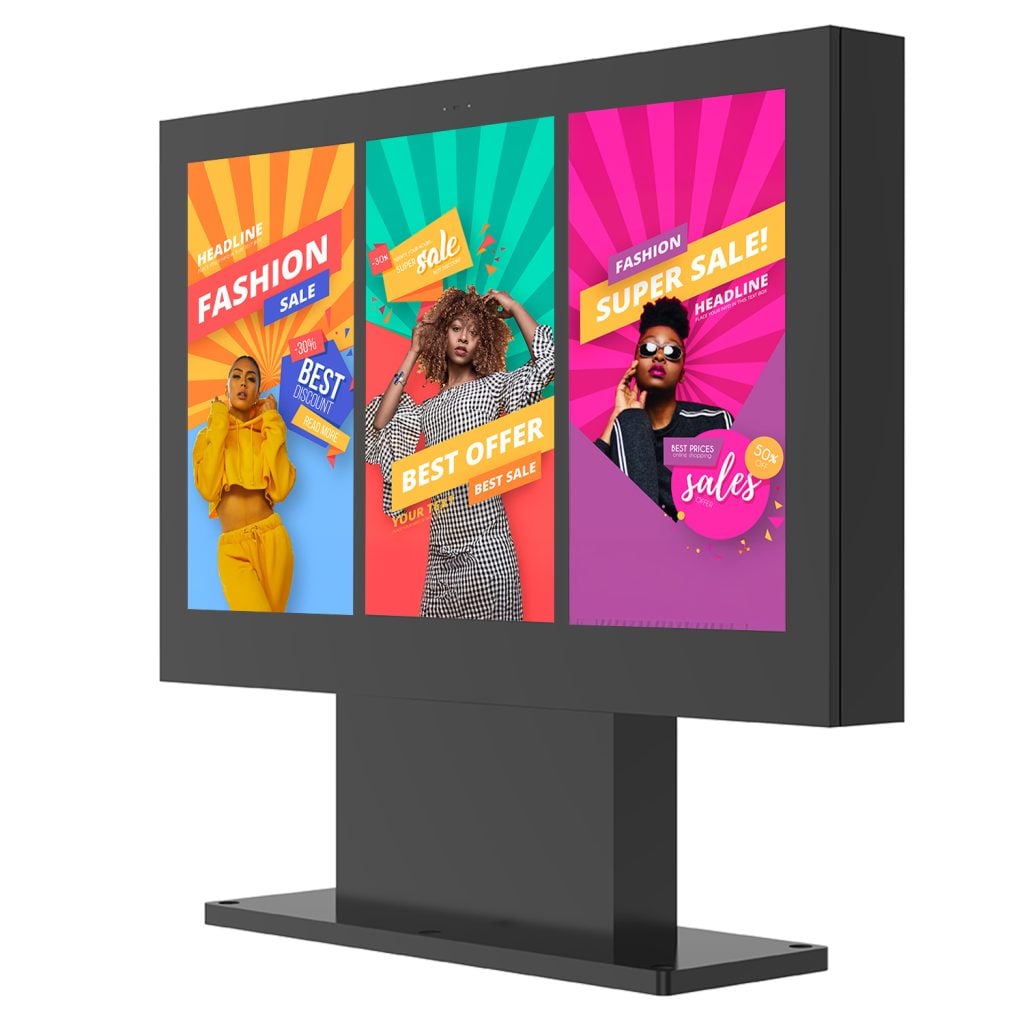
The “Help Wanted” sign has become a permanent fixture in the QSR window. For franchise owners and operators, the labor shortage is no longer a temporary hurdle; it is the new operational reality. With drive-thru lanes generating up to 70% of total revenue for fast-food chains, a lack of staff at the headset doesn’t just slow down service—it cripples profitability.
In response, the industry is pivoting aggressively toward automation. AI voice ordering kiosks are stepping in to take orders, allowing human staff to focus on food preparation and fulfillment.
However, moving to an automated drive-thru isn’t just a software challenge. You might have the smartest AI bot in the world, but if the hardware housing it turns black under the midday sun or drowns out the customer’s voice with fan noise, your investment fails.
Here is why industrial-grade hardware is the backbone of the AI drive-thru revolution, and what you need to look for to ensure your digital drive-thru menu board survives the harsh reality of the outdoors.
The Hardware Gap: Why Consumer Tech Fails Outside
Many independent owners, in a bid to save costs, attempt to retrofit consumer-grade TVs with waterproof enclosures. Others rely on low-end outdoor screens with insufficient brightness. In the high-stakes environment of a drive-thru, these shortcuts lead to catastrophic failures:
- The “Black Screen” Effect: Standard LCD panels suffer from isotropic failure when the surface temperature rises, turning the screen black and unreadable.
- The Visibility Issue: A screen with 500–1000 nits of brightness is invisible under direct sunlight, slowing down the ordering process.
- The Audio Conflict: Loud cooling fans in cheap enclosures interfere with AI microphones, causing order errors.
To truly solve the labor shortage, you need hardware that works as hard as your best employee—24/7, in rain or shine.
1. Sunlight Readability: Defeating the Sun
The most critical metric for any high brightness outdoor displays for QSR is visibility. If a customer has to squint to read the menu, the line stops moving.
The Brightness Standard: 2500+ Nits
Standard indoor screens output 350-500 nits. In the shade, this might look fine. But at noon, under direct sunlight, you need at least 2500 nits to cut through the glare.
At Marvel Technology, we engineer our drive-thru solutions to meet the demands of the sunniest locations:
- Optimal Brightness: For standard dual-screen or large-format drive-thru units, we recommend a calibrated brightness of 2500 to 3000 nits. This is the “sweet spot” that ensures perfect readability without generating excessive heat or energy costs.
- Compact Brightness: For smaller, dedicated ordering screens, we can push luminance up to 3500 nits, ensuring that high-margin promo items pop off the screen.

Preventing Isotropic Failure (The Black Spot)
Have you ever seen an outdoor screen with a large black blotch in the center? That is isotropic failure—the liquid crystals losing their ability to control light due to overheating.
While many businesses attempt to use standard displays for storefronts, consumer TVs typically fail at roughly 60°C (140°F). When placed inside a metal enclosure under the summer sun, internal temperatures can hit this critical limit within minutes, resulting in permanent screen blackouts. To combat this, Marvel Technology utilizes industrial-grade high-temperature (TNi 110°C) liquid crystal panels. Our screens are rigorously tested to operate normally even when surface temperatures reach 80°C (176°F). This advanced thermal resilience ensures that even during a record-breaking heatwave, your digital menu remains crisp, clear, and open for business.
2. AI Integration: Can Your Kiosk “Hear” the Customer?
The rise of the AI voice ordering kiosk has introduced a new hardware challenge: Acoustics.
For an AI bot (like SoundHound, Valyant, or Presto) to function, it needs a clean audio feed. If the kiosk’s internal cooling fans sound like a jet engine, the AI will struggle to separate the customer’s voice from the background noise.

Controlled Acoustics
We have engineered our cooling systems to balance thermal management with acoustic performance. Through optimized airflow design, our standard outdoor units maintain an operational noise level of approximately 60-70dB at a one-meter distance. This creates a manageable audio environment that allows noise-canceling microphone arrays to capture clear, accurate voice commands.
Modular Customization for ISVs
Different AI software providers require different sensors. A “one-size-fits-all” box often leads to messy, exposed wiring.
- Camera Integration: Our chassis designs include pre-reserved mounting points for cameras, essential for loyalty program facial recognition or license plate reading.
- Microphone Flexibility: We understand that microphone placement is critical for AI. Unlike competitors with fixed slots, we offer customizable microphone integration. We work with your technical team to drill and position microphone ports exactly where your specific hardware requires them, ensuring the best possible audio pickup cone.
3. Surviving the Elements: Grease, Grime, and Rain
A drive-thru lane is one of the most hostile environments for electronics. It’s not just rain; it’s car exhaust, dust, and the microscopic grease particles vented from the kitchen.
To protect your investment, you need a weatherproof drive-thru digital signage enclosure IP65 rated or higher.
Advanced Filtration and Optical Bonding
Cheap outdoor enclosures often use direct air cooling that sucks dust and grease directly onto the circuit boards, leading to short circuits. Marvel Technology employs a multi-layered defense strategy:
- Extended Air Intakes: We design the airflow path to minimize the intake of direct debris.
- Medium-Efficiency Filtration: Our intake systems use replaceable medium-efficiency filters that block dust and oily particles from coating the internal electronics.
- Optical Bonding: For the ultimate protection, we recommend full optical bonding. This process eliminates the air gap between the glass and the LCD panel. Not only does this improve visual contrast, but it also prevents internal condensation (fogging) and stops dust from ever getting between the glass and the screen.
4. The ROI: Why Static Lightboxes Are Costing You Money
Some franchisees hesitate to upgrade, sticking with traditional static lightboxes because they are “reliable.” While a printed poster doesn’t break, it also doesn’t sell.
In a labor shortage, you cannot rely on an overworked crew to upsell every order. An AI-powered digital drive-thru menu board never forgets to ask, “Would you like to make that a large?”
- Dynamic Upselling: Digital screens can change content based on weather (promoting ice cream on hot days) or inventory levels (pushing items that need to move).
- Ticket Size Growth: Studies show that digital menu boards with dynamic content can increase average ticket size by 20-30%.
- Zero Printing Costs: Changing a price on a lightbox requires printing and shipping new films. With digital, it takes a click.
Conclusion: Future-Proofing Your Drive-Thru
The labor shortage isn’t going away, and neither is the demand for faster, more accurate service. Implementing AI voice ordering is the right move, but placing that AI inside inferior hardware is a risk you cannot afford.
You need a partner who understands the hardware reality of the QSR industry. Marvel Technology provides the industrial strength, high-brightness visibility, and acoustic precision required to make your AI transition a success.
Don’t let a black screen or a noisy fan silence your sales.
Ready to upgrade your drive-thru? Contact Marvel Technology today to discuss our customizable, high-brightness outdoor solutions designed specifically for the next generation of AI-powered QSRs.