AR
AR  EN
EN  ES
ES 
The Challenge of the Modern Airport Environment
Airports are among the most dynamic and challenging environments for advertisers. They are high-traffic hubs filled with passengers who are often rushing, distracted, or overwhelmed by sensory input. In such a bustling atmosphere, traditional static signage often fades into the background. To truly capture attention and deliver a message that resonates, hardware must be more than just a screen—it must be an architectural feature that commands attention.
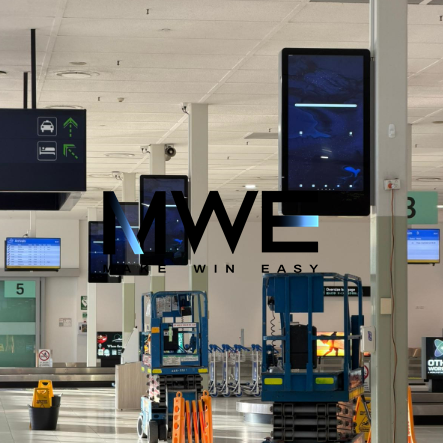
This is the context for a recent, groundbreaking installation in Brisbane, Australia. As one of the busiest gateways in the Asia-Pacific region, Brisbane Airport represents a prime location for high-value advertising. However, the challenge was clear: how to deliver maximum visual impact in a constrained indoor space without obstructing passenger flow, while simultaneously offering advertisers a versatile canvas for their campaigns.
The answer lay in a bespoke technological solution: a 49-inch Custom Indoor Dual-Screen Wall-Mounted Display.
The Solution: Why Dual-Screen?
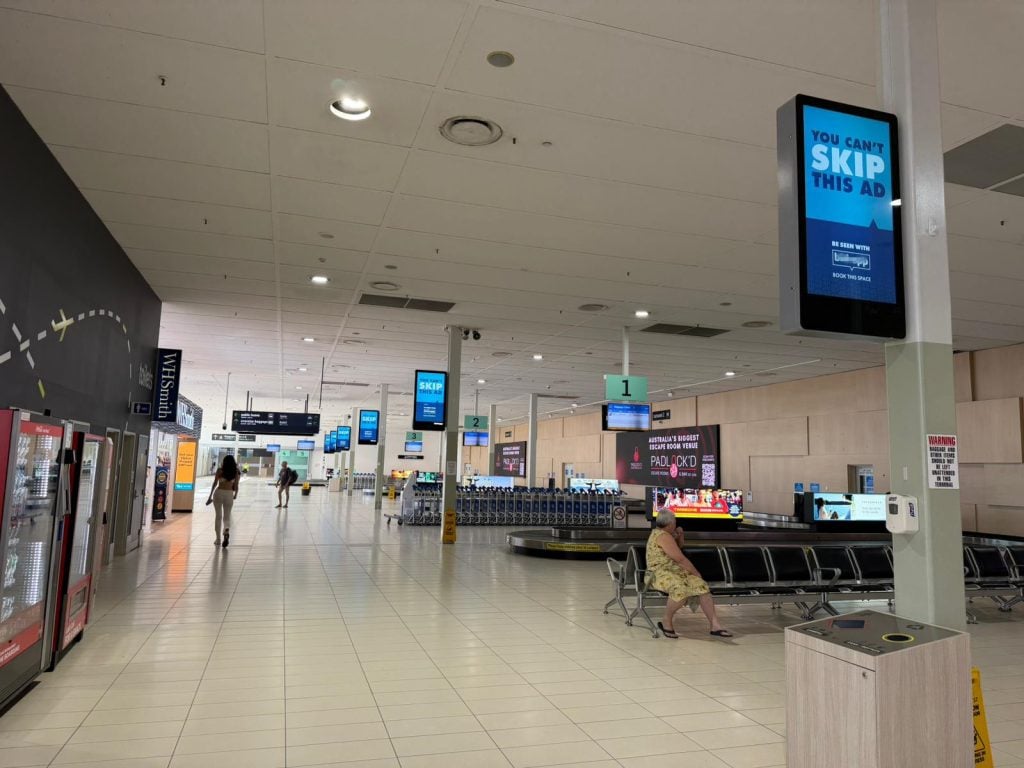
The decision to utilize a dual-screen configuration was a strategic masterstroke. While a single large screen provides a focal point, a dual-screen setup creates an ecosystem.
In the Brisbane installation, the 49-inch size was carefully selected as the “Goldilocks” dimension for indoor viewing. It is large enough to provide cinematic 4K clarity from a distance, yet compact enough to be wall-mounted on pillars or corridor walls without dominating the walkway or creating safety hazards.
By placing two 49-inch screens side-by-side (or vertically stacked, depending on the specific architectural pillars of the terminal), the display effectively doubles the dwell time of the viewer. The human eye is naturally drawn to symmetry and contrast. A dual-screen setup allows for a unique content strategy that single screens cannot match:
- Complementary Content: One screen can run a high-definition brand video to catch the eye, while the second screen displays static details, QR codes, or call-to-action information.
- Panoramic Flow: Creative agencies can utilize the combined resolution of both screens to create a massive, flowing image that travels across the bezel gap, creating an immersive window effect.
- Language Localization: In an international hub like Brisbane, one screen can display English content while the other cycles through key tourist languages (Chinese, Japanese, Korean), maximizing reach without alienating local viewers.
Engineering Excellence: The Custom Wall-Mount Design
Standard off-the-shelf commercial displays often fail in airport environments because they look like “add-ons” rather than integrated infrastructure. The success of the Brisbane project relied heavily on the Custom Indoor Wall-Mount design.
This was not merely a bracket; it was an engineering solution tailored to the airport’s specific interior design. The enclosure had to be slim to adhere to protrusion regulations (ADA compliance in the US, or DDA in Australia), ensuring that visually impaired passengers would not collide with the screens.
Furthermore, the customization extended to the thermal management and durability of the units. Although “indoor,” airport terminals run 24/7. The displays generate heat, and the wall-mounting system needed to ensure efficient airflow to prevent blackening of the LCD panel (isotropic failure) during prolonged operation. The custom casing was also designed to be tamper-proof and dust-resistant, ensuring that the sleek, modern aesthetic of the Brisbane terminal was maintained without frequent maintenance interventions.
Transforming Advertising Revenue
For the media operators at Brisbane Airport, the installation of these 49-inch dual screens has opened new revenue streams. The “Digital Out of Home” (DOOH) market is driven by engagement metrics.
Because these screens are digital and networked, advertisements can be programmatic. A coffee brand can purchase ad slots specifically during the morning rush hours on the left screen, while the right screen displays real-time flight updates sponsored by an airline. This flexibility transforms the wall from a passive surface into a dynamic, revenue-generating asset.
The dual-screen format also allows for “Roadblock” advertising—where a single brand takes over both screens simultaneously for a moment of exclusive dominance. In a crowded visual field, this 100% share-of-voice is a premium product that advertisers are willing to pay significantly more for.
The Brisbane Effect: Setting a New Standard
Brisbane is known for its sunny, vibrant, and modern atmosphere. The technology installed needed to reflect that. The high-brightness panels used in these 49-inch custom units ensure that even with the abundance of natural light filtering through the airport’s glass atrium, the advertisements remain crisp, vivid, and readable.
This installation serves as a proof-of-concept for airports globally. It demonstrates that you do not need massive LED video walls to make an impact. Sometimes, the smart application of mid-sized, dual-screen LCDs, positioned strategically at eye level in high-dwell zones (such as baggage claim or departure lounges), yields a higher ROI than a massive screen placed high up in the rafters.
خاتمة
The deployment of 49-inch Custom Indoor Dual-Screen Wall-Mounted Displays at Brisbane Airport is more than just a hardware upgrade; it is a rethinking of spatial communication. By combining custom engineering with a strategic dual-screen format, this solution captures passenger attention in a way that is respectful of the architecture yet impossible to ignore.
As airports continue to compete for passenger satisfaction and advertising dollars, the Brisbane model stands out. It proves that when precision customization meets high-quality display technology, the result is a seamless blend of information, art, and commerce. For the advertisers utilizing these screens, the message is clear: in Brisbane, your brand isn’t just seen—it’s experienced in double the definition.