AR
AR  EN
EN  ES
ES 

—— A Hardware Procurement Checklist to Avoid Expensive Mistakes
In digital signage projects, one of the biggest misconceptions is thinking that “a screen is a screen.” In reality, moving an indoor commercial display directly into an outdoor environment often leads to equipment failure or “black screens” within three months. To ensure ROI, understanding the technical specification differences between Outdoor و Indoor scenarios is crucial.
1. Brightness: The Lifeline of Visibility
This is the most immediate difference. Indoor lighting is controllable, while outdoor screens must compete with the sun.
- Indoor Standard: Usually between 350 ~ 700 nits. Anything higher can cause glare and visual fatigue.
- Outdoor Standard: Must reach 2500 قمل or higher. Areas with direct, strong sunlight may require 3500+ nits.
- Key Feature: High-quality outdoor screens should be equipped with automatic light sensors to dim the screen at night, saving energy and preventing light pollution complaints.
2. IP Rating: The Indicator of Survivability
Outdoor environments are full of electronics killers: rain, dust, insects, and humidity.
- Indoor: Typically IP40 or IP50, preventing only large dust particles.
- Outdoor: Must reach IP65 (fully dust-tight + protection against low-pressure water jets) or IP66. For coastal areas with high salt spray, special anti-corrosion coatings are also necessary.
3. Thermal Management
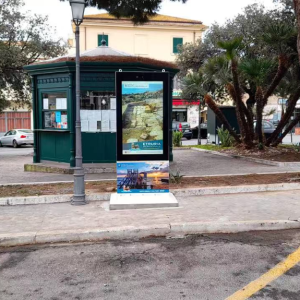
This is the number one cause of outdoor screen failure and explains why أكشاك LCD خارجية بشاشة LCD are much bulkier than indoor ones.
- Blackening Effect: When liquid crystal panels are exposed to direct sunlight and overheat (usually exceeding 100°C / 212°F surface temperature), the liquid crystals lose control and turn black.
- الحل: Outdoor kiosks must be equipped with intelligent air-cooling or air-conditioning systems. For high-end applications, using High Tni panels is mandatory, as they can withstand temperatures up to 110°C without blackening.
4. Pixel Pitch: Distance Creates Beauty
For LED displays, pixel pitch determines clarity and cost.
- Indoor (P1.2 – P2.5): Viewers are very close to the screen (1-3 meters), requiring high pixel density to ensure a smooth image.
- Outdoor (P4 – P10): Viewers are usually watching from 10 meters or further away. Blindly pursuing small pitch (like using P2 for a highway billboard) is a massive waste of budget.
Parameter Comparison Cheat Sheet
| الميزة | Indoor Scenario | Outdoor Scenario |
| سطوع | 300 – 700 nits | 2500+ nits |
| تصنيف IP | IP40 / IP50 | IP65 / IP66 |
| Cooling Needs | Passive / Silent Fans | Active Air Cooling / AC / Heat Exchanger |
| Glass Treatment | Anti-Glare (AG) Optional | Anti-Reflection (AR/AG) + Vandal Proof Essential |
| Cost Drivers | Panel Resolution, Aesthetics | Brightness, Environmental Durability, Structural Strength |