AR
AR  EN
EN  ES
ES 

تقنية LED مقابل LCD للافتات الرقمية: ما هي التقنية المناسبة لعملك؟
When choosing a digital display for your business, you will inevitably encounter a fundamental technology choice: LCD or LED? While these terms are often used interchangeably, they represent two distinct technologies, each with unique strengths suited to different applications. Understanding this difference is the first step to making a smart investment.
As of August 2025, both technologies have advanced significantly, but their core principles remain. This simple guide will break down the key differences between LCD and Direct-View LED (dvLED) to help you decide which is the right fit for your needs.
What is an LCD Display?
LCD (Liquid Crystal Display) is the technology you are most familiar with. It is used in everything from TVs and monitors to smartphones. An LCD screen works by shining a backlight through a layer of liquid crystals. These crystals twist and untwist to block or allow light to pass through color filters, forming the image you see.
- الإيجابيات:
- High Resolution at Close Distances: LCDs excel at displaying crisp text and detailed 4K images, making them perfect for indoor viewing where customers are close to the screen.
- Cost-Effective for Standard Sizes: For screen sizes under 100 inches, LCDs are generally the more affordable option.
- السلبيات:
- Bezels: LCD screens have a border or “bezel” around them. When you tile them together to create a video wall, these lines are visible.
- Limited Brightness: While high-brightness LCDs exist, they cannot match the extreme brightness levels of outdoor LED technology.
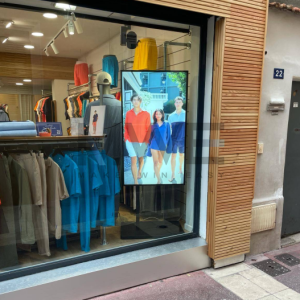
الأفضل لـ Indoor retail stores, corporate lobbies, digital menu boards, and meeting room displays.
What is a Direct-View LED (dvLED) Display?
Unlike LCD, a dvLED screen has no backlight. Instead, the image is created by millions of tiny, individual light-emitting diodes (LEDs) that produce their own light. These LEDs are grouped together on modules, which can be seamlessly tiled together to create a screen of virtually any shape or size.
- الإيجابيات:
- Completely Seamless: Because they are built from modules, you can create massive video walls with absolutely no visible lines or bezels.
- سطوع شديد: dvLED technology is incredibly bright, making it the only choice for true outdoor, sunlight-readable applications.
- Ultimate Flexibility: You can create curved screens, right-angled screens, or displays of any custom size and aspect ratio.
- السلبيات:
- Higher Cost: dvLED technology is a more significant investment, especially for finer “pixel pitches” (the distance between LEDs).
- Resolution vs. Distance: A lower-cost LED screen may look pixelated up close, making it better suited for viewing from a distance.
الأفضل لـ Large-scale video walls, outdoor billboards, stadium scoreboards, and public venue displays.
Conclusion: The Right Tool for the Job
The choice between LCD and LED is not about which is “better,” but which is the right tool for your specific application. It depends entirely on your planned viewing distance, environment (indoor vs. outdoor), and desired screen size.
في مWE Display, we are experts in both technologies. Our team can assess your needs and recommend the perfect LCD or dvLED solution to help you achieve your goals.